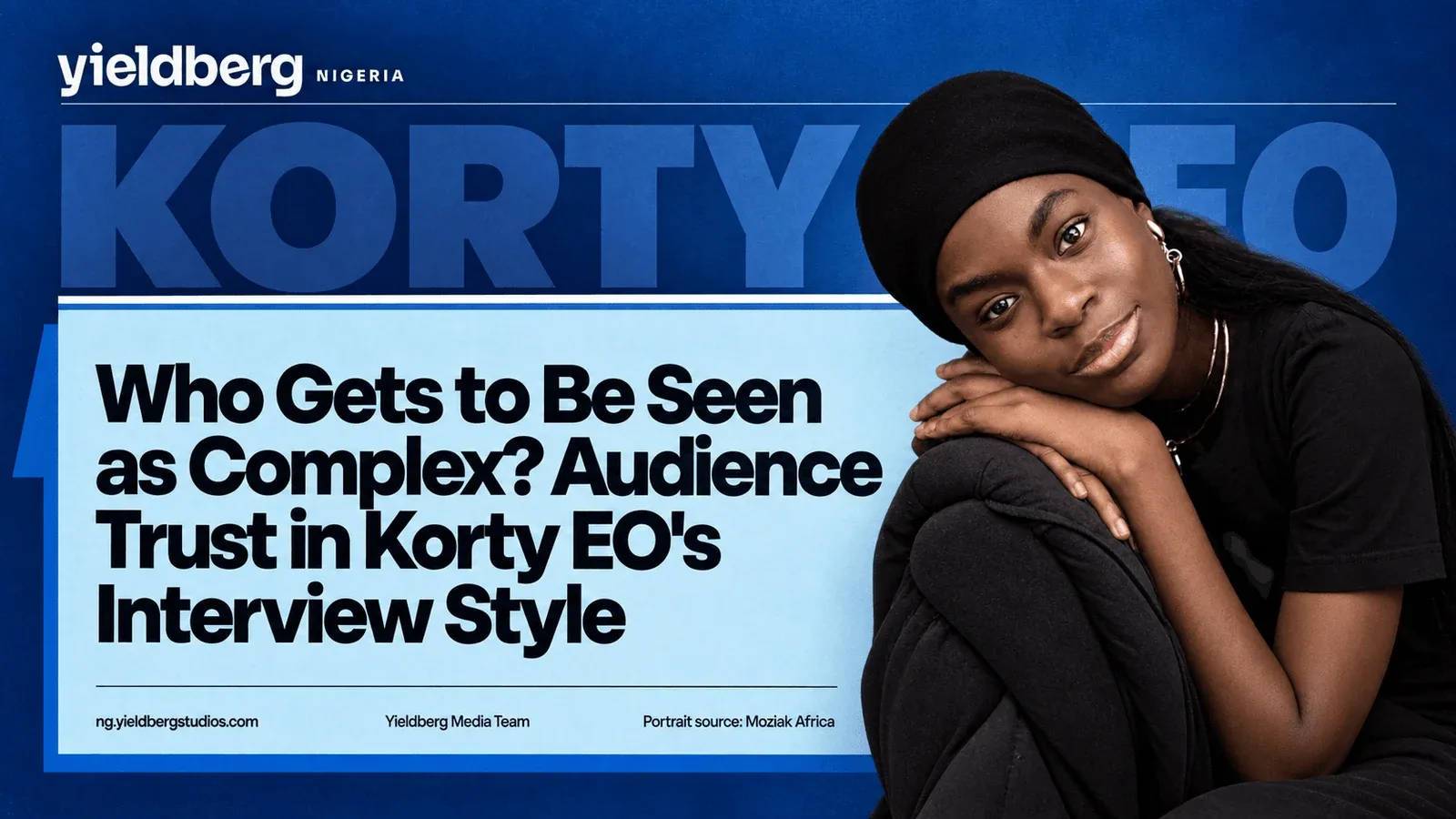
Korty EO earns trust by giving guests time, environment and editorial texture rather than forcing them through a list of promotional questions. Viewers can observe how a person speaks with family, moves through familiar places or pauses before an answer. That intimacy does not remove mediation. It increases the editor’s power to decide which version of a guest becomes legible.
The right question is therefore not whether Flow With Korty is authentic or staged. Every produced interview is selected and shaped. The useful test is whether the film shows enough evidence for viewers to distinguish a guest’s self-presentation, the host’s interpretation and the realities left outside the frame.
The format makes proximity an editorial tool
Korty EO is the public name of Nigerian filmmaker and creator Eniola Olanrewaju. Her official site describes Flow With Korty as a series about the experiences of successful Africans and also lists Love or Lies and commissioned film work. The site is first-party evidence of the programme’s scope, not an independent audience measurement service.
Unlike a studio interview whose visual grammar reminds the viewer that questions and answers are being exchanged, Korty’s films often mix conversation with movement, observation, family or work environments and the host’s presence. The result can feel less like a press appointment and more like time spent with the subject.
The 2026 Asake episode illustrates the approach. BellaNaija’s account describes a homecoming film that moved through family, the University of Ife, a meeting with the Ooni of Ife and discussion of money, love and fame. A later Tony Elumelu conversation generated discussion around his statement that luck contributed to his success. In both cases, a headline travelled because the wider encounter had made the speaker appear unusually unguarded.
How this public-sentiment sample was built
This article uses a qualitative desk sample collected on 26 September 2026. The primary window is 26 September 2025 to 26 September 2026. We reviewed Korty’s current public site, accessible programme descriptions, direct and indexed X posts concerning the Asake episode, public commentary responding to the interview’s Yoruba-language passages, coverage of the Tony Elumelu conversation, and a January 2026 X dispute about whether her access reflected work or “female privilege”. Older interviews were used only to establish her production history.
YouTube and Facebook did not expose complete, consistently ordered comment samples through the available logged-out interfaces. X exposed selected conversations and search-indexed replies, not a full population. We therefore do not assign sentiment percentages, equate views with approval or use hostile gendered comments as legitimate creative criticism.
Reactions to a guest were coded separately from reactions to Korty. Praise for something Asake said is not automatically praise for the interviewer. Criticism of Tony Elumelu’s account of success is not evidence of distrust in the programme.
What audiences appear to trust
The guest is allowed to have texture
The Asake film gave viewers public performance, family context, place and language. A March 2026 X post highlighting his Yoruba answer circulated one part of that texture, while a detailed independent viewer response praised both the production and the choice to let him speak Yoruba. The value was not simply “access to Asake”. It was access to registers that a short promotional interview might exclude.
Questions do not have to sound adversarial to produce information
Korty’s method shows that an interviewer can produce revealing material through patience and environment. Tony Elumelu’s discussion of luck became a public argument about merit, opportunity and timing. His own subsequent writing placed luck beside talent, opportunity, timing and resilience, adding context to the clipped headline.
This is an important distinction. A soft tone is not necessarily a soft interview. The test is what the audience learns and whether a consequential claim receives enough follow-up.
Visible authorship creates loyalty
Korty appears not only as a questioner but as a filmmaker with a recognisable visual and emotional style. Supporters in the January 2026 X dispute pointed to years of uploads, unsuccessful approaches and visible craft. They were defending labour they believed had been erased by a gendered explanation of access.
That defence should not become immunity from critique. The useful insight is that regular viewers recognise process history that a new viewer may not see.
Where trust becomes more complicated
Intimacy can look like completeness
A bedroom, family visit or car conversation feels private, but it remains a negotiated production. The guest knows a camera is present; the team chooses what not to show; and a publicist, sponsor or schedule may shape access. A warm scene can be true without being the whole truth.
Selection determines who receives complexity
Interviewing an already prominent musician, billionaire or cultural figure may reveal a new side of that person. It also concentrates production resources on people who already command attention. The editorial question is not whether famous guests deserve nuance. It is which less powerful subjects are routinely shown only as background, audience or evidence in someone else’s story.
A beautiful edit can reduce friction
Music, pacing and reaction shots help viewers stay with a story. They can also turn contradiction into atmosphere. When a guest makes a factual or consequential claim, the film needs a follow-up, an on-screen note or supporting material. Cinematic confidence should not substitute for verification.
Access attracts gendered suspicion
In January 2026, an X user attributed Korty’s success to “female privilege”. She responded by listing years of work and unsuccessful attempts to secure interviews. Many visible replies defended her craft; others repeated the gendered claim. The exchange is evidence of a frame applied to her career, not proof that gender never affects access or that hard work explains every outcome.
The editorial safeguard is to ask the same evidence-based questions of every interviewer: how was the guest secured, what resources enabled the production, what commercial relationship existed, and what did the host contribute? Reducing a woman’s work to sexual access is abuse when unsupported, not media analysis.
The Editorial Intimacy Audit
The Editorial Intimacy Audit is a method developed for this article. It helps viewers, commissioners and producers assess whether a close-feeling interview earns trust or merely performs closeness.
| Audit dimension | Question | Evidence to inspect | Warning sign |
|---|---|---|---|
| Access | Why did this guest agree, and under what conditions? | Credits, disclosure, publicist or partner role, location permissions | “Exclusive” is treated as proof of independence |
| Agency | Can the guest set limits without the limit becoming content? | Pre-interview agreement and producer notes | Reluctance is edited as suspense or confession |
| Inquiry | Does the host follow consequential claims? | Full question sequence, not only the final cut | Warmth replaces clarification |
| Edit | Which choices create the feeling of intimacy? | Rough cut, music, reaction shots, chronology and subtitles | Several days appear to be one continuous moment without notice |
| Context | What information would change the viewer’s interpretation? | Fact-check, timeline and relevant public record | Contradiction is omitted because it disrupts tone |
| Selection | Who repeatedly receives depth, and who remains scenery? | Guest list by field, gender, geography, class and career stage | Variety is claimed from a narrow access network |
| Commercial frame | Who funded or benefits from the episode? | Contract, product placement and distribution plan | A branded commission is presented as wholly independent discovery |
The audit does not demand aggressive questioning. It demands visible editorial responsibility.
A practical comparison of three moments
| Moment | What audiences received | What remains uncertain | Best editorial response |
|---|---|---|---|
| Asake homecoming | Family, language, place and career reflection | How access and scene selection were negotiated | Preserve Yoruba accurately in subtitles; publish clear credits and avoid reducing the film to flirtation clips |
| Tony Elumelu on luck | A counter-intuitive statement from a major business figure | How luck relates to structure, capital and other people’s opportunity | Keep the full qualification beside the headline; add follow-up on what can and cannot be replicated |
| “Female privilege” dispute | Korty’s first-person account of years of labour | No public reply thread can quantify the causes of career access | Assess output, process and relationships without gendered insinuation or hero worship |
The comparison shows that trust should attach to an editorial practice, not to a feeling of familiarity alone.
What interview creators and brands should do
Korty’s strongest asset is not a list of famous contacts. It is the ability to make the encounter carry narrative shape. Protect that by documenting chronology, verifying consequential claims and making disclosure legible without interrupting the film.
For language-rich episodes, commission subtitles from someone competent in the language and social register. The viewer response to Asake’s Yoruba shows why translation is not clerical work. It decides whether confidence, humour and cultural meaning survive.
Brands should not buy intimacy as if it were a visual filter. Agree on editorial purpose, sponsor visibility, question independence, guest approval boundaries, clip rights and correction responsibility. A guest may reasonably review factual details without receiving a right to remove all difficult material. Define that line before filming.
A 12-day production sequence
- Days 1–2: write the editorial proposition. State what this film may reveal that a standard publicity interview cannot.
- Days 3–4: research beyond biography. Build a timeline, identify contested claims and select follow-ups. Record source confidence.
- Day 5: disclose the relationship. Set out sponsor, publicist, access and distribution conditions internally and in viewer-facing language.
- Days 6–7: pre-interview for boundaries. Identify protected topics, not to manufacture surprise but to avoid accidental coercion.
- Days 8–9: film for evidence. Capture enough sequence, place and follow-up to support the eventual interpretation.
- Day 10: run the Editorial Intimacy Audit. Review chronology, omissions, music, subtitles, claims and selection.
- Day 11: verify and respond. Check consequential facts and give the guest a route to correct factual error, not rewrite judgement.
- Day 12: decide. Publish only if the film’s feeling of access is matched by clarity about how it was produced.
For 30 days after release, log corrections, full-episode completion, clips that changed meaning and comments that identify missing context. The next commission should proceed when the format generates return viewing and useful understanding, not merely one viral quote.
Related reading
Frequently asked questions
Does a relaxed interview produce more truthful answers?
Not automatically. It may reduce defensiveness, but a comfortable guest can still perform a preferred identity. Trust grows when the film supplies context, follow-up and accurate editing.
Is guest approval compatible with editorial independence?
Limited factual review can be compatible. Giving a guest control over every question, interpretation or difficult passage is different. Put the boundary in writing before production.
Should every interview include criticism?
No. It should include the questions needed to understand the subject. A profile can be generous without becoming promotion, and challenging without staging hostility.
How should multilingual interviews be edited?
Keep the original language where it carries meaning and use reviewed subtitles. Do not replace a guest’s most natural register merely to make the film appear nationally neutral.
Sources
- Korty EO official site, first-party description of Flow With Korty, other formats and commissioned work.
- BellaNaija: Asake on Flow With Korty, dated account of the March 2026 homecoming episode.
- Public X post highlighting Asake’s Yoruba response, example of how a language-specific moment travelled outside the full film.
- Techpoint Africa: interview with Korty on her production process, first-person discussion of planning, editing and managing creative work.
- Tony Elumelu: resilience, opportunity and luck, first-party context relevant to a widely excerpted interview claim.
- Naija Feminists Media: January 2026 X exchange, report of the creator’s response and selected public reactions. The reactions were not treated as representative.
Next decision: Read Build the Show, Not Just the Spot before turning an intimate interview concept into a repeatable branded series.
 By Isong Godswill
 By Omodot Jackson