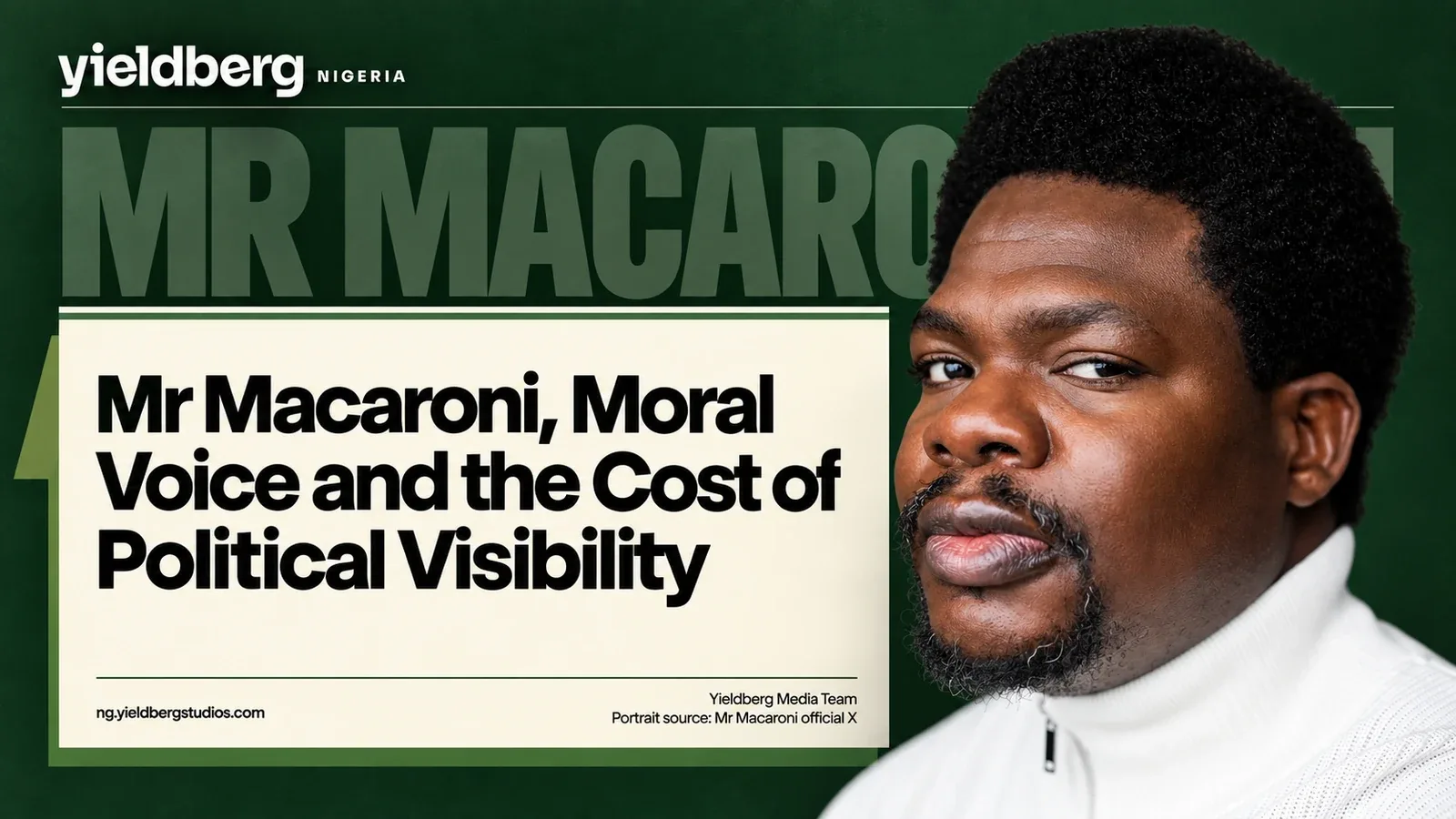
Mr Macaroni’s civic advocacy deepens trust among audiences who see consistency between his comedy, public conduct and demands for accountability. It also attracts partisan hostility, identity policing and expectations that he must comment on every issue. Political visibility therefore adds both meaning and risk to the creator brand. The condition that changes a partnership decision is whether the sponsor can respect his independent civic voice without presenting it as the brand’s endorsement.
This is not a claim that his followers share one politics. Some people enjoy the comedy and reject his views. Others value his advocacy but rarely watch a sketch. A third group evaluates each issue separately. Treating all reactions as one reputation score conceals those differences.
Comedy and advocacy are connected but not identical
Adebowale Adedayo, known as Mr Macaroni, built recognisable comic characters around entitlement, hypocrisy and social power. He also became publicly associated with the 2020 #EndSARS movement and later governance commentary.
In a TheCable interview, he described the political environment as toxic and noted that some people valued what he stood for even when they did not watch his content, while others insulted him. The account makes a useful distinction: affection for a performer and trust in a citizen can overlap without being the same.
By May 2024, he said he had reduced political commentary because people he believed he was speaking for treated him as troublesome, according to TheCable. He also referred to threats against himself and his family. Those are his attributed claims. They should not be turned into unsupported conclusions about who issued a threat.
Withdrawal is therefore not simple inconsistency. Repeated commentary creates a cost in time, safety, relationships and emotional labour. An audience may want an always-available moral voice without carrying those costs.
What produces trust
A visible line across issues
Supporters frequently frame Mr Macaroni as consistent about accountability, regardless of who holds office. Consistency is not proven by the volume of posts. It should be assessed against comparable situations: does he apply the same principle to allies, opponents and people with whom he disagrees?
His June 2025 defence of chess advocate Tunde Onakoya is a useful example. Onakoya faced backlash after visiting President Bola Tinubu. Pulse reported that Mr Macaroni defended Onakoya’s right to pursue a different route towards social contribution. That public position complicates a simple partisan label. It indicates that disagreement with government does not require condemning every person who engages it.
Comedy gives the moral claim a familiar language
Mr Macaroni’s comic work repeatedly stages power differences between wealthy men, young women, family members and citizens. Viewers may therefore read civic speech as continuous with the performance world rather than a sudden political rebrand.
That connection has limits. A comic character’s slogan is not a policy argument. A serious claim needs evidence even when the speaker has earned affection through entertainment.
Public cost can signal commitment
Arrest, reported threats and sustained abuse can make advocacy appear costly and therefore sincere. This is a common trust cue, but it should not become a demand for further sacrifice. A creator does not owe an audience danger as proof of integrity.
What produces distrust or resistance
Issue disagreement
Some criticism is a genuine objection to his position, tone or evidence. It should be retained in analysis and separated from partisan abuse. A useful criticism identifies the claim, explains the disagreement and supplies a competing reason or fact.
Symbolic conduct
In March 2025, a public clip of Mr Macaroni not greeting Lagos State Governor Babajide Sanwo-Olu generated backlash. Punch documented his response that he would not greet the governor and his criticism of political loyalty overriding accountability.
The dispute was about more than a greeting. Supporters read refusal as principled distance. Critics read it as disrespect or performance. The same physical action became evidence for opposite moral stories. A sentiment report should code the reason, not simply count approval and disapproval.
Identity policing
In May 2025, he pushed back against claims that opposition to the All Progressives Congress made him insufficiently Yoruba, as Pulse reported. Disagreement about policy is legitimate. Treating ethnicity as a test of party support is identity-based pressure, not a constructive campaign insight.
The obligation to speak every time
Visible advocates are often judged for silence on an issue as well as for speech. That expectation ignores knowledge, safety, timing and private commitments. A creator can hold a general principle without becoming a newsroom or civil-society organisation.
The Civic-Creator Trust Split
The Civic-Creator Trust Split is an editorial method developed for this article. It prevents one political moment from being used as a complete brand judgement.
| Trust layer | Question | Useful evidence | Common error |
|---|---|---|---|
| Entertainment | Does the work deliver the promised comic or dramatic experience? | comparable content, completion, audience recall | using politics to predict joke quality |
| Factual | Are public claims sourced, corrected and kept within evidence? | original records, corrections, dated posts | assuming moral reputation makes every claim true |
| Principle | Is the stated rule applied across allies and opponents? | comparable cases over time | calling any disagreement hypocrisy |
| Conduct | How does the creator treat people while advocating? | complete posts, interactions, responses | judging from a clipped insult or greeting alone |
| Safety | What risk does visibility create for the creator, team and family? | threat assessment, moderation records, event plan | demanding constant speech regardless of risk |
| Commercial | Can the partnership coexist with independent civic expression? | contract, category fit, disclosure and escalation plan | buying silence or borrowing moral authority |
The split allows a brand to say, for example, that a creator is a strong performer and principled advocate while one factual claim still requires correction. It also allows an audience to reject a political position without pretending the comedy disappeared.
A worked partnership decision
Imagine a Nigerian financial company considering Mr Macaroni for a consumer-rights campaign. The concept asks him to explain complaint channels while playing a familiar authority figure.
The entertainment layer fits: satire can expose a power imbalance. The factual layer requires strict review because complaint timelines and protections must be accurate. The principle layer could fit if the campaign genuinely helps people act. The safety layer requires moderation and escalation because political replies may spill into the campaign. The commercial layer fails if the contract forbids any criticism of public institutions during the entire term.
A better agreement limits conflicts to verified category concerns, protects his independent speech, distinguishes personal posts from campaign material and establishes a correction route. The brand should not caption the partnership as proof that he endorses its whole corporate record.
Measure task completion: among people who saw the full explanation, how many could identify the first complaint step? Views and praise do not show that.
Platform differences change the argument
X is central to rapid political commentary, quote-post conflict and identity-based attacks. It also exposes corrections and counterarguments quickly. TikTok and Instagram can turn a speech or encounter into a short visual symbol. YouTube supports longer comedy and interviews in which principles can be explained. Facebook reposts can introduce a clip to audiences responding primarily to a publisher’s headline.
Do not aggregate those spaces into “Nigerians say”. The people visible in political X threads are not a representative sample of comedy viewers. A viral refusal-to-greet clip may travel much further than the full context. A brand’s own comment section may be shaped by its moderation rules.
This desk sample reviewed Mr Macaroni’s public statements, accessible posts preserved in Nigerian reporting, creator interviews and public issue coverage through 26 September 2026. Complete platform comment sets and deleted material were not available. No sentiment percentage is claimed. Partisan insults, tribal abuse, threats and attacks on family members are recorded as safety concerns, not treated as reasonable criticism.
What creators with civic visibility should do
Define the public role you can sustain. You may comment on issues where you have evidence or direct standing without promising to cover every event. State when a post is opinion, when a fact is provisional and where a correction will appear.
Separate the civic archive from the content calendar. Preserve sources, original posts and corrections. Do not let a deleted thread become the only record of a serious claim.
Build safety capacity before a flashpoint. Assign moderation, preserve credible threats, protect private contact information and establish when professional security or legal advice is needed. Do not ask a junior social-media manager to absorb abuse alone.
What brands should do
Assess issue fit, not political blandness. A creator who takes positions can still be a responsible partner. The real questions are factual discipline, conduct, category conflicts and whether the brand can tolerate independent speech.
Avoid morality laundering. Do not use an activist’s reputation to imply that a product, company or public institution has been independently validated. Verify the campaign claim on its own evidence.
Write a disagreement process. Specify who reviews factual risk, what happens when a current event affects publication, and which posts count as contracted deliverables. A vague “no controversy” clause transfers unlimited political risk to the creator.
A 14-day civic partnership review
- Days 1–2: define the public-interest task. State the audience action and the evidence behind it.
- Days 3–4: separate trust layers. Review entertainment, factual, principle, conduct, safety and commercial evidence independently.
- Days 5–6: inspect comparable issues. Test consistency across at least three dated cases rather than one viral clip.
- Days 7–8: run a threat and moderation review. Identify protected contacts, escalation routes and staffing.
- Days 9–10: write the independence clause. Distinguish creator opinion, campaign speech and verified brand claims.
- Days 11–12: rehearse a conflict. Test what happens if the creator criticises an institution relevant to the category during the campaign.
- Days 13–14: decide. Proceed only if the brand can protect factual accuracy without purchasing silence.
The decision point is whether the partnership can survive principled disagreement. If not, the apparent fit is only temporary.
Related reading
Frequently asked questions
Does activism make Mr Macaroni unsuitable for brands?
No. It changes the due diligence. Brands need to assess factual discipline, issue fit, independence and safety rather than requiring political neutrality.
Is criticism of his refusal to greet a governor automatically abusive?
No. People can reasonably debate the conduct. Ethnic attacks, threats and family abuse are separate and should not be presented as a valid opposing view.
Can audience trust in an activist transfer to a product?
Not automatically. The product claim still needs evidence, and the partnership should not imply a broader endorsement than the creator agreed to provide.
Must a civic creator respond to every national issue?
No. Sustainable public speech requires knowledge, capacity and safety. Silence on one event does not by itself establish hypocrisy.
Sources
- TheCable: Mr Macaroni on comedy, activism and public reactions, attributed discussion of his dual audience relationship.
- TheCable: why Mr Macaroni reduced political commentary, his account of fatigue and reported threats.
- Punch: response to backlash over not greeting Governor Sanwo-Olu, dated conduct dispute and response.
- Pulse: Mr Macaroni on Yoruba identity and party support, identity-based political pressure.
- Pulse: defence of Tunde Onakoya’s right to engage the president, a comparable principle case.
- Mr Macaroni’s public X account, checked as the creator-controlled source for civic posts.
- Mr Macaroni’s official website, checked for current creator identity and work context.
Next decision: Use Beyond Follower Count: A Better Framework for Creator Fit to assess whether a creator’s public values, format and working practice fit the campaign task.

 By Isong Godswill

 By Omodot Jackson