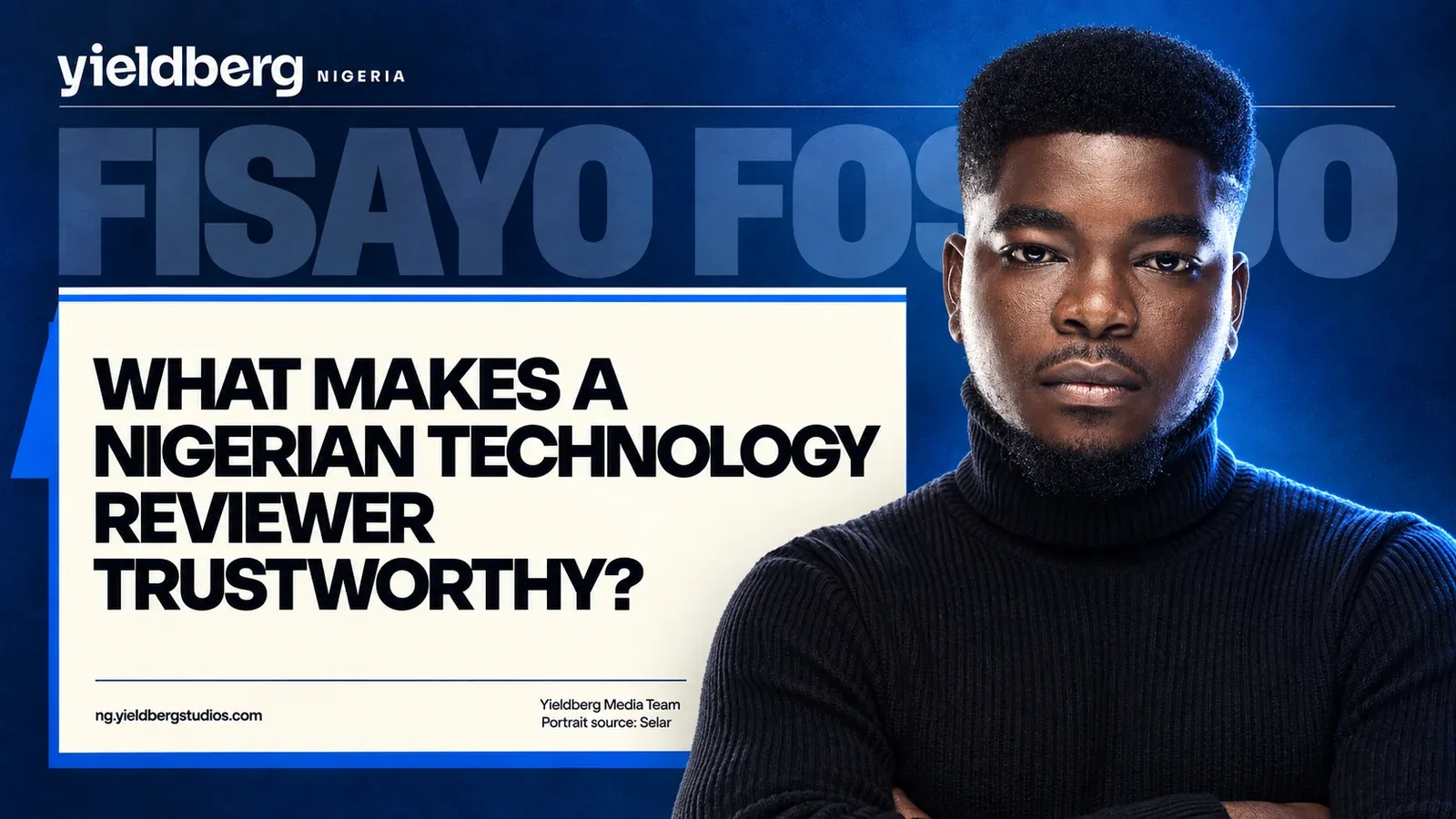
Fisayo Fosudo’s strongest trust proposition is not production quality alone. It is translation: what a device, platform or financial technology means under Nigerian prices, networks, power conditions and consumer choices. That trust weakens whenever access to a review unit, sponsorship, local availability or testing conditions remain unclear. A beautiful video can make evidence easier to understand, but it cannot replace the evidence.
The most useful standard is therefore local reproducibility. Could a viewer in Nigeria find the same product, pay roughly the stated amount, use it on an available network and expect the reviewed feature to behave in comparable conditions?
A Nigerian lens is an editorial choice
Fosudo’s work has expanded from phones into finance, productivity and the Nigerian economy. In a November 2025 Punch interview, he described YouTube as the home for depth, Instagram and X as conversational surfaces and TikTok as a discovery channel. He also framed his perspective as the reason people should watch. That is his own account, but it offers a clear contract: global technology interpreted from Nigeria.
An earlier Semafor profile documented why that perspective can require unusual access decisions. Fosudo said some Apple and Google phones were not officially launched in Nigeria and had to be bought at full price, while one early Tecno device was loaned. A 2025 Zikoko production interview said smartphones were by then commonly sent ahead of launch. These accounts establish that access routes vary. They do not establish how any unexamined individual video was funded.
Recognition shows relevance, not automatic accuracy. Fosudo won the technology category at the 2024 Pulse Influencer Awards. The award’s public-voting component demonstrates audience mobilisation within its rules, not that every recommendation is correct.
What the sentiment review covered
On 26 September 2026, The Yieldberg Brief reviewed Fosudo’s public YouTube, TikTok, Facebook and X surfaces where accessible; Nigerian profiles published from 2023 to 2026; and current manufacturer and Nigerian Communications Commission material. TikTok and Facebook did not expose complete reply histories without sign-in. X returned only parts of some conversations. YouTube comments were visible selectively and could not be exported as a complete population.
This was a qualitative, purposive sample. We did not calculate a positive-to-negative ratio, infer purchases from comments or treat a viewer’s reported experience as a controlled test. The visible questions were most useful when they concerned price, release status, network compatibility, battery, warranty, sponsorship and how a feature behaved after launch.
Platform distinctions were clear. YouTube supports a sustained review and later description update. TikTok makes a single verdict or feature travel quickly but compresses conditions. X is useful for corrections and rapid comparison, while Facebook shares can give an old clip a second life after its price is stale. A trust system must follow the claim across all four.
What builds trust
Local use cases replace imported assumptions
A device can score well in a global review and still be a poor Nigerian purchase. The relevant questions include whether it has official local support, compatible network bands, an obtainable charger, repair parts, warranty coverage and acceptable battery performance during outages or heavy hotspot use.
The NCC’s Q2 2026 network-performance page notes regional and operator differences and a gap between 5G-ready devices and effective 5G access. That means “supports 5G” is only a specification. A Nigerian review should state the operator, city or area, SIM, test period and fallback behaviour rather than implying national experience.
Production can expose rather than decorate
Good lighting reveals screens and finishes. Clear graphics make comparisons legible. A repeatable camera, charging or performance test helps viewers distinguish observation from preference. High production earns trust when it makes the method inspectable.
It creates suspicion when cinematic access becomes the evidence. A launch venue, executive interview or early unit may be useful, but proximity to a manufacturer should not be presented as independent verification.
A creator can correct without losing authority
Technology changes after publication. Firmware can improve a camera, a promised feature may arrive late and a Nigerian retailer may alter price. A dated correction is evidence that the reviewer monitors the product rather than a confession of failure.
The accessible public sample contained recurring viewer requests for comparisons, current price and longer use. Those requests are illustrative, not a representative vote. They point to an editorial opportunity: attach an update record to every high-intent review.
What scepticism is really testing
Review-unit access
“Sent by the brand” can mean a temporary loan, a unit retained without editorial payment, a gift or part of a paid campaign. These arrangements are not interchangeable. A viewer needs to know which one applies and whether the brand saw or controlled the conclusion.
The fact that Fosudo has described both bought and supplied devices makes per-video disclosure more important, not less. A permanent channel policy cannot tell a viewer how the phone in front of the camera was obtained.
Nigerian price and availability
A launch price in dollars is not a Nigerian purchase price. It may exclude import costs, exchange movement, warranty and retailer margin. Samsung’s 2026 Nigerian promotion terms show why date and stock matter: the offer applied during a defined period, while stock lasted, and the terms warned that prices could change with foreign-exchange movement.
A useful review therefore names the seller and date, says whether stock was checked, distinguishes official from grey-market import and includes the warranty route. “Available in Nigeria” should not mean one marketplace listing.
Network claims
The NCC publishes quarterly regional and operator quality-of-service reports. A single speed test cannot generalise over that variation. It is evidence about one device, operator, location and moment.
Reported purchase outcomes
A viewer who says a review informed a purchase offers valuable follow-up, especially about defects, repair or battery ageing. It remains a self-report. Brands should not convert one success story or complaint into an outcome rate.
The Nigeria Review Reality Check
The Nigeria Review Reality Check is the original method for this article. It turns a polished review into a locally auditable buying aid.
| Evidence line | Required disclosure | Minimum local test |
|---|---|---|
| Access | Bought, borrowed, gifted, retained or sponsored | State who supplied it and whether approval was required |
| Price | Naira figure, seller, date, tax and condition | Confirm live stock at two legitimate routes where possible |
| Network | Bands, SIM/eSIM, operator and location | Test calls and data on at least two conditions, not one speed run |
| Power | Charger in box, wattage and charging source | Record full-charge time and use during unstable supply |
| Support | Warranty territory, service centre and parts | Verify the Nigerian service route before recommending |
| Time | First look, review period and firmware | Add a 30- or 90-day note for high-intent devices |
| Correction | What changed and when | Link every short clip to the dated master record |
The method does not demand identical tests for every product. It requires the reviewer to make omissions visible.
A fourteen-day trust audit
- Days 1–2: inventory ten recent product videos. Include positive, mixed and non-review coverage.
- Days 3–4: log access. Record purchase receipt, loan return date, gifting, sponsorship, travel support and any affiliate link.
- Days 5–6: verify Nigeria. Check dated naira price, live stock, authorised seller, warranty and service location.
- Days 7–8: retest connectivity. State operator, location, network generation and firmware. Compare with the NCC’s published regional context rather than promising universal performance.
- Days 9–10: separate claim types. Mark manufacturer claim, measured result, personal preference and viewer report.
- Days 11–12: review public questions by platform. Keep repeated questions about price, battery, signal, repair and disclosure. Exclude insults and unverified fraud accusations.
- Day 13: publish one correction or confirmation. If nothing changed, date that finding too.
- Day 14: decide. Continue recommending, narrow the recommendation to a use case, or withdraw it.
The decision point is day 14. A trust audit should end with a buying position and its evidence, not an engagement summary.
Implications for creators and brands
For Fosudo and other reviewers, a compact disclosure card at the start of every review would remove needless ambiguity. Keep a public test protocol and a correction log. When a product has no official Nigerian release, say what that means for repair, warranty, eSIM, parts and resale.
Brands should contract for editorial independence in writing. Supply current Nigerian price and stock, network-band documentation and after-sales contacts. Do not prohibit comparison or require a positive verdict. If travel, production or a device is provided, make the disclosure easy to repeat in every cut-down.
Audiences should use a review to narrow choices, not to outsource the purchase. Confirm today’s price, the exact storage variant, condition, warranty and network support before paying.
Related reading
Frequently asked questions
Is a free review unit the same as sponsorship?
No. A loan, gift and paid integration create different incentives. All are material to evaluation and should be labelled precisely.
Why is Nigerian network testing necessary?
Coverage and performance differ by operator, generation and location. Device support on paper does not prove effective service where a particular buyer lives or works.
Can an imported phone still be a good recommendation?
Yes, for a buyer who understands warranty, repair, band, SIM and resale trade-offs. The review should state those costs rather than treating global availability as local availability.
Do high production values make a reviewer more reliable?
They can make evidence easier to inspect. Reliability still depends on method, independence, disclosure and correction.
What is the most important line in a tech review?
The buyer fit: who should buy, who should not, under what Nigerian price and network conditions, as of what date.
Sources
- Fisayo Fosudo, official YouTube channel
- Punch, interview on viewing technology through a Nigerian lens
- Zikoko, how Fisayo Fosudo makes his videos
- Semafor, Fisayo Fosudo’s Nigerian technology-review model
- NCC, Q2 2026 network-performance reports
- Samsung Nigeria, 2026 promotion terms
Next decision: Use the Nigerian audience-nuance planning guide to set the minimum local evidence required in the next technology review.

 By Isong Godswill

 By Omodot Jackson