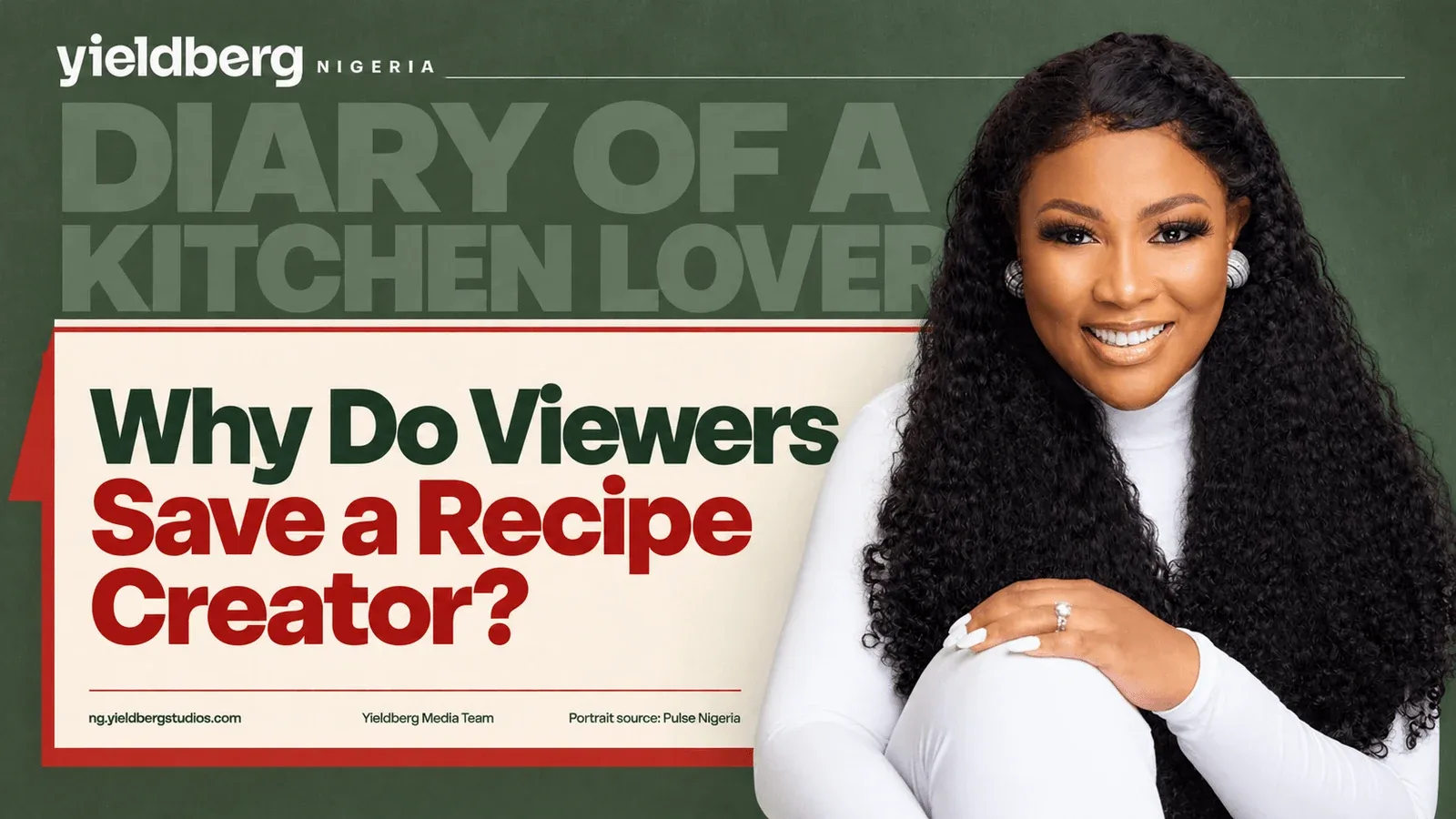
Viewers appear to save Diary of a Kitchen Lover because her strongest posts combine three kinds of value: food that looks worth attempting, instructions that reduce uncertainty and a host whose pleasure in cooking makes the attempt feel inviting. A save, however, records future intention rather than a successful meal. Trust begins when a viewer can return, source the ingredients, recover from an imperfect step and produce a result that makes sense in their own kitchen.
This distinction matters for creator and brand decisions. Visual appetite can win the first watch. Reproducibility gives the content a life after the scroll.
Chef T has built more than a recipe feed
Tolani Tayo-Osikoya, known as Chef T and Diary of a Kitchen Lover, publishes recipes, meal plans, kitchen guidance, travel and lifestyle material. Her official site also sells meal plans for families, workers and pregnancy, while linking to her public Facebook, TikTok, YouTube and X accounts. That product structure turns cooking content into a continuing service rather than a collection of attractive clips.
Her current X profile, @diaryofakitchen, also shows a move into owned entertainment. In September 2026 she promoted the third season of Delicious or Disaster, explaining the participant mix and asking viewers to support a Nigerian cooking show. The shift matters because people can admire a recipe teacher while judging a competition host, casting choice or sponsor integration differently.
The 2025 Trendupp Awards listed Diary of a Kitchen Lover among its food-content nominees for work between March 2024 and March 2025. That establishes industry recognition within the organiser's process, not independent audience satisfaction.
What the available public reaction can show
The observation window for this article was 27 September 2025 to 26 September 2026, with collection completed on 26 September 2026. The desk review checked the creator-controlled website, the public Facebook page linked by that site, the public TikTok profile, accessible X posts and search-indexed discussion around current work.
Complete response populations were not available. Facebook restricted most logged-out comment access, TikTok exposed profile and post surfaces without a complete auditable comment stream, and X exposed only portions of conversations. Meta's Content Library, the X API and TikTok's Research Tools each have access conditions that this editorial desk did not claim to meet. No reaction percentage is therefore published.
The testimonials displayed on Chef T's own website repeatedly describe saved recipes, improved confidence, more interest in cooking and better household budgeting. They are useful clues about the value proposition, but they are selected by the business and cannot stand in for independent sentiment. Public replies that could be viewed were treated as illustrative, de-identified observations. A comment saying a dish looks good is evidence of appetite, not proof that the method worked.
Within those limits, three recurring positive frames were visible.
Why people return
The food creates an immediate visual promise
Colour, texture, cookware and a finished serving give viewers a clear reason to pause. This is not superficial. A home cook often needs to understand the desired endpoint before deciding whether the effort is worthwhile. The risk is that a polished final shot can conceal preparation time, unavailable equipment or several unshown trials.
The host makes effort feel sociable
Chef T addresses followers as “Besties”, reacts expressively and places cooking inside travel, friendship and celebration. That language turns instruction into company. It also creates a commercial responsibility: friendship-style address should not blur whether an ingredient, appliance, trip or placement was sponsored.
The content promises practical return
The official recipe pages separate breakfast, lunch, dinner and drinks, while the shop organises plans around recognisable household situations. Those categories answer a decision a viewer already has: what can I cook for this day, budget or group? This is stronger than inspiration alone.
The criticisms around food content are usually more specific than dislike of a creator. Viewers may question an ingredient cost, ask for a substitute, reject a claimed level of ease or defend another household's version of a dish. Those are recipe questions. They should not be converted into a personality verdict.
The Save-to-Stove Test
The Save-to-Stove Test is an editorial method developed for this article. It asks whether a saved video can survive contact with an ordinary kitchen.
| Test | Question | Evidence the post should provide | Failure signal |
|---|---|---|---|
| Source | Can the viewer identify the ingredients and realistic alternatives? | written list, quantities, local names, substitution note | an unnamed “special spice” carries the whole result |
| Sequence | Can the viewer reproduce the order without replaying every second? | numbered steps, heat level, preparation cues | rapid cuts remove a decisive step |
| Sense | Can the cook judge progress without identical equipment? | colour, texture, aroma and doneness markers | timing is the only guide |
| Recovery | Does the recipe explain common mistakes? | what to do if sauce splits, dough is wet or seasoning is strong | a failed step means starting again |
| Disclosure | Is commercial involvement clear before it shapes the decision? | visible sponsor label and a precise product role | praise is presented as independent discovery |
| Variation | Is this version located honestly? | household or regional context and respectful alternatives | one method is declared the only authentic version |
The test does not demand that every short video contain a cookbook. A caption, pinned comment or linked long-form recipe can carry the detail. The viewer should not have to guess where the usable instructions live.
Different posts need different evidence
| Content type | What viewers may value | Main risk | Best supporting asset |
|---|---|---|---|
| Everyday meal | speed, cost and familiarity | hidden preparation or unrealistic portions | cost date, substitutions and storage note |
| Celebration dish | spectacle and skill | “easy” language that understates labour | preparation timetable and make-ahead steps |
| Sponsored recipe | discovery and demonstrated use | product praise mistaken for independent comparison | clear disclosure and explanation of what the product changes |
| Travel food | curiosity and cultural exchange | treating one vendor or dish as a whole cuisine | place, contributor credit and local context |
| Competition show | entertainment and learning | judging theatre overwhelms useful feedback | published criteria and qualified food voices |
An earlier report about the launch of Delicious or Disaster recorded enthusiasm and criticism of celebrity judges. That is a different decision from whether viewers can reproduce Chef T's recipes. A commissioning editor should code sentiment by format before drawing a conclusion about the brand as a whole.
Facebook, X and TikTok are not one kitchen
TikTok rewards a compact reveal, recognisable sound and repeat viewing. Its comment prompts often invite an immediate answer such as whether a viewer would try the dish. That is useful creative feedback, but it does not establish that anyone cooked it.
X gives a recipe another life through screenshots, jokes, questions and show promotion. It can concentrate criticism of cost, casting or claims because a short statement travels without the full method. Chef T's September 2026 posts about her show illustrate X as a mobilisation and explanation channel rather than a recipe archive.
Facebook can reach viewers through the creator's page and through publisher reposts. The framing attached to a repost may emphasise travel, luxury or controversy before a person sees the cooking. Comments under that copy belong to the publisher's context, not automatically to the original post.
Treat a TikTok save, an X bookmark and a Facebook share as different actions. None is a verified cooked result.
What creators and brands should change
Recipe creators should publish a reproducibility layer. Keep the pleasurable short edit, then attach quantities, heat, equipment assumptions, likely substitutions and a failure cue. Where Nigerian dishes vary by household, town or language, name the version being demonstrated and invite additions without staging a contest over authenticity.
Brands should commission the recipe and the evidence around it. Ask what the ingredient does, whether an unsponsored alternative exists, what claim needs substantiation and how viewers can find the full method after paid distribution ends. Do not require a creator to call a premium appliance “essential” when a pot and spoon can achieve the relevant result.
Measure saves as an intention signal. Pair them with clicks to the full recipe, useful questions, repeat visits and voluntary reports of attempts. A viewer's result remains self-reported unless the team independently verifies it.
A seven-day reproducibility sprint
- Day 1: choose one recipe. Select a dish that serves a defined situation, such as a weekday dinner, rather than trying to prove universal appeal.
- Day 2: document the real method. Record quantities, preparation time, equipment, heat and every step removed from the short edit.
- Day 3: map variation. Ask two competent cooks from relevant backgrounds where their versions differ. Describe difference without ranking households.
- Day 4: test a substitution. Replace one costly, seasonal or hard-to-find item and record how the result changes.
- Day 5: run a cold read. Give the written method to a tester who did not watch production. Note every question; do not claim a successful audience test from one cook.
- Day 6: publish with disclosure. Put the sponsor and product role where viewers encounter the recommendation, then link the complete recipe.
- Day 7: decide. Continue the format only if questions concern taste and personal variation rather than missing instructions. Update the recipe when a repeated, well-founded problem appears.
The decision point is whether the content still works after the beauty shot is removed.
Related reading
Frequently asked questions
Does a high save count prove a good recipe?
No. It proves that users activated a platform feature. A save may mean aspiration, entertainment, shopping reference or an intention that never becomes cooking.
Are substitutions disrespectful to Nigerian food?
Not inherently. The creator should distinguish a practical adaptation from a claim about the dish's defining tradition. Naming the version and the change protects both usefulness and context.
Should sponsored ingredients always have an alternative?
Where the product is not essential, an alternative helps viewers understand the method rather than the advert. If the product performs a unique function, demonstrate that function and disclose the relationship clearly.
Is criticism of an expensive recipe hostility towards the creator?
Usually not. Cost and availability are legitimate parts of usefulness. Record the date and market basis for any price claim, since Nigerian food costs change.
Sources
- Diary of a Kitchen Lover official website, creator-controlled recipes, services, social links and selected testimonials, checked 26 September 2026.
- Diary of a Kitchen Lover recipe index, current category and instruction structure.
- Diary of a Kitchen Lover on X, public show and creator updates checked 26 September 2026.
- Diary of a Kitchen Lover on TikTok, public profile checked with logged-out limitations.
- Trendupp Awards 2025 nominees, used for industry-recognition context rather than population sentiment.
- Meta Content Library announcement, research-access context.
- X API query tools, access context.
- TikTok Research API eligibility FAQ, access context.
Next decision: Use There Is No Single Nigerian Audience to separate recipe utility, host affection and show-format reactions before briefing a partnership.

 By Isong Godswill

 By Omodot Jackson