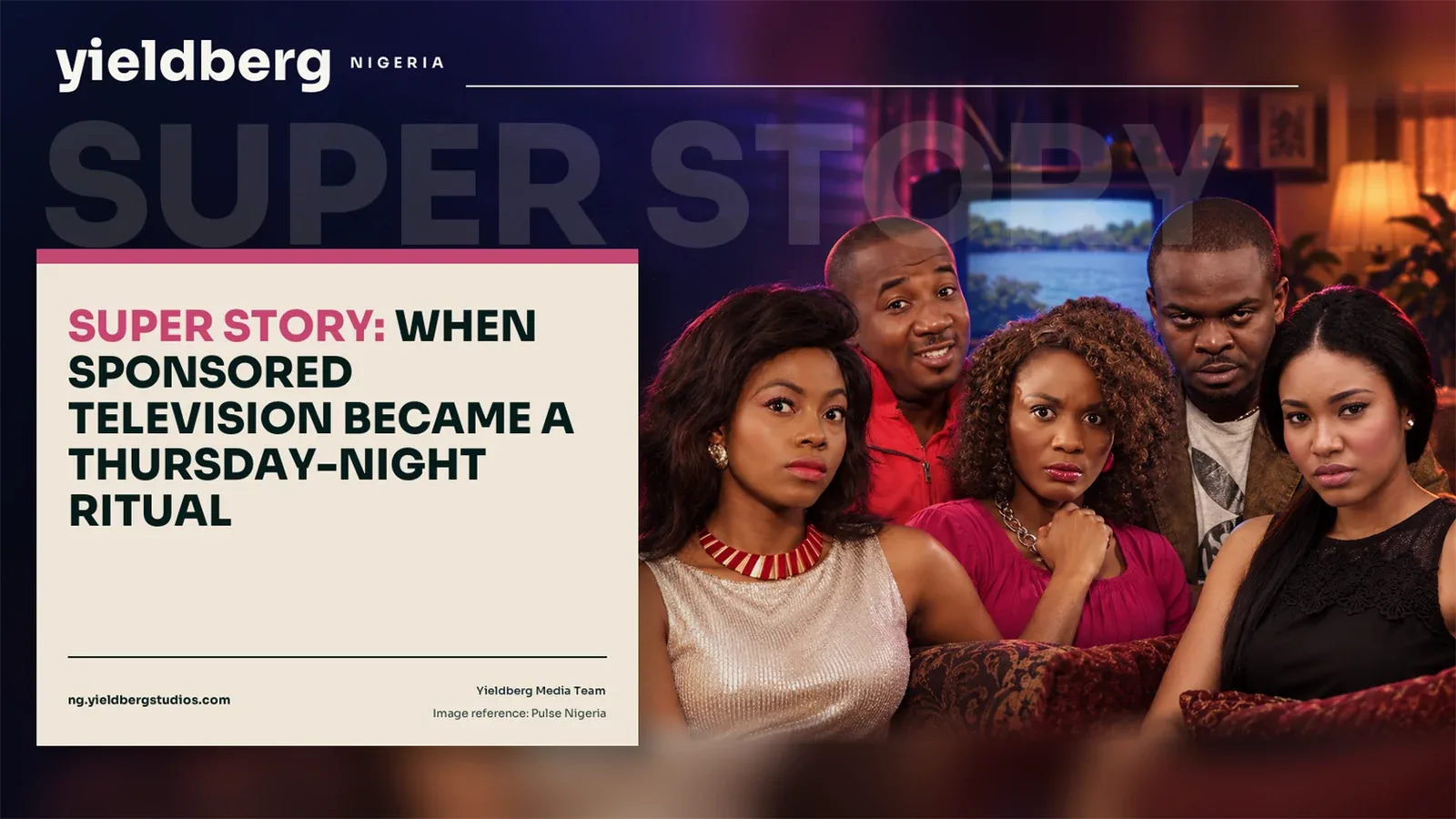
The music did more than announce a programme. It altered the evening. Conversations had to conclude, plates moved closer to the television, and anybody still outside risked returning to a room that already knew the newest betrayal. On Thursday night, the opening of Super Story felt like a summons.
Then came a world in which choices never stayed private. A favour requested in desperation could poison a marriage. Sudden wealth carried an invoice. The charming stranger had a second life; the dutiful relative had a secret; the person dismissed in episode three might hold the moral account in episode eighteen. Every consequence waited patiently for its entrance.
The series is remembered for melodrama, unforgettable characters and a theme tune fused to the era of terrestrial television. Its more consequential achievement sits behind those memories: Super Story converted commercial sponsorship into a recurring national story circle. An advertiser helped make the first television season possible, but the drama earned attention by turning social anxieties into appointment viewing. It was branded entertainment whose strongest brand was consequence.
A sponsor opened the door
Super Story had a life on paper before television. Wale Adenuga had built a publishing business around popular magazines, then shifted towards broadcast as newsprint costs and distribution problems weakened the print model. In Adenuga’s own account, an advertising-agency contact told him in 1999 that Lever Brothers wanted to sponsor a soap opera. He returned to his archive, selected the Suara story and developed a one-hour pilot called Oh Father! Oh Daughter!; the proposal won the sponsorship after a competitive submission process.
Wale Adenuga Productions dates the series’ television run from 2001 and describes its aim as telling relevant, culturally grounded stories. The first season followed Suara, Abike and the formidable Toyin Tomato. Its plot joined unemployment, marital sacrifice, shame, mobility and infidelity in a chain reaction. Suara’s hunger for a job required a moral compromise; improved fortune did not heal the wound but enlarged it. Sola Sobowale’s Toyin Tomato arrived with glamour, strategy and a name that escaped the programme to become part of her public identity.
Adenuga later explained that the production invested deliberately in Toyin’s distinction, particularly her wardrobe, jewellery and high-status appearance, because Sobowale could embody both toughness and vulnerability. The role became a major screen breakthrough; his recollection places the Suara production across 2000 and 2001. The character’s afterlife is evidence of what sponsorship can enable when craft, casting and distribution align: not a disposable campaign asset, but a figure capable of outliving the campaign that financed her arrival.
The anthology was the secret weapon
Unlike an endless soap built around one family, Super Story could finish a tale and begin again. Each new cycle replaced its characters, dilemma and social terrain while preserving the programme’s moral weather. This anthology structure protected it from one of long-running television’s greatest risks: becoming trapped by its own success.
The reset did several things at once. It welcomed viewers who had missed previous stories. It allowed established performers and emerging actors to enter without disturbing a permanent cast. Most importantly, it gave the programme permission to follow a problem all the way to an ending. Actions accumulated consequences; secrets could be revealed; a season could close its moral ledger and clear the stage.
Across successive stories, the lens moved through relationships, campus life, family conflict, ambition, corruption, abuse, migration and the seductions of money. Itohan: A Call to Action, for example, addressed trafficking, forced prostitution and irregular migration. A scholarly analysis found that the serial connected exploitation abroad to pressure and disconnection within the family, using personal testimony to make a structural crisis emotionally legible.
That is the anthology’s civic value. Statistics describe a problem at scale; melodrama gives it a face, a kitchen, a mother, a lie and a moment at which another choice might have been made. Super Story translated “social issue” into domestic suspense.
Thursday at eight was part of the text
Appointment television depended on scarcity. There was no full season waiting to be consumed before Monday. Missing an episode meant relying on an unreliable recap from someone who enjoyed withholding the best detail. The interval between instalments allowed suspicion to ripen and arguments to travel through schools, offices, buses, salons and family compounds.
The NTA Thursday 8 p.m. slot became closely associated with that experience. Long after the programme’s debut, listings still placed it there: a 2024 report recorded Thursday broadcasts on NTA from 8 to 9 p.m., with later slots on AIT and STV. By then, episodes also moved onto YouTube, but the persistence of the weekly schedule carried an older promise. At the same hour, separate households would enter the same argument.
The theme music performed essential infrastructure. It functioned as a household alarm and an emotional contract: seriousness was coming, but so were twists, heightened performances and the pleasure of knowing more than at least one doomed character. Before autoplay and personal recommendations, sound could gather an audience across rooms.
This shared timing amplified the show’s moral design. A lesson delivered privately can be ignored privately. A cliffhanger watched by a household becomes a debate before the credits have finished. Who was wrong? Was the punishment deserved? Could the disaster have been prevented? The programme did not merely transmit a story; its schedule organised the conversation around it.
The brand financed attention; the story had to keep it
The origin of Super Story is a useful corrective to thin ideas of branded entertainment. Sponsorship was not a logo pasted onto a finished cultural object. It was part of the production system that allowed a locally made drama to occupy valuable network time, return weekly and develop professional continuity. WAP has continued to present the programme as a platform through which companies, public agencies and non-governmental organisations can communicate with family audiences.
But sponsorship could only purchase the opportunity for attention. It could not manufacture attachment. That required actors capable of making archetypes feel dangerously specific, writers who understood when to disclose and when to delay, and production choices that made ordinary homes carry operatic stakes. The advertising break may have funded the hour; Suara, Abike and Toyin Tomato made viewers come back after it.
The programme’s endurance also shows why relevance matters more than one perfect format. Corporate partners change. Distribution multiplies. Terrestrial schedules coexist with cable and online video. An anthology can absorb those changes because its true asset is not a fixed cast or set. It is a repeatable promise: a recognisable Nigerian problem will become a suspenseful story, and the story will eventually reckon with itself.
A moral universe worth questioning
The show’s clarity could also become simplification. Super Story often organised characters along sharp lines: faithful and treacherous, humble and arrogant, victim and corrupter. Melodrama works by making moral pressure visible. Women, particularly glamorous or financially independent women, could be pushed towards familiar temptress or home-breaker types. Academic work on Nigerian screen culture has specifically noted Toyin Tomato as an example of the successful single woman framed as a threat.
That limitation belongs in the memory too. A programme can expand public discussion and still reproduce the assumptions of its moment. Indeed, the argument over a character may be part of the cultural work: viewers can accept the caution, reject the stereotype or do both at once. Television’s meaning is never owned entirely by its sponsor, producer or narrator.
What Super Story mastered was the creation of a common object to argue about. It gave moral questions colour, music and a weekly deadline. It introduced characters so forcefully that their fictional names followed performers for years. It made the end of an episode feel less like closure than the transfer of responsibility from the screen to the sitting room.
The Thursday-night ritual belonged to an era of fewer channels and more shared clocks. Yet its lesson remains modern. Reach is not the same as resonance. A brand can fund distribution; only a story with emotional stakes can become memory.
Source note
Public sources disagree on whether the Super Story print magazine began in 1978 or 1980, while the television debut is consistently dated to 2001. WAP and partner coverage sometimes use promotional superlatives and large audience claims without publishing comparable ratings methodology; this article therefore makes no audience-size or ranking claim. Public season and episode archives are also incomplete.
Sources
- Wale Adenuga Productions overview of Super Story
- Wale Adenuga interview on the print-to-television transition and first pilot
- Wale Adenuga on Sola Sobowale and Toyin Tomato
- Academic analysis of Super Story: Itohan and migration
- The Sun report on the programme’s broadcast schedule and partnerships
- University of Westminster thesis on popular fiction and gender
Next decision: Read Build the Show, Not Just the Spot.
Related reading
 By Omodot Jackson

 By Isong Godswill