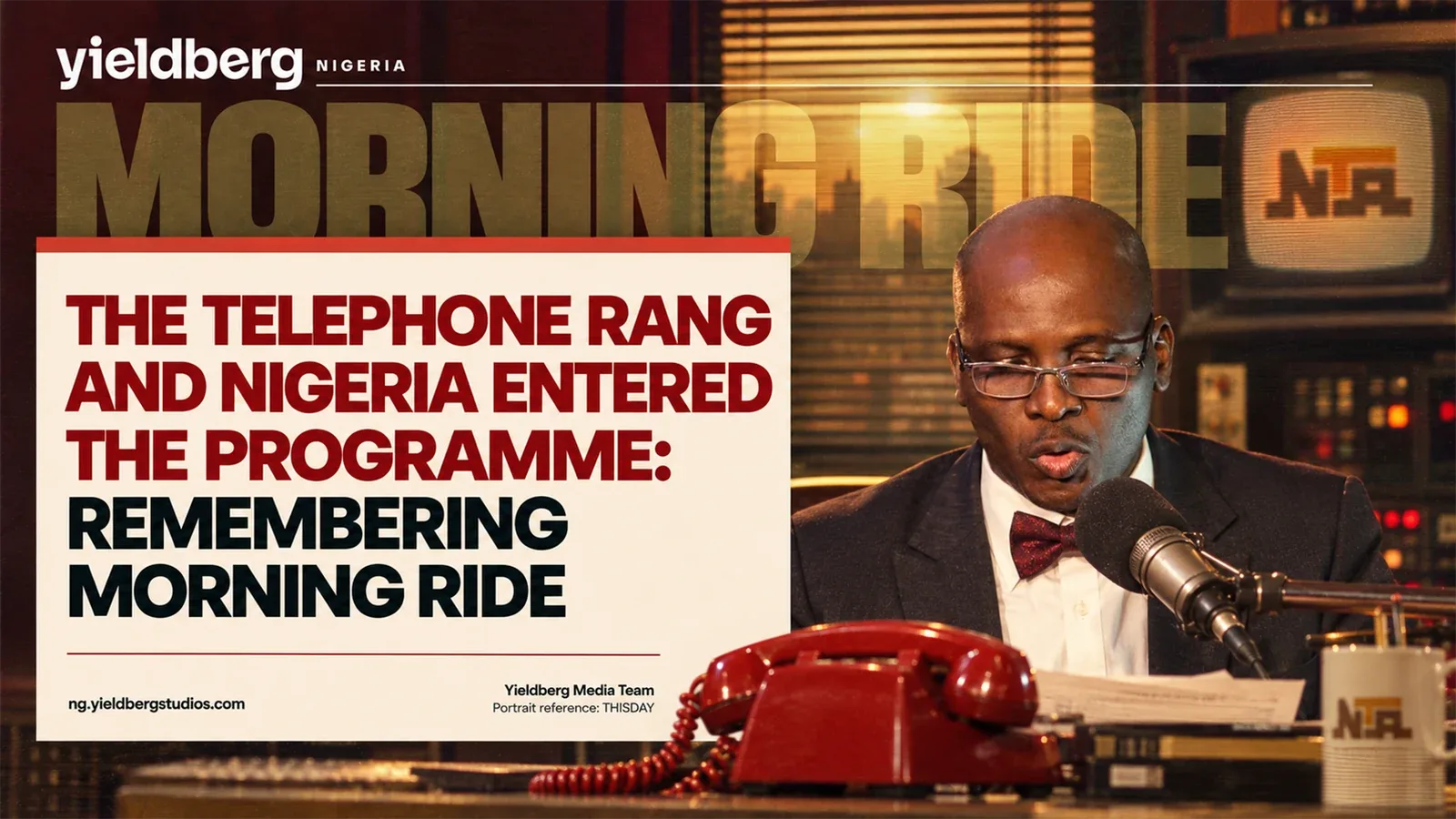
The defining instrument of Morning Ride was not the studio camera. It was the telephone. Once a caller could enter a live conversation, television stopped feeling like a sealed room occupied only by officials, celebrities and presenters. The viewer could become part of the event.
That sounds ordinary now. A live broadcast can receive thousands of comments before a guest completes a sentence. In the late 1980s, during military rule, an unscripted caller was not ordinary. The possibility carried editorial risk, political anxiety and the thrilling sense that anything might happen before the credits.
A simple idea that sounded dangerous
Danladi Bako has said that he took the concept for a live talk programme with a phone-in segment to NTA management in 1987. According to a ThisDay profile of the broadcaster, one concern was blunt: what if a caller used the open line to insult the military president?
The question reveals the programme's real innovation. The technology itself was not the whole breakthrough. The breakthrough was allowing an ordinary voice to arrive without being fully polished in advance.
Bako's account places the start of the programme in 1988 and describes it as an early live Nigerian television talk show built around that access. He also recalled drawing a senior police officer into an on-air admission about corruption in the force. That recollection comes from the programme's creator and should be read as such, but it illustrates the type of encounter the format made possible.
The pleasure of Morning Ride came from controlled uncertainty. The presenter had to protect the broadcast without strangling the conversation. The caller had to be heard, the guest had to respond and the programme had to continue.
Television with its collar slightly loosened
Old state television is sometimes remembered only for formality: careful diction, composed announcers, fixed schedules and the authority of the network ident. Morning Ride retained professional control while allowing more air into the room.
The title itself helped. A ride suggests motion, company and a route that may include turns. It is less severe than a “national interview” and more purposeful than casual chatter. The programme could move through public affairs, entertainment and personality while the host remained the driver.
For viewers, the attraction was not simply access to important guests. It was the chance to watch a conversation respond to pressure. A prepared answer could be interrupted by a caller's practical question. A public figure accustomed to speeches had to speak to a person.
That live friction created presence. Missing an episode meant missing the exact moment in which a voice, hesitation or reply became television. There was no guaranteed clip waiting on a social platform the next morning.
The ceremony of being ready at the right time
Nostalgia for scheduled television is partly nostalgia for anticipation.
You could not carry Morning Ride in your pocket. The programme met you at a time chosen by the broadcaster. A household arranged itself around that fact. Someone adjusted the aerial. Someone called from another room. A conversation already under way drew people toward the set.
This did not make the old system more convenient. It made attention more concentrated.
The screen was often the only place to encounter the programme. Viewers did not watch while simultaneously reading hundreds of strangers' reactions. The first interpretation was more likely to happen inside the home, at work later that day or in a discussion with neighbours.
The scarcity of the programme gave each broadcast weight. Modern abundance gives audiences choice, but it also makes almost every item feel replaceable. Morning Ride belonged to an appointment culture in which the next programme could not be summoned immediately.
The host as shock absorber
The phone-in format succeeds only when the presenter can hold conflicting obligations at once.
The caller deserves enough time to make a point. The guest deserves clarity about what is being asked. The broadcaster must avoid defamation, dead air and a conversation captured by one participant. The audience needs momentum. In a politically restricted environment, the host also understands that a careless transition may have consequences beyond the episode.
Bako's achievement was therefore not merely persuading NTA to try the format. It was making the risk look manageable on screen.
This is an underappreciated broadcasting skill. When a live programme feels natural, the labour of keeping it coherent becomes invisible. The host listens for what is being said, what is being avoided and what must happen next. The best intervention is often short enough that viewers remember the guest's answer rather than the presenter's rescue.
When the public entered through one line
A phone-in did not make Nigerian television fully democratic. Access to a working telephone was unequal. Producers still selected guests, set topics and controlled which calls reached air. Network reach did not mean every citizen could participate on the same terms.
Yet the line altered the symbolic shape of the programme. It introduced the possibility that public speech could travel in the other direction.
That matters because media formats teach audiences what role they are allowed to occupy. A lecture format says: receive. A talent contest says: judge. A phone-in says: ask, challenge or contribute, provided you can get through.
The later history of Nigerian phone-in radio, audience-vote programmes, social television and live streams makes that role feel familiar. Morning Ride belongs to an earlier stage, when the sound of a caller arriving was itself evidence that the wall around broadcasting had become more permeable.
Why its archive matters now
NTA still identifies Morning Ride in its contemporary programme catalogue, and the show has experienced later rebranding and continuation. The present listing does not by itself document the changing format, presenters or editorial character across decades. It does show that the name has outlived the media environment in which it first became significant. NTA's current show listings include the programme on NTA2 Lagos.
That long life creates an archival responsibility. A title can continue while its earlier versions become difficult to study. Researchers need more than a logo and a summary. They need episodes, production papers, presenter notes, guest lists, call-screening procedures, promotional materials and oral histories from crew and viewers.
Without those records, nostalgia flattens change. Every era becomes “the good old days”, and the precise reasons a programme mattered disappear.
What a modern live show should recover
Copying the old set would produce a tribute, not a successor. The lasting ideas sit beneath the surface.
First, make audience access consequential. Reading compliments from a screen is not participation. A viewer's contribution should be capable of changing the interview.
Second, prepare for openness. Producers need call screening, delay protocols, fact-checking support, clear moderation standards and a presenter who can interrupt respectfully.
Third, choose guests who can answer rather than merely announce. A live conversation is wasted when every response has been reduced to a campaign line.
Fourth, preserve the episode in full. Short clips reward dramatic moments but remove the path by which the conversation reached them.
Finally, let the presenter remain curious. Authority on a talk show does not come from speaking longest. It comes from creating the conditions under which something honest can be said clearly.
The sound people still miss
The most evocative memory of Morning Ride is not necessarily a particular guest or question. It is the idea of the line opening.
Somewhere outside the studio, a viewer had been listening. A telephone connected. The presenter's attention shifted. The guest waited. For a moment, a programme made by a national broadcaster had to respond to a citizen it had not completely scripted.
Today, everyone can publish, comment and broadcast. Yet genuine exchange can still feel rare. That is why the old phone call carries such force. It reminds us that access is not measured by the number of voices making noise. It is measured by whether the programme listens when one of them gets through.
Sources
- ThisDay: “Danladi Bako: Garlands for the ‘Morning Rider’ at 60”
- NTA current television show listings
- The Nigerian Voice: “NTA2 Morning Ride, Back and Rebranded”
Next decision: Read From Audience to Co-Author.
Related reading

 By Isong Godswill

 By Omodot Jackson