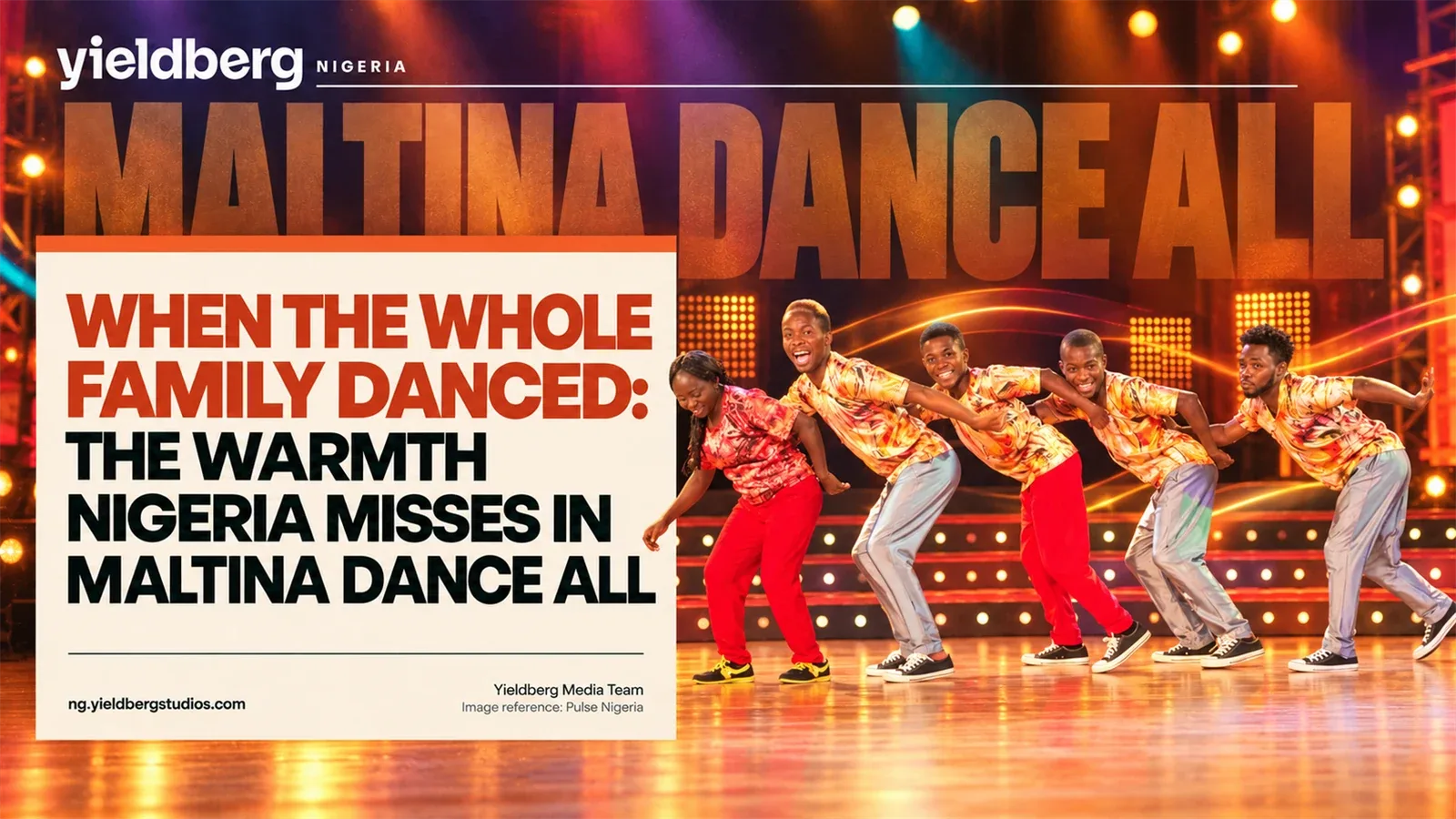
Maltina Dance All made the family, not the individual celebrity, the unit of entertainment. Parents, children and relatives had to move as one team, carrying private familiarity into a public competition. The result was joyful television with real stakes: a missed step belonged to one person, but recovery belonged to everyone.
Its special warmth came from recognition. Viewers were not watching distant professionals perform perfection. They were watching families negotiate rhythm, age, confidence and affection under pressure.
The surname became a team name
Most reality competitions ask contestants to create an individual brand. Maltina Dance All placed the family name on the scoreboard.
That small decision changed the emotional structure. A win could not be narrated as one person's ascent. The strongest dancer still needed relatives to remember formations, sustain energy and trust the rehearsal process.
It also gave the audience an easy language of attachment: the Ibiam family, Ekubo family, Green family, Briggs family, Utere family and others. The names carried people from audition through academy, performance and final.
Nigerian Breweries' 2009 annual report described the programme as a family dance reality show and recorded the Ibiam family as winners of that edition. Later reports documented other families, changing prize values and evolving themes.
The continuity made the idea feel bigger than any one season. A new family could enter the same dream.
Rehearsal turned affection into technique
Family closeness does not automatically produce a clean routine.
Different generations hear music differently. A parent may prioritise discipline while a younger dancer wants flair. One person learns quickly, another needs repetition. Someone must accept a less visible position because the formation works better that way.
The academy format converted those tensions into story. Practice showed that love and coordination were not the same thing, but one could help build the other.
Dance styles also widened the challenge. Reports from different seasons refer to forms including hip-hop, jive, pantomime, Wazobia and contemporary African dance. A Nigeria CommunicationsWeek account of the 2010 competition described families moving through multiple styles before the final.
That variety allowed older and younger viewers to recognise different movement traditions. It also required care. Labels such as “Wazobia” or “African dance” can flatten distinct practices if choreographers do not name origins, teachers and cultural meanings precisely.
The living room became a rehearsal room
Dance television produces an immediate physical response. Viewers do not only judge. They copy.
A child tries a step in front of the screen. A sibling joins to correct it. An adult who claimed not to be watching begins marking the rhythm from a chair. The programme's family premise made this imitation feel invited.
Unlike a contest built around technical vocabulary alone, Maltina Dance All offered an accessible fantasy: perhaps our household has a routine too.
The programme therefore extended beyond its contestants. It supplied music, movement and an excuse for people at home to perform together without needing a formal stage.
That claim is cultural interpretation, not measured national behaviour. Public audience research available online is limited. What can be established is that the sponsor and press coverage consistently positioned family participation, bonding and happiness at the centre of the format.
Kemi Adetiba held a different kind of stage
Kemi Adetiba hosted several seasons before becoming more widely known for directing major music videos, television and films. Her presence is part of the show's nostalgia because she had to manage both competition and family emotion.
The host could not treat a struggling child exactly like an adult professional. Nor could the programme remove all pressure without losing the contest. The presentation needed encouragement, clarity and momentum.
The 2011 final, hosted by Adetiba, ended with the Ekubo family winning. Contemporary coverage described performances by five finalist families and a programme that included distinct musical and dance choices. The archived report also identified the judges and prize package.
The episode demonstrates how many roles a family format must coordinate: host, judges, choreographers, welfare staff, teachers, parents and producers. Children may be entertaining, but they are not simply content. Safeguarding, schooling, rehearsal limits, consent and privacy require specific protection.
Dance carried memory between generations
One of the format's strongest ideas was that family entertainment need not mean childish entertainment.
Older dance references could sit beside contemporary styles. A parent might understand a rhythm before the child did. A younger performer might bring speed or a movement vocabulary learnt from newer music videos. The choreography became a negotiation between memories.
Season seven used an “Evolution” theme that moved through periods of dance. A BusinessDay report on the final recorded the Briggs family as winners after competing against four other finalist families.
The theme offered more than costume changes. At its best, it could show that popular movement does not arrive from nowhere. Steps travel through communities, stages, ceremonies, clubs, films and television before a new generation renames or recombines them.
A future version should go further by crediting dance traditions and teachers on screen. Nostalgia becomes richer when viewers know whose practice they are enjoying.
The prize was shared, and so was the pressure
Public voting and judges' scores created familiar reality-show tension, but family participation complicated the consequences.
If one person forgot a step, everyone risked elimination. That could produce compelling television, but editing needed to avoid assigning blame in ways that damaged real relationships after broadcast.
The production also had to account for unequal resources. Some families might arrive with prior dance training, flexible work schedules or easier travel. Others might have equal creativity but less time, space or money for preparation.
Support inside the academy could reduce those differences. Transparent judging criteria also mattered. Audiences needed to know whether the competition rewarded difficulty, synchronisation, storytelling, cultural interpretation, improvement or popularity.
The most satisfying performances made those criteria feel secondary for a moment. The family looked connected, and the audience could see why they had chosen to enter together.
A malt brand found a format wider than a commercial
Maltina's long-running association with “happiness” and family life fitted the show's design. The product did not need to become the subject of every scene because the format enacted the desired emotional territory.
This is why the programme remains a useful branded-entertainment case. It aligned sponsor, participants and audience without reducing the show to a sequence of demonstrations.
The alignment was not automatic proof of effectiveness. Sponsor statements about engagement establish the company's view, not independent evidence of incremental sales. Proper evaluation would separate viewing, brand recall, sentiment, purchase behaviour and long-term commercial effect.
Still, the creative fit was clear enough for viewers to remember the show and the sponsor as one object.
What a revival should protect
A new family dance programme would have more platforms, cameras and ways to vote. It should use those tools without allowing social-media popularity to overpower the dance.
Judging should remain intelligible. Choreographers should be credited. Families should receive welfare and rights support, including clear terms for footage used after the season. Children need age-appropriate schedules and protection from hostile online commentary.
Regional auditions should be genuinely accessible, and production should avoid treating Lagos availability as national representation. Submissions could include community and home performances, but selected families would still need safe, funded routes into the main production.
Most importantly, the programme should preserve imperfection. The joy came partly from seeing real families become better together, not from disguising them as professional dance companies.
The music stopped, but the family remained
At the end of a performance, the pose held for a second. Breathing was heavy. Someone looked sideways to confirm that everyone had reached the final position. Then the room responded.
That glance contained the show's entire promise. The family had entered as people who already knew one another and emerged as people who had learnt a new way to move together.
Viewers miss the colour, costumes and competition. More than that, they miss television that made collective joy look important. Maltina Dance All did not ask one star to leave the family behind. It asked the whole family to step forward.
Sources
- Nigerian Breweries 2009 annual report
- Nigeria CommunicationsWeek on the 2010 competition
- Report on the Ekubo family's 2011 victory
- BusinessDay archive on the Briggs family's season-seven victory
- The Nation on the Utere family's season-eight victory
Next decision: Read From Audience to Co-Author.
Related reading

 By Isong Godswill

 By Omodot Jackson