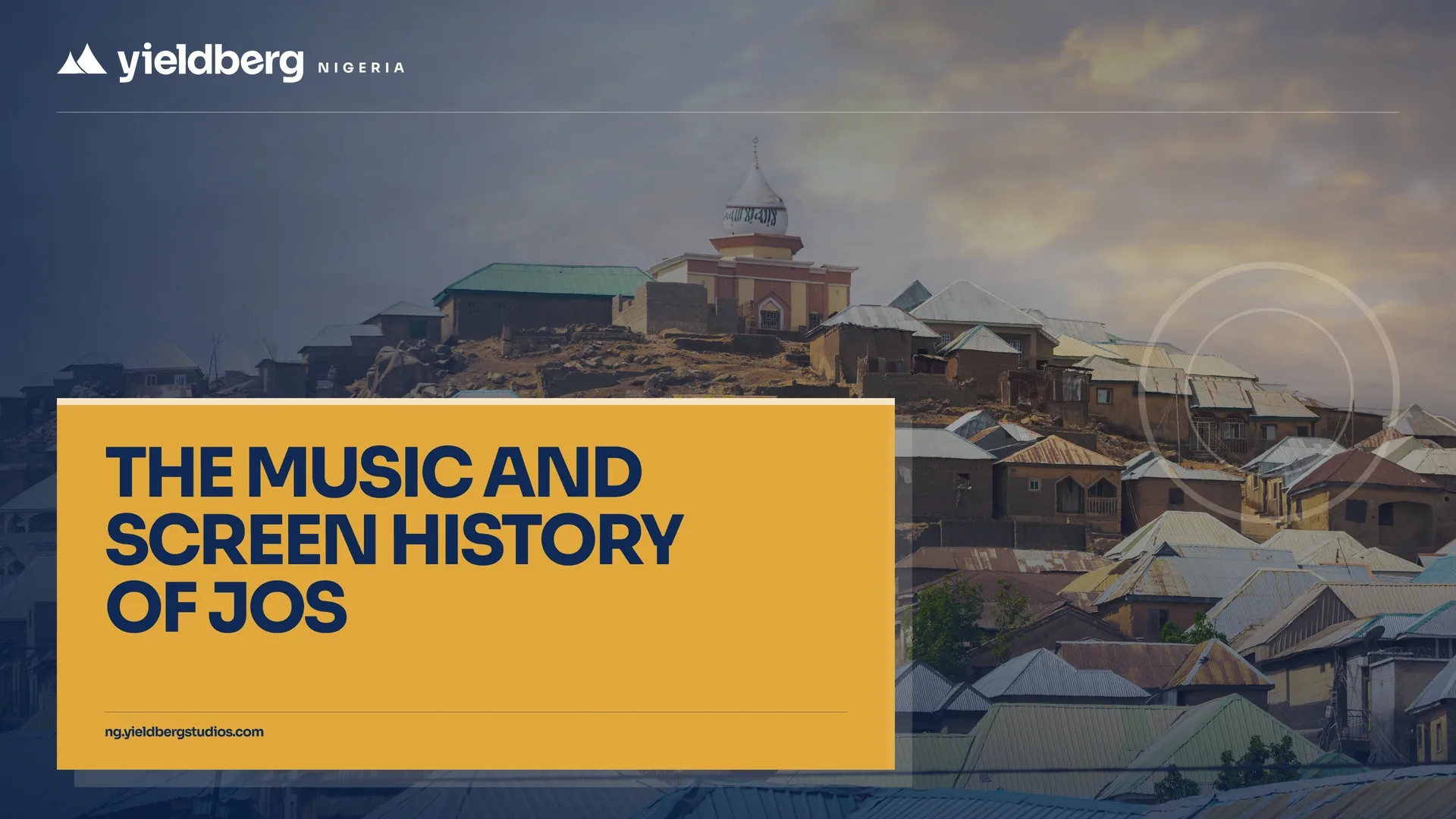
Jos became important to Nigerian music and screen culture through broadcast production, film and media training, university provision, documented church and peer networks, and routes into national industries. The surviving record shows places to learn, perform, make television and meet collaborators, but it does not document every part of the scene equally.
A list of famous people associated with Jos is not a scene history. It becomes one only when the record connects people to institutions, working spaces, teachers, programmes, audiences and routes to market.
Define the place before describing the scene
Jos city, Plateau State and the wider Jos Plateau region are not interchangeable. A musician from another Plateau community may have trained, performed or recorded in Jos without being a “Jos artist”. A television programme produced by a national broadcaster in Jos may have reached viewers far beyond the city. A performer born in Jos may have built a career elsewhere.
The distinction matters because Plateau contains many musical cultures. Roger Blench's paper on music of the Jos Plateau region explicitly covers peoples of the Jos Plateau and adjacent regions, discussing named communities, instruments, dance and cultural history. It is not a survey of Jos city or contemporary urban music, and it should not be used to claim that every tradition described belongs to the city or remains unchanged.
For each person, programme or institution, record four separate fields: birthplace, formative location, place of work and distribution territory. That small discipline prevents a city history from absorbing the whole state.
The Jos Scene Evidence Chain
The Jos Scene Evidence Chain is an original Yieldberg editorial method for testing claims about the city's creative history. It is not an established academic standard, an audience-measurement model or a replacement for archival and oral-history research.
| Link | Question | Useful evidence | What it prevents |
|---|---|---|---|
| Institution | Where could someone learn or make the work? | Prospectus, staff record, facility list, programme log | Treating talent as unexplained |
| Practice | Where did people rehearse, perform or apprentice repeatedly? | School club, church ensemble, venue diary, studio log | Mistaking one appearance for a scene |
| Peer network | Who worked, learned or competed together? | Credits, photographs, flyers, interviews, session notes | Turning a collective history into a celebrity list |
| Work | What was actually made? | Recording, broadcast, film, script, master or production file | Repeating reputation without an object |
| Circulation | How did the work reach a public? | Schedule, distributor record, label release, ticket, transmission log | Equating production with reach |
| Record | What survives, who holds it and what may be reused? | Catalogue, accession record, rights note, preservation copy | Confusing memory with accessible evidence |
The chain can be incomplete. A surviving broadcast without a full credit list is still evidence, but the missing names should be marked as a research gap. An artist interview can establish that person's memory of a scene, but not every participant's experience.
Television created a production environment
Jos's screen history is inseparable from public broadcasting. A 2016 retrospective based on interviews and reporting by The Guardian uses the broader phrase “Jos axis” when connecting the area to television dramas including Cock Crow at Dawn, Behind the Clouds and Moment of Truth. It reports participation by NTA staff and a few university students, and names actors associated with the productions. The article is valuable testimony, but programme logs, surviving episodes and production papers are still needed before exact dates, production locations or complete credits are treated as settled.
One documented training node remains visible. The NTA Television College says it was established in Jos in 1980, has offered an affiliated mass-communication degree since 2008 and received approval for two National Diploma programmes in 2025. This establishes an institutional route for television and media training. It does not show how many graduates stayed in Jos, obtained industry work or shaped particular programmes.
Integrated Television Services, presented on NTA's corporate site, lists Jos among cities where it has launched digital terrestrial television and says its transmission sites can provide local playout facilities (Integrated Television Services). That establishes the company's account of infrastructure, not automatic carriage or viewing.
Film infrastructure made Jos more than a location
The Nigerian Film Corporation identifies Jos as its headquarters and lists film-production development, production facilities and audiovisual preservation among its core functions. Its presence matters because a city scene depends on organisations that can hold equipment, convene practitioners and preserve records.
Jos also contains a linked training system. The University of Jos currently lists Music and Theatre and Film Arts among the departments in its Faculty of Arts. For the 2025/2026 academic session, the university advertised a 24-month master's programme in Film Culture and Archiving Studies with the National Film Institute through the Nigerian Film Corporation and German partner institutions. Its notice assigns theoretical teaching to the University of Jos and Goethe University, practical work to the NFI, and says the programme was expected to commence in March 2026 (University of Jos programme notice). The notice establishes an announced training route and preservation aim, not proof that teaching commenced as scheduled.
These pages establish provision, partnership and stated purpose, not course quality, employment outcomes or collection condition. Those questions require graduate records, archive inventories and interviews.
Music grew through repeated social practice
One detailed popular account of the modern music scene points to church learning, family and peer relationships, instruments and production rather than a single genre. A 2024 essay in The Republic connects Panam Percy Paul, Jeremiah Gyang, Ruby Gyang, M.I Abaga, Jesse Jagz and Ice Prince to overlapping Jos histories. It republishes a quotation attributed to Ruby Gyang about musically active church denominations and describes several artists combining performance, instruments and production.
That essay is an interpretive account, not a census of the city's musicians. It is strongest as a route into named people, songs and relationships that can be checked through recordings, credits and interviews. It should not reduce Jos music to gospel and hip-hop or treat artists who reached national visibility as the only participants.
Commercial organisation and migration are part of the scene too, but their origins must be evidenced. Chocolate City Music's current first-party history dates the label's founding to 2005 and names M.I Abaga, Jesse Jagz, Ice Prince, Jeremiah Gyang and Ruby Gyang among former roster members (Chocolate City Music). That page does not say where those relationships began, where company functions were based in each period or that a move occurred from Jos. Contracts, office records, release credits and interviews are still needed before turning an artist roster into a company geography.
Leaving a city is not evidence that its scene failed. It may show that recording, finance, media buying, distribution or management were located elsewhere. The analytical task is to trace what Jos supplied and what practitioners had to seek outside it.
An institutional map for commissioning new research
Use this map as a starting hypothesis, not a finished directory.
| Node | Historically relevant function | Evidence to request now | Responsible researcher |
|---|---|---|---|
| NTA Jos and Television College | Production, transmission and professional training | Programme logs, course records, staff lists, surviving masters | Broadcast historian |
| Nigerian Film Corporation and NFI | Sector development, facilities, training and preservation | Annual reports, equipment records, student productions, archive catalogue | Film researcher |
| University of Jos | Music, theatre, film and research training | Department histories, production programmes, alumni and staff records | Education researcher |
| Churches; schools as a research question | Church-linked learning appears in named accounts; the school role is not established here | Choir books, competition programmes, photographs, teacher interviews | Oral historian with local-language support |
| Studios, rehearsal rooms and venues | Recording, peer learning and audience formation | Session logs, rate cards, flyers, credits and venue calendars | Music researcher |
| Labels and management companies | Release, finance, marketing and career migration | Contracts where authorised, catalogues, release credits and staff interviews | Music-business researcher |
Do not ask one famous artist to stand in for the whole network. Interview visible performers, but also engineers, choir directors, camera operators, production managers, costume staff, teachers, venue operators, archivists and people whose work was uncredited.
A worked evidence ledger
Suppose an editor wants to claim that “Jos schools and churches trained the generation that reshaped Nigerian pop”. The claim is too broad. Convert it into a ledger.
| Proposed statement | Current evidence | Missing test | Publishable wording |
|---|---|---|---|
| Churches were important learning spaces | A quotation attributed to Ruby Gyang and republished in The Republic, plus its account of the Abaga brothers | Interviews across denominations; choir records; dates | “Several documented artist accounts identify church music as one formative route.” |
| Schools created performance networks | Not established by the sources used here | School programmes, teacher testimony and participant lists | Hold until at least two independent records agree |
| Jos reshaped Nigerian pop | Nationally visible careers linked to the city | Discographies, credits, audience evidence and comparison with other cities | “Jos supplied influential artists and peer networks to national music.” |
| Conflict ended the scene | Retrospective testimony about disruption and migration | Time-bounded venue, studio, broadcast and population records | Do not publish as a single-cause conclusion |
This ledger makes the article more accurate without draining it of meaning. It also shows readers where the next report should begin.
Rights, safety and missing records
Old broadcasts, photographs, flyers and recordings are not automatically free to reproduce. Identify the holder, copyright owner, performers, photographer and restrictions. Permission to inspect an item is not permission to publish it.
The Guardian reports recurring attacks in Plateau State, while The Republic includes individual recollections of the 2001 crisis and a visit to a local camp for displaced people. Neither account represents every community's experience. Do not use conflict as a dramatic shortcut or assume a creative decline had one cause. A participant may face personal or community risk when discussing past events. Agree attribution, recording, storage and withdrawal terms before an interview, and provide qualified Nigerian legal or safeguarding advice when the material is sensitive.
Absence online is not evidence that work never existed. Records may remain on tape, in private homes or in institutions without public catalogues. This article did not inspect programme logs, archive inventories, contracts or physical collections, and no new interviews were conducted.
A six-week route to a defensible city history
Week 1: Set boundaries. The commissioning editor defines Jos city, the wider Plateau links, the period and the two media tracks. Create separate claims for broadcast, film training, popular music and local musical traditions.
Week 2: Build the institution list. A researcher contacts the broadcaster, training institutions, archives, university departments, schools, churches, studios and venues. Record a named custodian and access status for each.
Week 3: Catalogue works. The screen researcher logs programmes, films and student productions. The music researcher logs recordings, performances, sessions and release credits. Mark every uncertain date and name.
Week 4: Conduct oral histories. Interview at least one visible practitioner and two less-visible workers from each track. Use the same event prompts, ask for documents and separate recollection from independently confirmed fact.
Week 5: Test circulation. Establish how selected works reached audiences: broadcast slot, cinema, festival, label, radio, physical media, platform or live venue. Rights and archive staff verify what may be shown.
Week 6: Decide. Publish only when every central claim has an institution, work and circulation record or is clearly labelled as testimony. If the chain breaks at two or more links, narrow the article to the documented period or commission further research. Do not fill gaps with a roll-call of celebrities.
Related reading
Frequently asked questions
Was Jos Nigeria's film capital?
Jos houses NTA broadcast training and the headquarters of a federal film agency, while The Guardian retrospective associates the “Jos axis” with television dramas carried by a national network. “Film capital” is an interpretive label, not a complete measure. Compare production volume, finance, employment, facilities, distribution and the period in question before using it.
Which genre defines the Jos music scene?
No single genre does. Published accounts connect the city to church music, gospel, pop, hip-hop and other practices, while Plateau's regional traditions extend far beyond those commercial categories.
Is every artist born in Jos part of this history?
Birth alone is insufficient. Record where the artist learned, worked, collaborated and reached an audience. The connection may be formative, professional, occasional or merely biographical.
What should be preserved first?
Prioritise vulnerable and uniquely held material: programme masters, session logs, photographs with names, production files, flyers, oral testimony and rights information. Preservation without identification and permissions leaves future researchers with another incomplete record.
Sources
- Roger Blench, “The Traditional Music of the Jos Plateau in Central Nigeria: An Overview”
- The Guardian, “Remembering and reinventing the good old Jos”
- NTA Television College, Jos
- NTA Integrated Television Services
- Nigerian Film Corporation: About NFC
- University of Jos Faculty of Arts
- University of Jos, Film Culture and Archiving Studies programme notice
- The Republic, “The Songs of Jos”
- Chocolate City Music: About Us
Next decision: Define the location, language public and distribution evidence for the next Jos report with There Is No Single Nigerian Audience.

 By Omodot Jackson

 By Isong Godswill