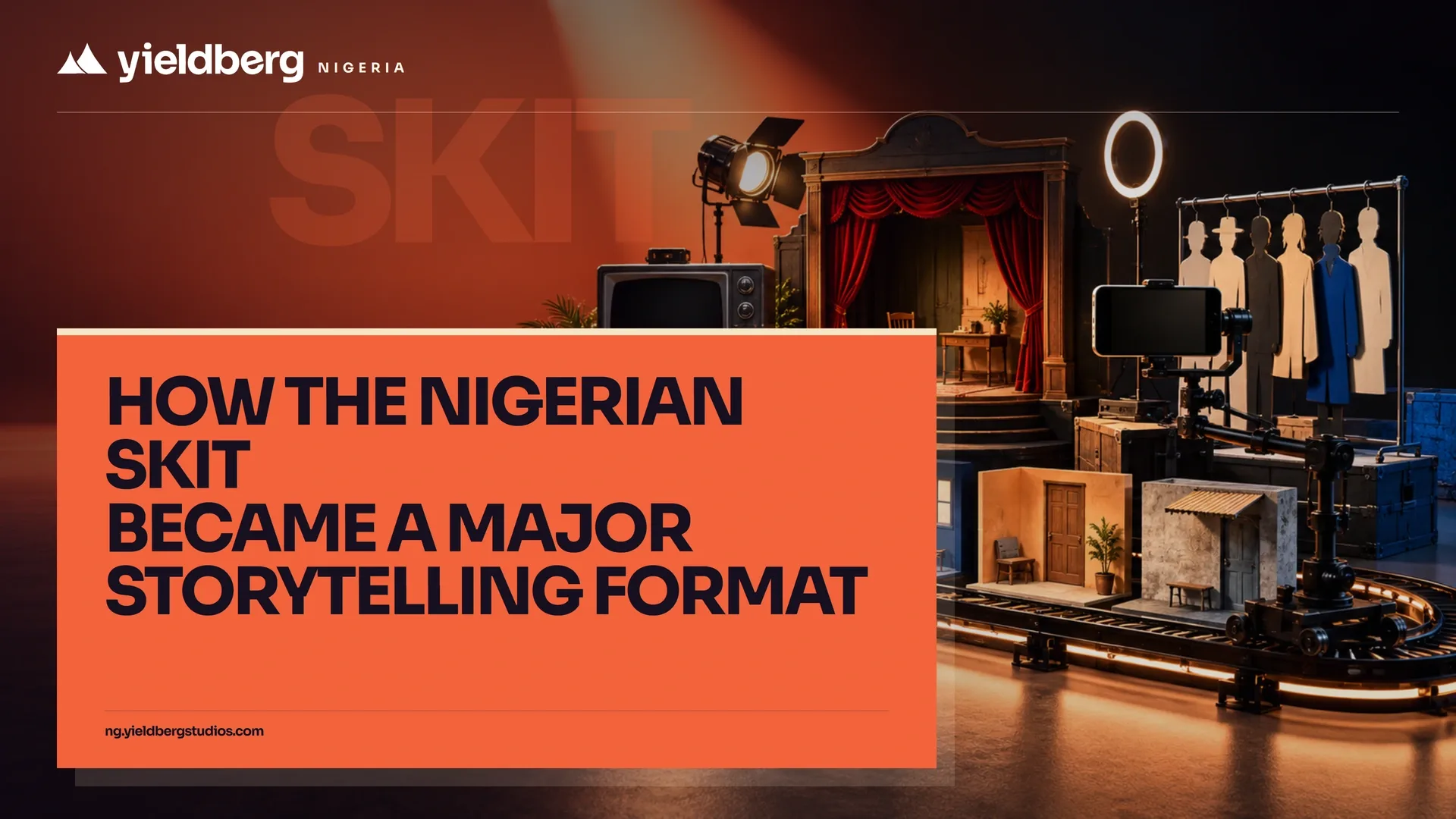
The Nigerian skit became a major storytelling format when creators did more than shorten comedy for a phone. They combined familiar performance traditions with recurring characters, compressed plots, direct audience feedback, regular publishing and several routes to revenue. The condition that changes this answer is evidence: a viral clip is not yet a format, and a popular character is not yet a durable creative business.
The history is therefore not a clean march from television to Instagram or from one supposed inventor to everybody else. Broadcast sitcoms, travelling theatre, stand-up, home video, parody, radio humour and everyday performance supplied different techniques. Digital creators reorganised those techniques around personal accounts, mobile screens and audiences that could watch, reply, imitate and circulate a scene without waiting for a broadcaster.
The Skit Format Chain
This article uses the Skit Format Chain, an editorial method developed for this history. It is not an established industry standard. The method tests five connected parts:
- Inheritance: which earlier performance or media practices can be documented?
- Compression: how does a complete dramatic event fit the viewing situation?
- Character memory: what does the audience already know when a familiar figure appears?
- Circulation: how do platform, language and audience participation change the work?
- Enterprise: which people, rights, records and revenue arrangements make continued production possible?
A credible history should trace all five. Starting only with follower counts erases the craft before the account, while starting only with old television treats digital distribution as a neutral delivery pipe.
The skit did not begin with the smartphone
Nigeria had compact comic performance long before social video. Television comedy established recurring characters and regular audience memory. The repository record for Timothy Asobele's 2003 book connects WNTV's 1959 start to Yorùbá teleplays and performers including Baba Sala, Duro Ladipo and Kola Ogunmola (University of Lagos repository). Its abstract supports a television and performance lineage, not a claim that these works were social-media skits or direct ancestors of every digital creator.
Stage and stand-up created another route. A 2012 journal essay on Ali Baba traces antecedents through theatre, disc jockeys and masters of ceremonies while examining professionalisation on the modern Nigerian stage (Ibadan Journal of Theatre Arts). In a 2018 interview, Opa Williams recalled that the first Nite of a Thousand Laughs took place at the National Theatre in October 1995 and described his attempt to gather comedians before paying audiences (Vanguard interview). That date and account come from the producer's recollection, not an independent event archive.
The useful claim is not that every digital creator descends from one television programme or stage producer. It is that the skit entered an environment where archetypes, satire, call-and-response, physical comedy, impersonation, code-switching and episodic characters were already legible. A creator could activate that memory without copying an earlier work.
Online video changed who could publish and how a joke travelled
Early YouTube culture showed that Nigerian identity could be remixed for audiences across borders. Olatoye and Teju Komolafe, the Nigerian-born, United States-based Naija Boyz, used music-video parody in their 2007 Crank Dat Naija Boy. An academic study treats the work as part of a diasporic digital creative economy, not as proof of a Nigeria-based skit industry (African and Black Diaspora). That distinction matters. Diaspora production and production inside Nigeria can share references while operating under different costs, audiences and infrastructures.
The next change was sustained, serial production from a recognisable creator account. Mark Angel Comedy's current About page retrospectively describes short, everyday sketches, familiar relationships and recognisable characters (official Mark Angel Comedy site). This is the brand's self-description, not an independent origin history. The useful point is the combination of an identifiable channel, repeated release and episodes that could circulate individually while strengthening a larger series, not a disputed claim about who was “first”.
Platform distribution also altered the audience's role. A 2021 conceptual study argues that social skits let viewers watch outside broadcast schedules, share clips, respond to creators and participate in the circulation of comedy (SAGE Open). It reviews literature and discusses Nigerian and other African creators rather than surveying a national audience, so it cannot tell us how every Nigerian watched. It does identify a structural difference: feedback and forwarding became part of the format's operating environment.
Compression became a craft, not merely a time limit
A skit has to establish a situation quickly, but brevity alone does not create a story. Tekena Gasper Mark's 2024 qualitative study examined eight skits from Taaooma, Mark Angel, Sabinus and Bello Galadanchi. In that bounded sample, running times ranged from 51 seconds to four minutes, while simple dialogue, clothing, facial expression, slapstick, sound effects, multiple-role performance, Nigerian languages and subtitles carried narrative information (Comedy Studies). Those findings describe eight selected works, not every Nigerian skit.
The sample nevertheless reveals why recurring characters matter. A familiar costume, gait, phrase or relationship can perform exposition that a new film would need to explain. Viewers know the boastful investor will overreach, the strict parent will misread a situation, or the entitled powerful man will expose himself. The creator can begin nearer the conflict because previous episodes live in audience memory.
That is serial storytelling in miniature. Mr Macaroni has described skit work as theatre adapted to another form, with society providing material for his characters (Guardian interview). Sabinus has described working from a storyline rather than a fully written script, relying on a crew able to respond spontaneously (Punch interview). These are two practitioners' accounts, not universal rules. Together they show that skit production can range from tightly scripted to structured improvisation.
The format grew because it could become a repeatable operation
Regular skit production requires more than a performer and a phone. Someone develops the premise, secures locations, casts supporting roles, records clean-enough image and sound, edits several platform versions, clears music, publishes, moderates responses, sells partnerships and preserves project files. As the operation grows, the public-facing creator may sit inside a small production company even when the audience experiences one personality.
Platforms can provide distribution and revenue tools, but neither reach nor income is automatic. YouTube requires eligibility, policy compliance, review, an AdSense for YouTube account and acceptance of relevant terms before a channel can share in platform revenue (YouTube Help). Meta says its 2023 Creator Lab Live in Lagos brought more than 40 emerging creators together for workshops on Instagram tools and monetisation strategies, with Taaooma and Mark Angel Comedy among the named attendees (Meta). Neither source establishes a typical Nigerian creator income.
A resilient skit operation should therefore separate four things: platform revenue actually received, commissioned production fees, payment for publishing to the creator's audience, and licences for a brand to reuse or amplify the work. Views are evidence of recorded plays under a platform's method. They are not cash received, unique people reached or proof that a sponsor changed behaviour.
Popularity does not excuse weak representation
The compressed form can expose a social contradiction quickly, but it can also repeat a stereotype quickly. A 2024 mixed-methods study ultimately analysed 48 completely coded YouTube videos from six creators, plus four available videos for qualitative visual analysis, and reported elements of sexual objectification (Sexuality & Culture). Its purposive, incomplete sample supports scrutiny of those works, not a claim that every skit or creator behaves identically.
Commissioners should review who gets to speak, who absorbs humiliation, whether disability, class, ethnicity, gender or language is doing lazy comic work, and whether a participant understood the final use. Cultural relevance must shape development, not arrive after a harmful character has already become the campaign's joke.
A production card for a repeatable skit
Use this card before approving a pilot. It turns the Skit Format Chain into a production record.
| Decision | What to record | Responsible person | Evidence before release | Stop condition |
|---|---|---|---|---|
| Dramatic promise | The recurring conflict and what changes each episode | Creator and writer | One-sentence format statement plus three distinct premises | Every premise is the same joke with a new product |
| Character memory | Name, behaviour, limits, costume and relationships | Creator, writer and performer | Character sheet and continuity stills | Humour depends on an unreviewed stereotype |
| Episode engine | Opening image, escalation, turn and ending | Writer and director | Beat sheet, even when dialogue is improvised | The sponsor appears before the scene has a reason to exist |
| Audience and language | Intended viewers, language, register, subtitles and review | Producer and language reviewer | Approved script or transcript and subtitle pass | A national claim rests on one community's response |
| Production | Cast, location, equipment, sound, releases and safety | Producer | Call sheet, releases, location permission and risk check | A participant or location has no usable permission |
| Distribution | Master, aspect ratios, captions, thumbnail, schedule and archive | Editor and channel manager | Version register and preserved clean master | Only a compressed platform download survives |
| Commercial terms | Creation, publishing, usage, exclusivity, amplification and revisions | Producer, creator representative and brand | Signed scope and approval route | Reuse rights or account access remain undefined |
| Measurement | Objective, metric, denominator, period and data owner | Campaign analyst | Pre-release measurement note | “Engagement” has no formula or decision attached |
When a brand is involved, do not disguise the commercial work as casual collaboration. ARCON's 2022 public notice addresses advertisements by skit makers, comedians, influencers and other digital publishers and states its position that advertising and marketing communications require pre-exposure approval (ARCON notice). The court record is not uniform: a Federal High Court decision reported in April 2025 upheld ARCON's authority over social-media advertising (Punch), while a separate June 2026 judgment voided ARCON's N60 billion fine against Facebook Nigeria after finding that the notice exceeded its statutory powers (TheCable). The cases involved different parties and issues. Obtain current Nigerian legal advice for the proposed execution rather than treating this article as a clearance.
The contract should also identify the script, characters, performance, footage, edit, music, account publication, paid amplification, territory and term. The Copyright Act 2022 grants exclusive rights in audiovisual works, requires assignments and exclusive licences to be in writing, and separately addresses performers' rights. It does not convert a vague brand message into a complete rights agreement. Public visibility is not permission for unlimited reuse.
Build and test the format in three weeks
Days 1 to 4: document the inheritance and audience. Watch comparable work, identify what belongs to a wider tradition, and separate inspiration from material that needs permission. Define the audience by situation, language and viewing context.
Days 5 to 9: develop the format statement, character sheet and five premises. Reject the format if fewer than three premises create genuinely different conflicts. Write one full beat sheet and decide where improvisation is allowed.
Days 10 to 14: produce one pilot and a clean master. Make required vertical, square or horizontal versions from that master rather than treating a platform download as the archive. Prepare captions and subtitles from a transcript.
Days 15 to 21: release to a defined test group or one owned channel. Record completion rate using the platform's stated denominator, substantive comment themes, shares or saves where relevant, and any confusion about character, product or language. Do not add unlike platform figures and call the result unique viewers.
At day 21, choose one of three decisions: commission a short run because the dramatic engine and production chain both worked; revise because the idea worked but comprehension or execution failed; or stop because recognition depended on one joke rather than a repeatable world. Evaluate the creator relationship beyond follower count before turning a successful pilot into a partnership.
Related reading
Frequently asked questions
Is a Nigerian skit the same as a sitcom?
No. Both can use recurring characters and episodic situations, but a sitcom normally has a longer programme structure and production package. A skit may be self-contained in under a few minutes and designed for circulation through creator accounts. Some skit worlds later expand into longer episodes, film, stage or television.
Does a skit have to be comedy?
Everyday Nigerian usage strongly associates “skit” with comedy, but the underlying short dramatic form can carry education, advertising, satire or public information. Name the purpose honestly. A commercial sketch remains advertising when its function and relationship make it advertising.
How long should a skit be?
There is no nationally correct duration. Use the shortest length that preserves the dramatic turn and lets the intended audience understand the scene. Platform limits, caption needs, language and paid-placement specifications can change the version plan.
Does a viral episode prove the format can last?
No. Test whether the character can generate several distinct conflicts, whether the team can produce consistently, whether rights are clear and whether viewers return for more than the original punchline.
Sources
- University of Lagos repository: Nigerian Top TV Comedians and Soap Opera
- Ibadan Journal of Theatre Arts: Nigerian stand-up comedy history and Ali Baba
- Vanguard: Opa Williams on the history of Nite of a Thousand Laughs
- Journal of African Cultural Studies: Naija Boyz and digital parody
- Mark Angel Comedy: official history and format description
- SAGE Open: Social Media Skits: Reshaping the Entertainment Experience of Broadcast Audience
- Comedy Studies: Social Media and the Form and Content of Nigerian Comic Skits
- The Guardian: Mr Macaroni on skits as adapted theatre
- Punch: Sabinus on storylines, improvisation and recurring language
- YouTube Help: Partner Programme overview and eligibility
- Meta: Creator Lab Live in Nigeria
- Sexuality & Culture: sexual objectification in selected Nigerian comedy skits
- ARCON: notice on advertisements by bloggers, skit makers and influencers
- Punch: Federal High Court decision on ARCON and social-media advertising
- TheCable: Federal High Court decision voiding ARCON's fine against Facebook Nigeria
- Nigerian Copyright Commission: Copyright Act 2022
Next decision: Use Build the Show, Not Just the Spot to test whether the skit has an owned format, a repeatable production system and a reason for its audience to return.

 By Isong Godswill
 By Omodot Jackson