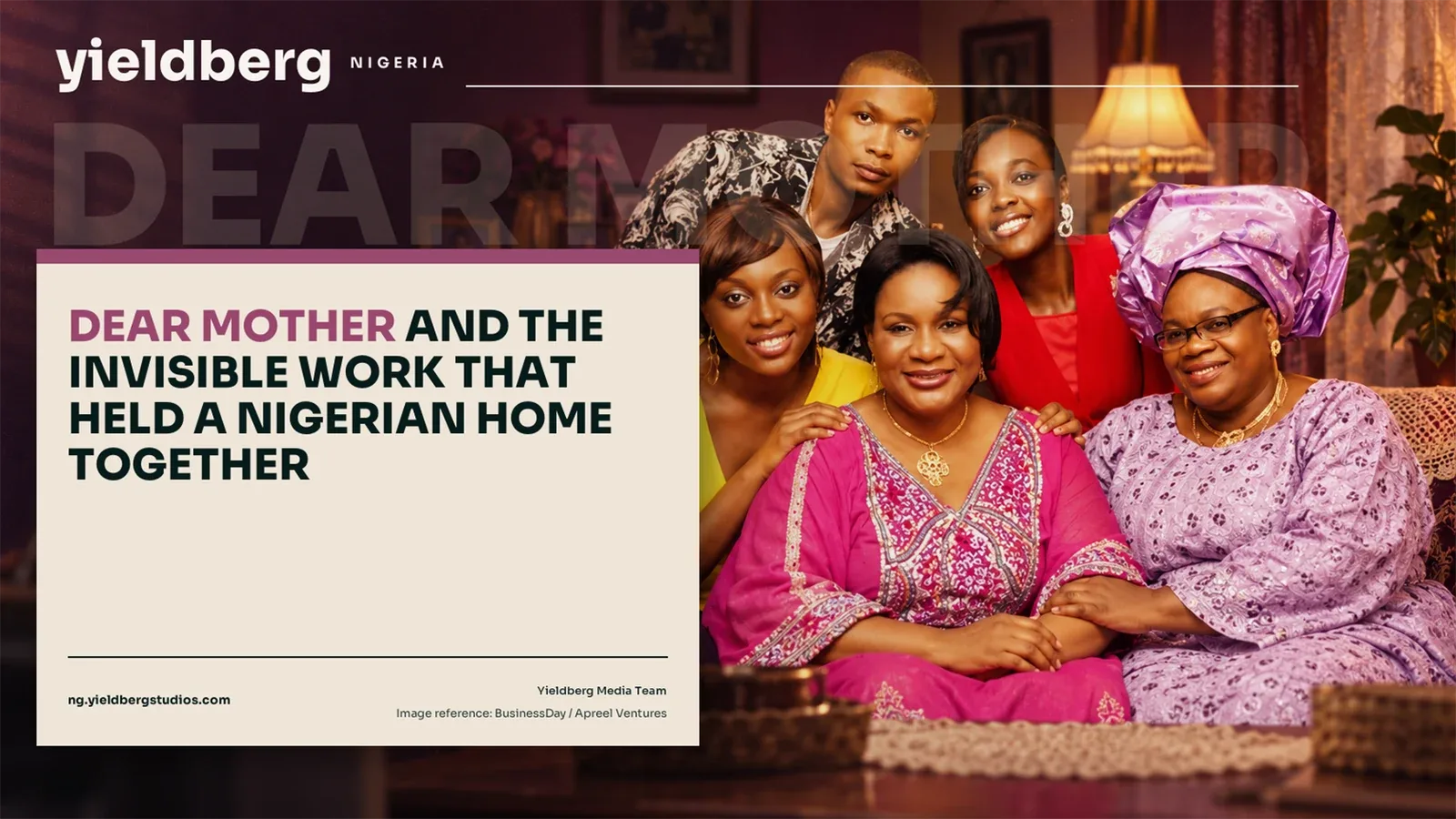
The great suspense in Dear Mother was often not whether the world would end. It was whether one woman could keep the day from coming apart.
There were children at different stages of becoming themselves, work that would not wait, bills and social pressures that did not care about grief, and a home expected to remain a home through all of it. Teju Phillips, a widowed mother of three, stood at the centre. Around her were Ada, Ifeanyi and Susan, each capable of turning an ordinary day into a negotiation, and Mama, Teju's mother, whose presence widened the household across generations.
That arrangement gave Nigerian television something quieter than spectacle and more enduring than a weekly crisis. It made care visible. Dear Mother treated the routines by which a family survives as proper dramatic material: correction, compromise, sacrifice, humour, exhaustion and the decision to try again tomorrow.
The nostalgia attached to the series is therefore unusually tender. It is not only nostalgia for an old picture format or a familiar cast. It is nostalgia for television that understood how much action can fit inside a mother's pause before she answers.
A home with four directions of pressure
An industry profile of producer Ariyike Oladipo describes Dear Mother as a 30-minute English-language drama of 101 episodes, produced in 2002 through Apreel Ventures. Its premise is stated plainly: Teju is a widow raising three children while navigating the social and economic pressures of modern Nigeria, with her mother serving as an important source of support (Electronic Media Content Owners Association profile of Ariyike Oladipo).
That premise is a compact piece of series design. Three children do not simply mean three additional characters. They give the household multiple clocks. One child may be pushing towards adulthood while another still needs protection. Rules that work for one age feel unfair to another. Teju must respond to the individual and preserve the unit.
Ifeanyi's position as the only son also created a particular comic and emotional tension. A retrospective on the cast describes him trying to balance teenage life with the imagined responsibility of being the household's only male, an effort that regularly produced humour (cast retrospective on Dear Mother). The detail matters because the series could question gender expectation without leaving the family-story form. A boy performing authority before he had earned experience was funny, but it also revealed what society had already told him about manhood.
The daughters expanded that negotiation. Ada, the eldest, and Susan, the youngest, met their mother's rules from different distances. The result was not a generic portrait of "the children" but a household in motion, where maturity was uneven and each new stage required Teju to revise the job while doing it.
Motherhood without a halo
Television mothers are often trapped between two weak extremes. They are saints whose sacrifices produce no anger, or obstacles waiting for younger characters to escape. Dear Mother offered a more useful centre. Teju's love did not remove pressure. Love was the reason the pressure mattered.
Widowhood sharpened the structure. Her labour could not be treated as supplementary. Earning, deciding, disciplining and emotionally repairing the family converged in one person. The programme thereby placed a form of work often taken for granted at the front of the frame.
This is one reason the title remains powerful. "Dear Mother" sounds like the beginning of a letter, the kind written when distance allows gratitude that daily proximity hides. It asks the audience to look again at the person who appears to be simply there. Who remembered the deadline? Who absorbed the child's panic? Who converted limited money into the impression of stability? Who made discipline feel survivable because affection remained underneath it?
The show did not need to convert those questions into a speech. Repetition did the work. Week after week, the family returned with another test, and week after week the invisible systems of care became visible because something strained them.
Mama and the wealth of another generation
The household was not built around Teju alone. Mama's support prevented the single-mother story from becoming a fantasy of solitary heroism. Veteran actress Lanre Hassan, widely known as Iya Awero, played the grandmother, according to the surviving cast retrospective, while Moyinoluwa Olutayo played Teju (roles documented in the Dear Mother cast retrospective).
That grandmother role acknowledged an economic truth familiar in many Nigerian homes: support is not always cash, and the person without a salary may still be holding up the whole enterprise. Childcare, counsel, mediation and memory are forms of household capital. Mama could bring comic relief, but her structural function was serious. She gave Teju somewhere to lean without removing Teju's authority.
The intergenerational arrangement also created a richer field of values. A grandmother's idea of obedience could meet a modern child's insistence. Teju stood between them, translating both ways. That is a distinctly productive place for drama because no generation owns the entire truth. Tradition carries wisdom and pressure. Modernity offers freedom and confusion. The mother becomes the negotiator of time itself.
Watching that negotiation in the era of scheduled television produced another layer of meaning. Several generations could be present in the actual room. The joke about an elder's habit might land beside an elder. A young viewer might recognise a child's frustration while a parent registered Teju's fatigue. The programme's family audience was not an abstract demographic. It was often physically assembled around one screen.
A woman's production vision behind a woman's story
There is a valuable industrial story behind the domestic one. Ariyike Oladipo's professional profile identifies her as the producer of Dear Mother and the founder of Apreel Ventures, a content company established in the early 2000s. It also places her across sitcoms, soaps, talk shows and commissioned productions (EMCOAN profile and programme catalogue). The Nigerian International Film Summit describes her as a pioneering female television producer whose career spans radio, television and film (NIFS profile of Ariyike Oladipo).
That authorship matters. Dear Mother did not merely put a woman in the centre of the picture. Its premise recognised the management intelligence of everyday motherhood: triage, persuasion, scheduling, budgeting and long-term human development. These are executive functions performed without an executive title.
For contemporary media businesses, the lesson is not that every series needs an exemplary mother. It is that neglected labour can be a source of fresh narrative value. The activities culture treats as background may contain the richest recurring conflicts. Care work, informal support, household budgeting and intergenerational negotiation all generate stakes before a writer adds any contrivance.
There is a brand lesson too. Family-oriented entertainment becomes weak when "family friendly" is interpreted as empty of difficulty. Dear Mother suggests a better definition: difficulty handled with emotional responsibility. A sponsor can safely enter a serious story if the programme's worldview is humane, the characters have dignity and the conflict does not exploit vulnerability for cheap shock.
The cast grew, and the old home travelled with them
Revisiting a long-running family programme also reveals how its young cast became attached to the country's wider screen culture. Documented principal roles include Matilda Nwankwo Williams as Ada, David Nnaji as Ifeanyi and Sharon Ezeamaka as Susan (the cast retrospective and career update).
Yet the deeper nostalgia is not celebrity spotting. It is watching children grow within a format built around growth. Actors change, voices settle, and faces become more self-aware. A family series records time even while filling next week's half hour.
That accumulation is harder to reproduce in a streaming culture that often commissions short seasons and waits long intervals between them. One hundred short episodes can create intimacy through recurrence. The audience does not only learn a character's major trauma. It learns the emotional weather of the house.
What Dear Mother leaves for today's Nigeria
Nigeria's care economy remains enormous and under-described. Grandparents help raise children. Older siblings become deputy parents. Widows build stability while managing grief and public expectation. Women coordinate homes while maintaining paid work. These realities are discussed as duty so often that their drama, skill and cost can disappear.
Dear Mother placed that work where it could not disappear: in the title, at the centre of the cast and at the start of every fresh problem. Its softness was not a lack of ambition. It was a decision that an ordinary household deserved sustained attention.
To miss the programme is to miss a style of Nigerian television in which recognition arrived gradually. There was no need for a shocking opening every few minutes. The hook was relational. Viewers returned because they understood who would be hurt by a careless word and who would pretend not to be worried. They knew that Mama's presence could change a conversation and that Teju's patience had a limit even when her love did not.
The old set may be gone. The children are no longer children. The broadcast schedule that gathered the household may have dissolved into separate devices. But the series' central insight survives every change in distribution: a family is held together by work, and much of that work is performed before anybody thinks to say thank you.
A note on the surviving record
The producer's industry profile provides useful programme basics, including format, episode count, language, premise and character names. Independent archives remain thin, and some nostalgia lists publish conflicting dates. This article uses the producer-linked 2002 production reference but does not claim an exact premiere day, full broadcast run, audience size or complete episode chronology.
Sources
- EMCOAN: Ariyike Oladipo profile and Dear Mother programme details
- Nigerian International Film Summit: Ariyike Oladipo producer profile
- OMG Voice archive: principal Dear Mother cast and roles
- BusinessDay: retrospective on Nigerian television soaps
Next decision: Read Cultural Relevance Is a Creative Operating System, Not a Final Check.
Related reading

 By Isong Godswill

 By Omodot Jackson