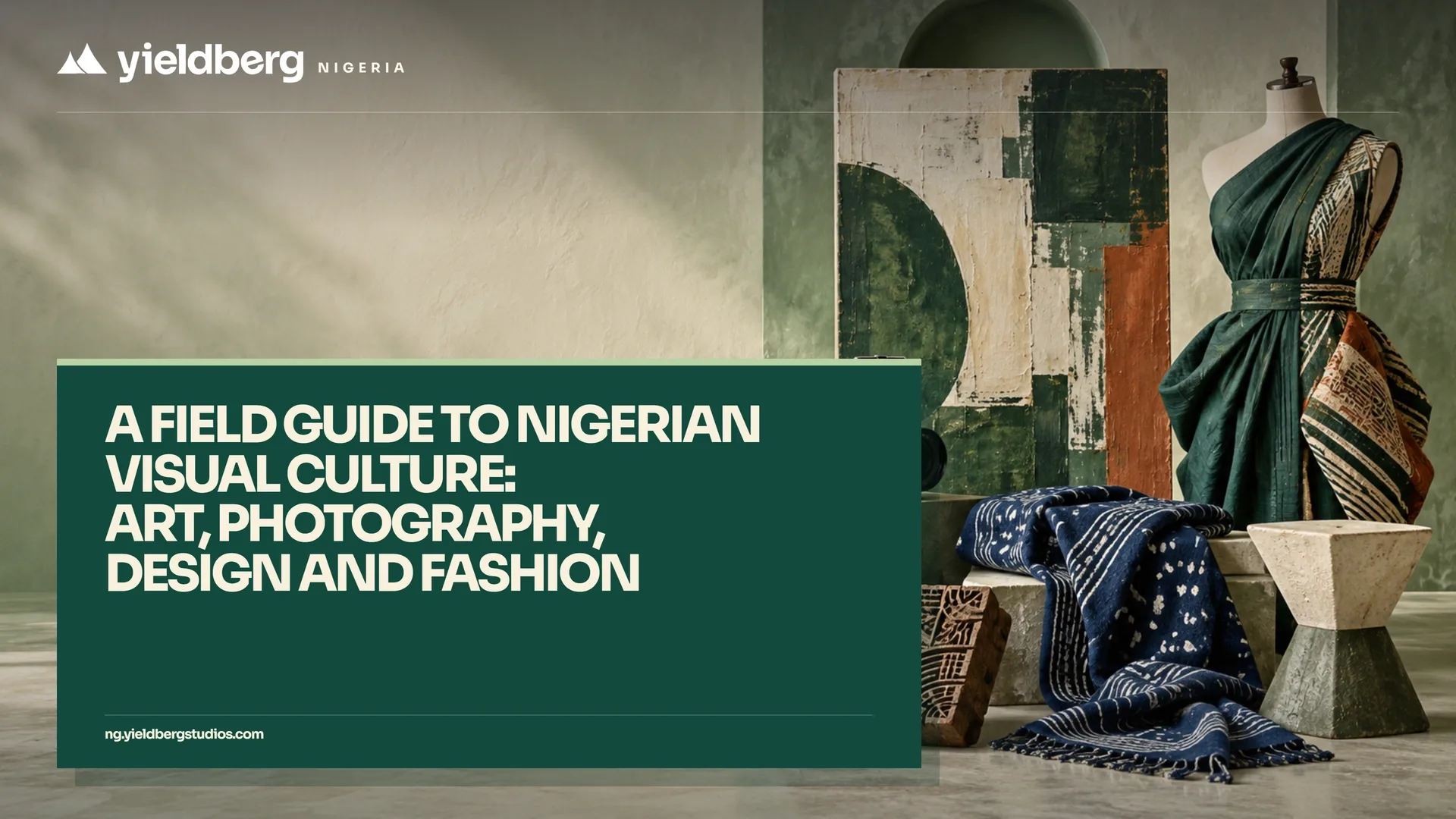
Do not search for one national look in Nigerian visual culture. Treat art, photography, design and fashion as distinct but connected production systems, then trace each work through place, lineage, labour, circulation and rights. If you are acquiring art, provenance and title may deserve the most attention; if you are commissioning a campaign, the production chain, consent and permitted uses become decisive.
This matters because a runway collection, a studio portrait, a gallery installation and a campaign identity may share references without sharing the same economics, gatekeepers or legal arrangements. Calling all four “African creativity” hides the decisions that made them possible.
Use the Five-Layer Visual Culture Map
The Five-Layer Visual Culture Map is an editorial method for analysing or commissioning visual work. It is not an established industry standard. Apply the five layers in order:
- Form: What is the work, materially and functionally?
- Lineage and place: Which practices, schools, communities or locations inform it?
- Labour: Who conceived, made, finished, documented and presented it?
- Circulation: Through which institutions, markets, media and audiences does it travel?
- Rights and responsibility: Who owns the physical object, the copyright, the image permissions and the authority to explain its context?
The method prevents a common error: reading surface resemblance as proof of origin. A resist-dyed textile, for example, should not be labelled by colour alone. Àdìrẹ refers to particular resist-dye practices associated with Yoruba makers, and the Victoria and Albert Museum notes both its changing techniques and its historical production by women in south-western Nigeria. The museum's collection also shows how imported cotton and changing demand affected the form over time (V&A history of àdìrẹ). Visual culture is inherited, but it is also adaptive.
Four fields, four production logics
The fields meet often, but they should not be collapsed.
| Field | Typical unit of work | Production questions | Circulation questions | Rights questions |
|---|---|---|---|---|
| Art | An object, edition, installation or performance | Is it unique, editioned, commissioned or collaboratively made? | Studio, gallery, museum, fair, public site or digital platform? | Who owns the object, copyright, documentation and reproduction licence? |
| Photography | A negative, file, print, assignment or archive | Who directed, photographed, styled, retouched and captioned it? | Newsroom, studio, archive, exhibition, publication or social feed? | Are subject consent, archive access and editorial or commercial uses clear? |
| Design | An identity, publication, interface, product, space or system | What problem and user situation shaped the work? | Client delivery, manufacture, public use or portfolio display? | Who owns source files, type licences, adaptations and design IP? |
| Fashion | A textile, garment, accessory, collection or styling language | Who supplied material, developed patterns, cut, sewed, finished and styled it? | Bespoke sale, retail, runway, editorial, costume or export? | Are textile authorship, labels, lookbook images and reuse permissions documented? |
Buying a painting does not automatically transfer the right to print it on packaging. Hiring a photographer does not settle ownership, exclusivity or future advertising use. A fashion image may involve separate permissions from the designer, photographer, model and location.
Nigeria's Copyright Act protects eligible artistic works without requiring a formality, while the Commission's registration system can provide statutory presumptions. The Act also treats work intended for use as an industrial design differently, so commercial teams should obtain qualified Nigerian advice when a design will be mass-produced (Copyright Act 2022; Nigerian Copyright Commission registration guidance). Registration, licensing and ownership are related questions, not interchangeable answers.
History is a network, not a straight line
Nigeria's visual histories did not begin with a gallery opening or political independence. Court arts, architecture, body decoration, weaving, dyeing, pottery, carving and ceremonial image-making long predate modern art institutions. Academic schools, workshops and commercial studios later created additional routes through which makers exchanged techniques and entered new markets.
One influential modernist route formed around the Zaria Art Society in 1958. Its members debated how locally grounded references could coexist with academic techniques. Uche Okeke's idea of “natural synthesis” became central to that conversation, but it was never the only Nigerian modernism. MoMA's account connects Okeke's work to Igbo uli line-making and to the political setting around independence (MoMA on Uche Okeke).
At the University of Nigeria, Nsukka, artists including Okeke and later generations worked with uli, nsibidi and other intellectual and material sources. The Smithsonian describes the school as an intergenerational formation rather than a single style, naming practitioners whose work travelled in different directions (Smithsonian on the Nsukka school).
Osogbo presents another history. Community workshops and the New Sacred Art movement intersected with local religious life, printmaking and international exchange. The Osun-Osogbo Sacred Grove is not merely an outdoor sculpture park: it remains an active religious site with shrines, art works, designated worship points and conservation obligations (UNESCO World Heritage record). Any account of its visual importance must therefore respect living worship as well as art history.
Ceramics shows why a field guide must look beyond famous paintings. Ladi Kwali's practice joined Gwari pottery knowledge with methods encountered at the Abuja Pottery Training Centre. A MoMA research essay also warns that older histories often centred the British potter Michael Cardew while leaving Kwali and other female potters under-documented (MoMA research on Ladi Kwali). The lesson is to ask whose labour, teaching and authorship the archive has made visible.
Photography has similarly deep roots outside contemporary editorial culture. Chief S. O. Alonge established the Ideal Photography Studio in Benin City in 1942 and served as photographer to the royal court. The Smithsonian archive contains negatives, prints and albums spanning 1926 to 1989, recording court life and commercial portraiture (Chief S. O. Alonge collection). J. D. 'Okhai Ojeikere's celebrated hairstyle series sits within a wider practice that also covered architecture and portraiture (Smithsonian bibliography and archive guide). These bodies of work show photographs functioning as authored images, social records and material archives at once.
Place changes the question
Lagos concentrates galleries, fairs, agencies, editorial production and fashion events, but it cannot stand in for the country. A better research plan treats cities and regions as production contexts:
- Benin City prompts questions about court patronage, bronze casting, studio portraiture and restitution.
- Nsukka and Enugu direct attention to university teaching, uli-informed practice, publishing and post-war cultural memory.
- Osogbo, Abeokuta and Ibadan reveal different relationships among sacred art, workshop movements, àdìrẹ production and modern urban markets.
- Zaria, Kaduna, Kano and Abuja open separate enquiries into academic art, graphic and textile production, indigo dyeing, architecture, public institutions and ceramics.
- Niger Delta cities and communities require attention to photography, performance, environmental politics, masquerade traditions and contemporary installation without treating the region as one culture.
These are research routes, not claims that every maker in a place belongs to one school. The National Gallery of Art reports 25 outstations across Nigeria and a collection covering painting, sculpture, photography, textiles and mixed media (NGA mandate and locations). It is a starting point, not a complete record of local practice.
Before describing a work as culturally representative, follow the guidance in Cultural Relevance Is a Creative Operating System, Not a Final Check. Identify the particular community, reviewer and decision affected. The label “Nigerian” can be accurate at national level while still being too broad to explain form or meaning.
Institutions decide what becomes visible
Visual authority is produced by more than makers. Schools train, archives preserve, curators frame, galleries sell, festivals build publics, clients fund, and fabricators determine what can be realised.
Several institutions illustrate different functions. The Centre for Contemporary Art, Lagos, founded by Bisi Silva in 2007, built exhibitions, education and discussion around contemporary practice, and its digital archive now preserves parts of that institutional history (CCA Lagos; CCA Lagos and Bisi Silva Archive). LagosPhoto, launched in 2010, uses exhibitions, workshops and public presentations to develop audiences for historical and contemporary photography (LagosPhoto overview). ART X Lagos, founded in 2016, combines a commercial fair with talks, prizes, film and music programmes (ART X Lagos history). Each solves a different problem.
Fashion has its own infrastructure. Lagos Fashion Week says it began in 2011 and now works year-round with designers, manufacturers, buyers, media and policymakers (Lagos Fashion Week). UNESCO's continental report identifies finance, training, infrastructure, intellectual-property protection and access to materials and markets as recurring constraints across African fashion, while warning that national contexts differ (UNESCO African Fashion Sector report). A runway invitation, therefore, does not prove that a label has production capacity, dependable payment terms or profitable distribution.
Visibility can distort the record. A fair's exhibitor list reflects selection and commercial conditions. A museum collection reflects acquisition history. A platform rewards particular formats. Treat each as evidence of circulation, not a census of quality.
Make the labour chain visible
Ask for a credit map before publication or launch. Depending on the work, it may include artists' assistants, dyers, weavers, embroiderers, pattern cutters, tailors, printers, framers, photographers, digital technicians, models, stylists, set builders, retouchers, writers, curators, installers, handlers and archivists.
The map prevents collaborative work being attributed only to its most visible person and clarifies who must approve or be paid for adaptations.
For every commission, record:
- each contributor's name and role;
- the material or file each person supplies;
- the agreed fee, expenses and payment date;
- the number of review rounds;
- approved media, territory and duration;
- whether cropping, recolouring, animation or other adaptation is permitted;
- the final credit line and archive location.
Where local language, sacred imagery or community knowledge affects meaning, appoint a reviewer with a defined relationship to that context. One person's approval should not be represented as the consent of an entire ethnic or religious community.
A practical field card for commissioning or criticism
Use this field card before acquiring, publishing or commissioning visual work.
| Layer | Evidence to request | Warning sign | Decision |
|---|---|---|---|
| Form | Object description, materials, dimensions, edition or deliverables | A vague label substitutes for technical detail | Clarify before valuation or production |
| Lineage and place | Maker statement, named references, informed local review | “African-inspired” with no traceable source | Pause attribution and research |
| Labour | Contributor list, production stages, fees and approvals | Invisible subcontractors or unpaid sample work | Re-scope and budget fairly |
| Circulation | Intended audience, channel, price, edition and archive plan | Exhibition or reach is treated as proof of impact | Define the actual outcome |
| Rights | Contract, licence, consent, credits and source-file terms | Physical ownership is treated as unlimited reuse | Do not publish until cleared |
Consider an illustrative scenario: a beverage brand commissions a portrait series in Abeokuta featuring garments made with àdìrẹ. The creative team identifies the textile only as “traditional print” and buys cloth from a reseller. Under the field card, that is insufficient. The producer should document the dye technique and maker where traceable, credit the designer and production crew, secure the photographer's commercial licence and the subjects' consent, agree whether images may be cropped for billboards and social video, and retain captions with the archive. If the maker cannot be traced, the team should say so rather than invent an attribution.
The output is not a claim of perfect authenticity. It is a documented chain of decisions that another editor, curator or community reviewer can examine.
Put the method into practice in ten working days
Days 1 and 2: Define the object or commission, audience, use and decision. Name the specific places and practices that appear relevant.
Days 3 and 4: Gather maker statements, institutional records, catalogues and oral accounts. Separate what the creator says from what an independent source establishes.
Days 5 and 6: Map every contributor and production step. Confirm fees, delivery dependencies and who can approve revisions.
Days 7 and 8: Review context, captions, consent, provenance and rights. Obtain specialist Nigerian legal advice where ownership, industrial design, heritage or community permissions are unclear.
Days 9 and 10: Test the presentation with an informed reviewer, correct the record and publish a complete credit line. Archive contracts, source captions and master files separately from social-media exports.
Proceed only when the team can answer all five layers without guessing. If the context is uncertain but the work can still be shown responsibly, label the uncertainty. If rights or consent remain unresolved, delay publication.
Related reading
Frequently asked questions
Is there one recognisable Nigerian visual style?
No. Nigeria contains many artistic lineages, materials, schools, markets and aesthetic arguments. A recurring colour, motif or fashionable treatment may indicate a trend, but it cannot establish national identity by itself.
Is fashion part of visual art?
Fashion can enter art contexts, and artists and designers often collaborate. Operationally, however, fashion has garment-development, sizing, manufacturing, retail and wearability requirements that a gallery artwork may not have. Keep the categories distinct until the project itself connects them.
Does buying an artwork include permission to use its image?
Do not assume so. Ownership of a physical object and copyright or reproduction rights can be separate. State the intended use and obtain a written licence from the relevant rightsholder.
How should a national campaign choose visual references?
Start with the audiences, locations and use situations, not a mood board labelled “Nigerian”. There Is No Single Nigerian Audience provides a broader planning method. Then use the Five-Layer Map to verify each chosen reference.
Sources
- National Gallery of Art: mandate, collection functions and outstations
- Nigerian Copyright Act 2022
- MoMA: Uche Okeke and natural synthesis
- Smithsonian National Museum of African Art: the University of Nigeria, Nsukka
- Smithsonian: Chief S. O. Alonge photographic collection
- MoMA: Ladi Kwali and the Abuja Pottery Training Centre
- Smithsonian Libraries: J. D. 'Okhai Ojeikere bibliography and archive guide
- UNESCO: Osun-Osogbo Sacred Grove
- UNESCO: The African Fashion Sector
- V&A: Àdìrẹ textile history and technique
- Centre for Contemporary Art, Lagos
- CCA Lagos and Bisi Silva Archive
- LagosPhoto Festival overview
- ART X Lagos history
- Lagos Fashion Week
Next decision: Use Cultural Relevance Is a Creative Operating System, Not a Final Check to decide who should review the meanings, language and references before a visual commission is approved.
 By Isong Godswill
 By Omodot Jackson