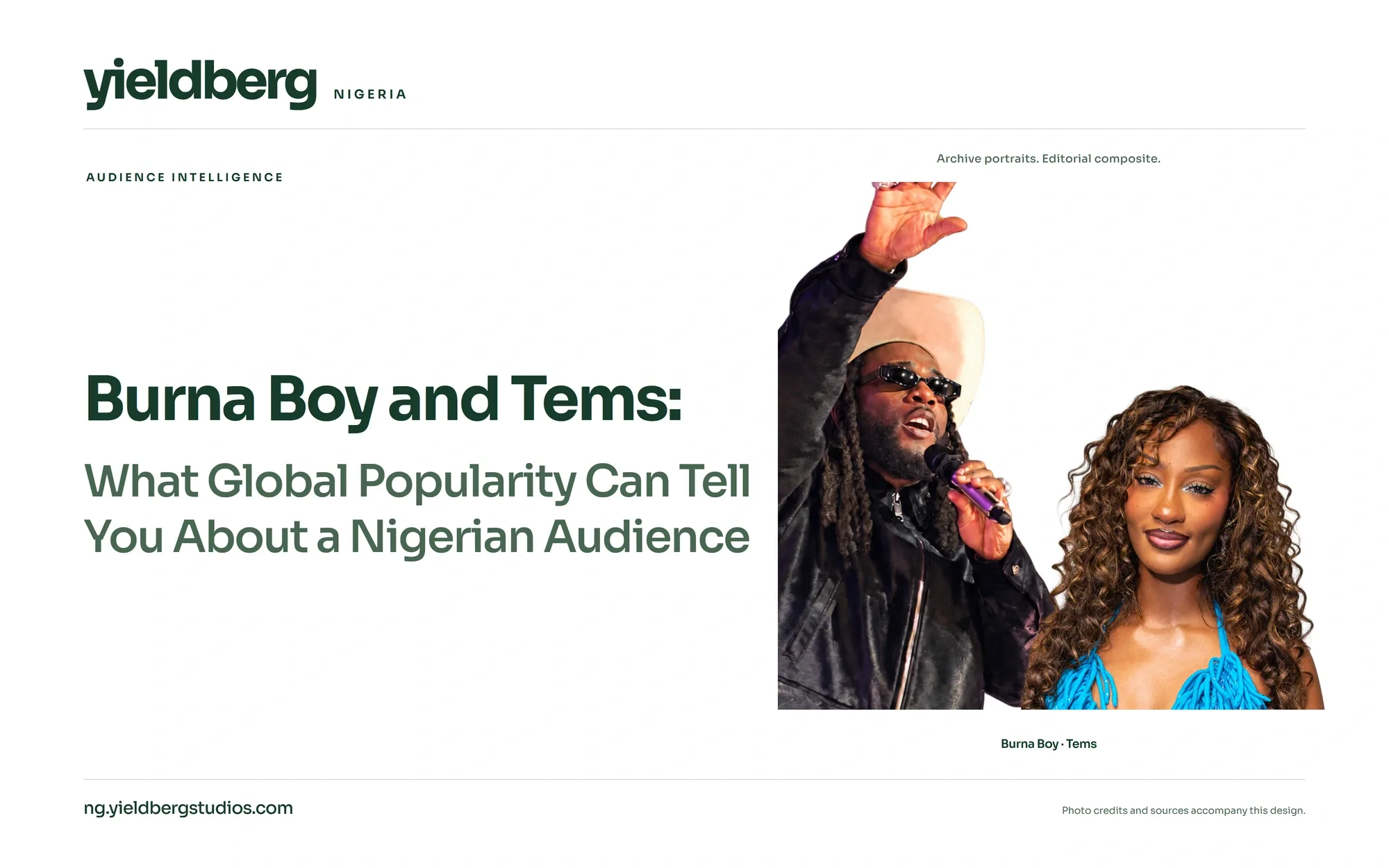
Global popularity can justify investigating an artist, but it cannot establish demand among the particular Nigerian people you want to reach. Start with evidence matched to their location, listening situation and intended action, then use international recognition as context. The recommendation changes when your project genuinely serves an international audience rather than a Nigerian location or community.
Burna Boy and Tems make the distinction worth examining. The Recording Academy documents their international award recognition in its Burna Boy record and Tems record. Those records establish award history. They do not tell a producer how many people in Uyo would attend a screening, whether listeners in Kano recognise a particular collaboration, or which story a Benin-based creator should tell.
The problem is not that international evidence is useless. It is that a strong answer to one question is easily borrowed to answer another. A headline about global listeners can support a story about international circulation while remaining insufficient for a local event, regional publication or Nigerian retail offer.
Start with the decision, not the celebrity comparison
Write the decision before collecting numbers. Are you choosing a guest for a programme, explaining how a recording travelled, planning a listening event or assessing a proposed partnership? Each task needs different evidence.
A listening feature can discuss international recognition without proving purchase intent. A ticketed event needs evidence concerning attendance conditions, price, access and the specific location. A creator who wants to discuss musical craft needs a defensible editorial question, not a claim that the artist represents every Nigerian listener.
Name the people narrowly enough that the research could actually reach them. “Nigerian youth” is not an operational description. “Adult students and early-career workers who attend this organiser's music events in Uyo” gives you a recruitment route and a boundary. It does not claim that students everywhere behave alike.
Keep residence separate from nationality and cultural identification. A person listening in London might be Nigerian, might not be, or might have a connection you cannot establish. Do not classify everyone outside Nigeria as diaspora. Equally, a Nigerian location does not prove a person's language preference or familiarity with an artist.
Use the Geography-to-Decision Ladder
The Geography-to-Decision Ladder is an editorial approach proposed here, not an industry standard. It orders evidence by how closely it answers your actual decision. Higher steps do not automatically mean more reliable data; they mean more relevant questions.
| Step | Evidence | Useful conclusion | Conclusion to avoid |
|---|---|---|---|
| Recognition | Awards, credited collaborations, documented international appearances | The artist has recognition in those settings. | Everyone in Nigeria knows or prefers the artist. |
| Consumption | A dated platform report for a stated market and period | Recorded activity occurred within that platform's coverage. | The figures describe all listening or all Nigerians. |
| Project audience | Authorised aggregate records from your publication, organiser or distribution partner | Your existing audience has specified measured characteristics. | The existing audience includes everyone you want to recruit. |
| Situation | Consented conversations or a bounded viewing or attendance check | These participants describe particular needs and barriers. | A small convenience sample is a national finding. |
| Action | Properly defined enquiries, attendance or another chosen outcome | People completed the recorded action under stated conditions. | The celebrity alone caused the outcome. |
Do not climb the ladder by pretending an unavailable dataset exists. If the organiser has no reliable attendance history, leave that field empty and design a small investigation. Missing information changes the commitment you can defend.
Spotify's five-year account of listening in Nigeria includes Burna Boy among its most-streamed artists in the country over the stated period. That supports a platform-specific listening observation. It neither ranks every Nigerian audience nor establishes a Tems-versus-Burna Boy preference for your project.
Ask for the right record, without asking for passwords
The producer should request an authorised summary rather than access to somebody's personal account. Ask the record owner to identify the platform, reporting dates, geographic label, metric, paid distribution where known and collection date. Request only information relevant to the decision.
Check the metric itself. Spotify defines listeners as unique listeners within the specified reporting period and distinguishes them from followers in its listener and follower documentation. A follower total and a period-based listening total are not interchangeable measures.
Record what the available geography actually measures. Do not silently change a share of listening activity into a share of people. If an export has no relevant local detail, say so. Do not invent city percentages by combining a global total with an unrelated national report.
For a smaller creator, the same principle applies when presenting your own audience. The Brief's first media-kit guide explains how to attach conditions and limitations to audience evidence. A famous subject does not remove that responsibility.
Illustrative scenario: an Uyo listening conversation
Assume a small Uyo publication is considering a discussion about Nigerian artists' international work. This is a fictional planning scenario, not a completed event or a finding about Uyo.
The proposed topic compares how listeners discover credited collaborations involving Burna Boy and Tems. The editor initially suggests an event because both artists have international recognition. That is an editorial starting point, not attendance evidence.
Complete this worksheet before announcing the event:
| Field | Illustrative planning entry | Responsible person |
|---|---|---|
| Decision | Whether to commission a local conversation and in what format | Editor |
| Intended participants | Adults reachable through the publication and a named local venue | Audience lead |
| Known evidence | Official award records and the publication's own available records | Researcher |
| Unknowns | Interest in the comparison, preferred session length, travel and access conditions | Producer |
| Investigation | Invite potential participants to discuss a clearly described concept | Audience lead |
| Permission question | Whether any recordings, artwork or performance excerpts may be used | Rights adviser and producer |
| Decision condition | Commission only if interest and practical access support the proposed format | Editor |
Ask participants how they encountered the relevant work, what they would want explained and whether the proposed location and time are workable. Do not begin by asking which artist is “bigger”. That invites rivalry without answering whether the event has a useful purpose.
If people recognise a collaboration but not the wider catalogue, a discovery-led conversation may be better than an assumed deep-fan discussion. If attendance conditions are unsuitable, a readable feature might serve the same editorial question. These are possible responses to investigate, not reported participant answers.
Measure the project without turning recognition into causation
Choose the outcome and denominator before release. For an invitation, record completed expressions of interest divided by delivered invitations where delivery is known. For an event, distinguish registrations, actual attendance and completed feedback. Explain the reporting period and collection method.
Illustrative arithmetic: assume 80 delivered invitations and 20 completed expressions of interest. The response rate is 20 ÷ 80 × 100 = 25%. If 12 of those 20 later attend, attendance among respondents is 12 ÷ 20 × 100 = 60%. Every number is assumed. Neither percentage proves that the artists caused participation or that 25% of Uyo residents want the event.
Record other changes, including venue, promotion, timing and access. If attendance improves after several changes, the available evidence may establish improvement without isolating its cause. Keep that distinction in your public account and internal decision.
Before choosing video over text or audio, investigate the actual viewing conditions. The Brief's format and viewing-conditions guide offers a way to do that without assuming one Nigerian data allowance.
Reach a first decision in ten working days
- Days one and two: the editor defines the decision, audience boundary and useful outcome. The researcher opens a source record and lists unsupported assumptions.
- Days three and four: request authorised aggregate information from relevant record owners. Log unavailable fields rather than supplying estimates.
- Days five to seven: the audience lead conducts the agreed small concept check. Record recruitment and consent, and separate individual experience from broader claims.
- Days eight and nine: the producer assesses access, format, permissions and actual costs. Revise the proposal around the evidence rather than the celebrity hierarchy.
- Day ten: commission, narrow, change format or postpone. Record which unanswered question would change the decision and when it will be revisited.
This is a proposed development window, not a promise of responses from artists or partners. Extend it where evidence or clearance requires more time. Your useful result is a decision matched to a defined audience, not a declaration that one star matters more than another.
Questions worth settling
Is a global audience useless for a Nigerian project?
No. It can establish context, identify a creative question or help an international project. It becomes misleading when used to claim local interest that has not been investigated.
Must you obtain private artist analytics?
Not for every article. Public award and release records can support a bounded cultural feature. A local commercial commitment may need stronger audience evidence, but unavailable private data is a reason to narrow the claim, not to request credentials or fabricate figures.
Sources and verification
- Recording Academy, Burna Boy and Tems artist records: Burna Boy and Tems. Undated live records, checked 18 September 2026. Support documented award recognition, not local demand.
- Spotify, five-year Nigeria listening account: 23 February 2026. Platform-published evidence with platform coverage, not a representative national survey.
- Spotify Help, listener and follower statistics: official definitions. Undated, checked 18 September 2026. Defines those measures without establishing any artist's current local audience.
- Internal reading destinations were checked on 18 September 2026. The ladder, worksheet, Uyo scenario, arithmetic and schedule are editorial proposals. No artist analytics, interviews or audience test were obtained or conducted.
Next decision: Choose a format from your audience's actual viewing conditions.
Cover photo credits
Burna Boy: Nuță Lucian (source photograph, CC BY-SA 2.0). Tems: Maryland GovPics / Polly Irungu (source photograph, CC BY 4.0). Editorial cover illustration; portrait framing and composition adapted from the credited sources.
Related reading

 By Isong Godswill

 By Omodot Jackson

