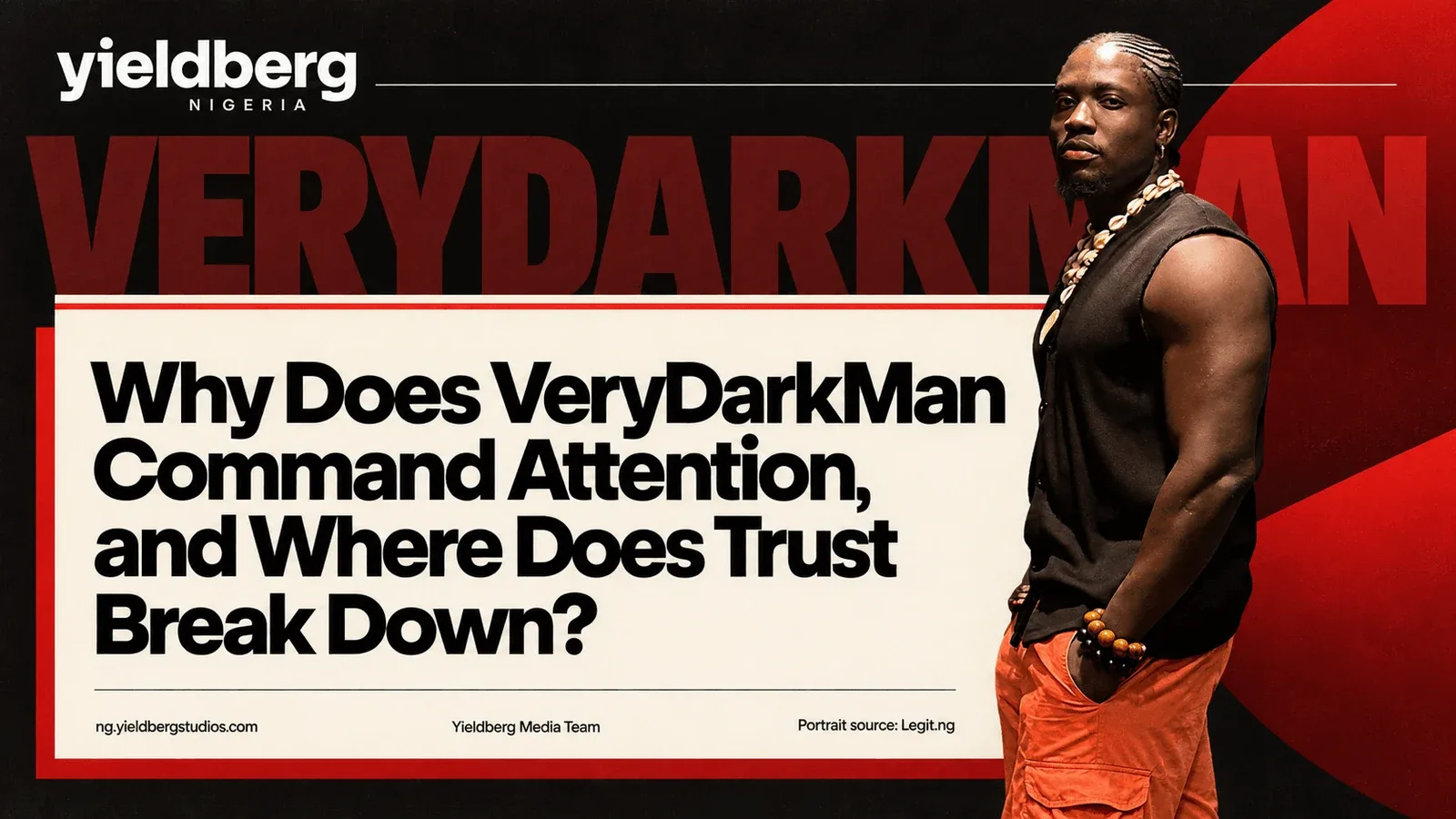
VeryDarkMan commands attention because he converts complaints into direct, named demands for action and speaks in a register that supporters experience as less filtered than institutional communication. Trust is strongest when he puts affected people, documents and an accountable authority in the same public chain. It weakens when accusation outruns disclosed evidence, when one institutional failure becomes a claim about an entire profession or agency, or when personal conflict competes with the public issue.
There is no responsible single answer to whether Martins Vincent Otse is trustworthy. Trust must be assessed claim by claim. Support for his work on one matter does not verify another allegation, and dislike of his manner does not invalidate evidence he presents.
A creator who functions as an escalation point
VeryDarkMan, often shortened to VDM, is a Nigerian social commentator who describes his role as an “online police”. People send him disputes, allegations and appeals because his posts can attract public and institutional attention. He also comments on national issues, leads public actions and challenges named institutions.
That role helps explain both loyalty and resistance. A person who believes formal channels ignored them may see a large creator as an accessible route to consequence. An institution or person named before verification may see the same process as trial by audience.
Prominence also creates impersonation risk. In October 2025, AFP found that scammers used a deepfake of VDM in a Facebook scheme. Any sentiment or claim audit must confirm that a post came from his current official account before attributing it to him.
How this sample was assembled
This article uses a qualitative review collected on 26 September 2026. The primary observation window is 26 September 2025 to 26 September 2026. It examines four distinct issue clusters: Nigerian scholarship students in Morocco, June 2026 insecurity protests, statements at the August 2026 Nigerian Bar Association conference, and the November 2025 in-flight altercation involving VDM and Mr Jollof.
For each cluster, we compared the creator’s attributable position, public responses or reporting, an institutional response where available, and any visible correction, apology or outcome. Facebook, X and Instagram material was accessed through public posts embedded or linked by established reporting because platform interfaces did not expose complete, chronologically stable comment populations. TikTok did not provide an auditable sample for these issues.
We do not publish a sentiment percentage, treat selected reactions as representative or repeat unresolved allegations as facts. A lawsuit, petition, invitation or charge proves that a process exists, not that an allegation has been established. A denial is a party’s position, not automatic disproof. Ordinary commenters are de-identified.
What produces trust
He gives a complainant distribution
In January 2026, VDM published a conversation with Nigerian students in Morocco who alleged serious hardship under a scholarship arrangement. The Federal Ministry of Education responded that valid pre-2024 beneficiaries had been paid through the 2024 budget year and described later delays as temporary fiscal constraints. Channels Television reported both the students’ allegations and the ministry’s position.
The post’s public value was not that VDM settled the facts. It was followed by an answer from an identifiable authority and made the disputed points visible. A useful next report would check individual award letters, payment periods, arrears and what happened after the response.
He turns attention into physical participation
In June 2026, VDM led an Abuja protest over insecurity and economic hardship. Vanguard reported that hundreds participated. Attendance is evidence of mobilisation around a cause; it is not proof that every participant endorsed every statement VDM has made.
For supporters, the move from post to street can make activism feel consequential. For critics, personality-led mobilisation may lack the governance, demands and follow-up needed for durable change. Both questions can be tested: were demands specific, was participation safe, and did organisers publish subsequent action?
He communicates accountability in plain language
Institutional statements often arrive late and in legal or bureaucratic language. VDM’s direct address names the alleged harm and the actor expected to respond. That clarity can be useful even when his conclusion remains unproven.
The strength becomes a risk when rhetorical certainty is mistaken for evidential certainty. Confidence is a delivery feature, not a source.
Where trust breaks
A serious claim is presented before the evidence chain
At the August 2026 NBA conference, VDM alleged that some security personnel at checkpoints supplied information to kidnappers and made broader claims about government and security agencies benefiting from insecurity. Channels Television noted that evidence was not presented during the session.
The Nigeria Police Force then asked him to supply evidence and rejected generalisation across the institution. VDM said he would present material in court rather than during police questioning, according to a subsequent Channels report.
As of this article’s verification date, those public reports establish the allegation, the police response and VDM’s position on disclosure. They do not establish that the alleged conduct occurred. Viewers who support scrutiny can still withhold factual judgement until evidence is tested.
Issue, person and fan identity merge
Visible reactions to the NBA invitation included praise for his influence, concern about the standard of discourse and conditional support asking him to avoid certain topics. Pulse documented examples from X and Instagram. The responses are curated illustrations, not a poll.
Once a disagreement becomes “Ratels versus enemies”, an evidential question turns into group loyalty. The same distortion works in reverse when opponents reject any complaint because VDM raised it.
Personal conduct contradicts the accountability role
In November 2025, VDM and Mr Jollof were removed from a United Nigeria Airlines flight after a physical altercation during boarding. Both later apologised. Channels Television reported that VDM accepted responsibility for disruption and acknowledged potential costs to passengers; the NCAA described the conduct as unacceptable and said an investigation would follow.
An apology is relevant evidence of repair, not erasure. The important trust question is whether later conduct changes and whether the people affected by the disruption receive proper acknowledgement.
The Claim-to-Outcome Chain
The Claim-to-Outcome Chain is an editorial method developed for this article. It prevents charisma, controversy or legal vocabulary from substituting for verification.
| Stage | Question | Acceptable evidence | Status label |
|---|---|---|---|
| 1. Origin | Who is making the claim and from what position? | Original post, full interview or signed statement | Claim made |
| 2. Specificity | Which person, act, date, place and amount are alleged? | Clear particulars rather than a general accusation | Specific or vague |
| 3. Support | What material accompanies the claim? | Documents, first-hand testimony, recording, public record or physical evidence | Supported, partly supported or unsupported publicly |
| 4. Response | Has the named party had a meaningful chance to answer? | Attributable response or documented no-response deadline | Answered, denied or no response |
| 5. Independent test | Has a competent body checked the material? | Audit, regulator, verified investigation or court evidence | Under review or tested |
| 6. Outcome | What was actually decided or remedied? | Final judgment, published finding, completed payment or correction | Resolved, unresolved or mixed |
| 7. Repair | If wrong or incomplete, what changed? | Retraction, correction, apology, updated evidence or process reform | Repaired or outstanding |
The labels should remain attached when a clip is reposted. “Police requested evidence” must not become “police confirmed the claim”. “A court summoned someone” must not become “the court found them liable”.
Applying the chain issue by issue
| Issue | What is established | What is contested or missing | Responsible public wording |
|---|---|---|---|
| Morocco scholarships | Students made hardship allegations; the ministry issued a detailed response | Individual payment histories and subsequent remedy were not established in the reviewed material | “Students alleged; the ministry said; follow-up records are needed” |
| NBA insecurity statement | VDM made allegations; police requested evidence; he said he would produce it in court | No tested evidence or final outcome was identified by 26 September 2026 | “Unproven allegation under public dispute” |
| June protest | VDM led a protest and participants attended | Attendance does not prove every allegation or policy solution | “Evidence of mobilisation, not factual verification” |
| In-flight altercation | Airline removed both men; VDM apologised; NCAA announced action | Later regulatory outcome was not identified in this sample | “Documented conduct and apology; follow-up status unverified” |
This structure allows conditional trust. A reader may value VDM’s ability to secure attention for students while requiring stronger evidence for security allegations.
Platform differences matter
Facebook gives VDM long-form distribution and also carries impersonation risk, as AFP’s deepfake finding shows. X accelerates clips, documents and institutional responses, but short quote-posts can turn an unresolved chain into a verdict. Instagram supports direct-to-camera argument and community identity. TikTok may recirculate excerpts to viewers who never see the initial claim or later correction.
Every issue page should pin the latest verified status and link backwards through the chain. A correction posted only on one platform will not automatically reach people who saw the allegation elsewhere.
What creators, publishers and brands should do
A public-interest creator should build an evidence desk separate from the performance function. One editor logs documents, requests response, removes personal data and writes the status label. For high-risk claims about crime, corruption, paternity, health or identifiable people, obtain qualified Nigerian legal review before publication.
Offer named parties a fair deadline. Preserve original files and metadata. Do not solicit harassment, publish home addresses or turn silence into an admission. When information cannot yet be published safely, say that evidence has been provided to an appropriate body rather than previewing a verdict.
Brands should not commission issue advocacy merely to borrow VDM’s intensity. They need a clear public purpose, editorial independence, disclosure and a correction protocol. Avoid inserting products into unresolved allegations. Commercial support must never control whether an adverse finding is published.
A 72-hour verification sequence
- Hours 0–6: define the claim. Write one sentence with actor, action, date and alleged consequence.
- Hours 6–18: secure and protect evidence. Preserve originals, check metadata and redact unnecessary personal information.
- Hours 18–30: seek independent corroboration. Find a separate witness, official record or technically competent reviewer.
- Hours 30–42: request response. Send the exact allegation and evidence category, allowing a proportionate deadline.
- Hours 42–54: obtain legal and safety review. Assess defamation, privacy, contempt, witness safety and public-interest necessity.
- Hours 54–66: run the Claim-to-Outcome Chain. Mark every unknown and write the status label into the script and caption.
- Hours 66–72: decide. Publish only what the evidence supports. If urgency prevents completion, publish a narrow alert without naming an unverified culprit.
Review the issue at seven, 30 and 90 days. Continue coverage if new evidence changes a status. Correct with the same prominence as the original claim.
Related reading
Frequently asked questions
Does a large following make a claim credible?
No. It makes the claim consequential. Credibility comes from identifiable evidence, fair response, independent testing and accurate updates.
Does an official denial settle the issue?
No. Record it as the institution’s position and examine supporting records. The same standard applies to the creator’s allegation.
Is a court filing proof that someone committed wrongdoing?
No. It proves that a legal claim or charge has been filed. Report the pleading, defence and procedural status separately from a final judgment.
Can a brand work with a controversial commentator?
Yes, if the assignment, evidence standard, independence, safety and correction process are explicit. Popularity cannot compensate for unmanaged defamation or participant risk.
Sources
- AFP Fact Check: deepfake Facebook scam using VDM’s likeness, account-verification and impersonation evidence.
- Channels Television: Morocco scholarship dispute, student allegations and Federal Ministry of Education response.
- Vanguard: Abuja insecurity protest, reporting on physical mobilisation.
- Channels Television: VDM’s NBA insecurity allegations, attributable claims and note that evidence was not presented at the session.
- Channels Television: police demand supporting evidence, official response to the checkpoint allegation.
- Channels Television: VDM says he would present evidence in court, the creator’s subsequent position.
- Pulse: reactions to the NBA appearance, selected public reactions used as illustrations, not a representative sample.
- Channels Television: apologies after the in-flight altercation, creator statements and NCAA response.
Next decision: Read There Is No Single Nigerian Audience before treating a creator’s supporters, opponents and issue publics as one national sentiment group.
 By Omodot Jackson

 By Isong Godswill