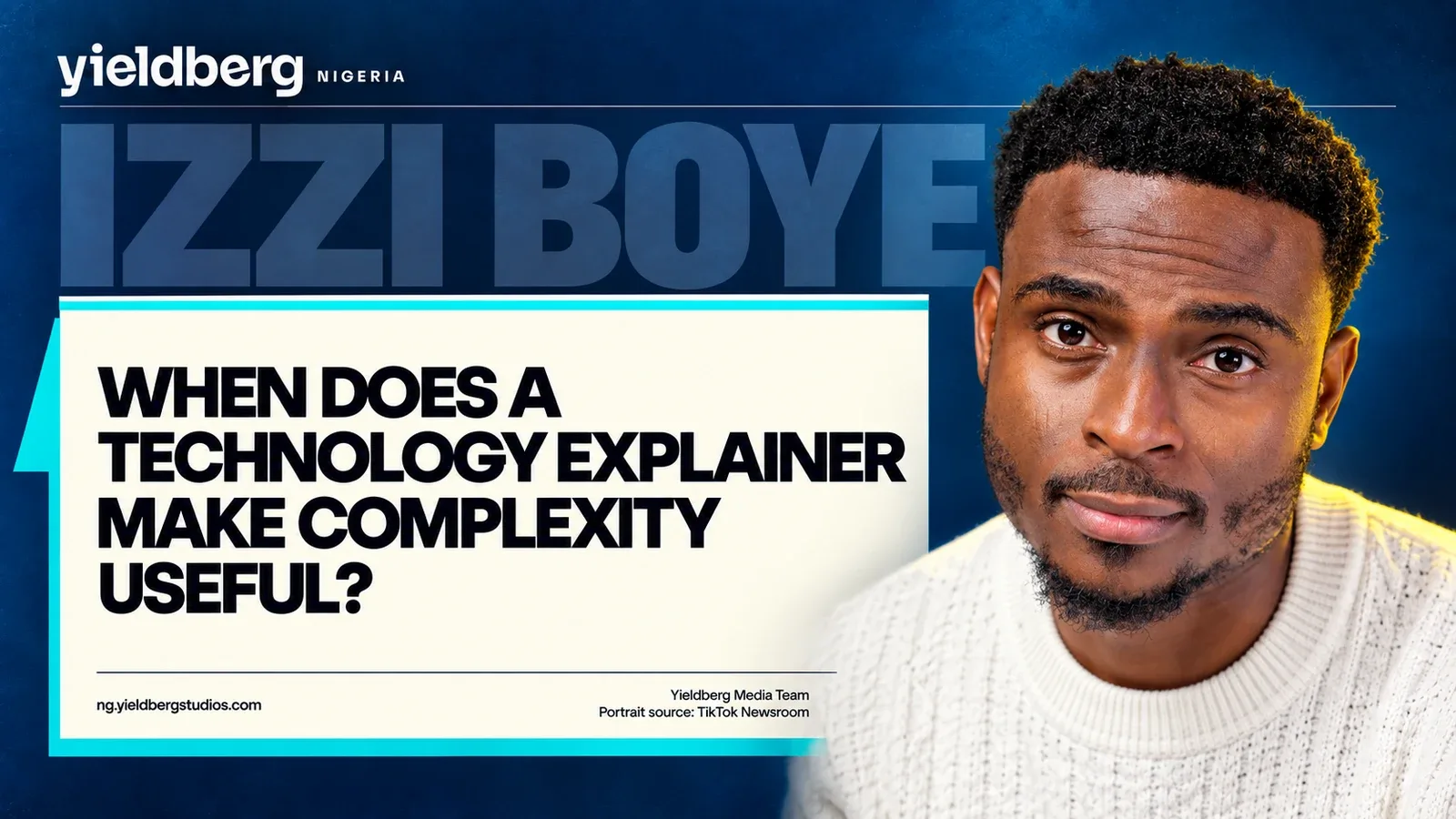
Izzi Boye makes complexity useful when a beginner can act without being misled about what has been omitted. His friendly language, humour and real-life examples lower the cost of entering a technical subject. The risk arrives when a short explanation collapses price, compatibility, privacy, safety or sponsorship into a confident conclusion. Simplicity is a service; missing decision-critical detail is not.
The right test is not whether an expert could add more facts. Experts can always add facts. It is whether the explanation preserves the conditions that would change a Nigerian viewer’s decision.
Accessibility is an intentional format
In TikTok’s February 2026 African All-Stars profile, Boye says he explains technology as though speaking to a friend beside him, prioritising real-life use over specification-heavy language. The profile also notes his Education Creator of the Year recognition at the 2025 TikTok Awards for Sub-Saharan Africa. Because the platform published the interview, it is evidence of TikTok’s recognition and Boye’s stated method, not an independent measurement of accuracy.
His official site identifies him as a digital content creator, while his public link hub connects YouTube, TikTok, X and Instagram. The hub also contains product and affiliate links, including one explicitly labelled as an affiliate link. That label is useful, but the commercial status still needs to travel with each relevant post. A viewer who sees a copied clip may never visit the hub.
In a January 2026 Independent interview, Boye discussed the cost and planning behind technology influence, brand work and travel. A June 2025 Techpoint Africa page about him was marked Brand Press, so its praise should be read as sponsored or client-supplied publication rather than independent evaluation.
What the public-reaction sample can show
The Yieldberg Brief reviewed accessible public material on 26 September 2026 across Boye’s TikTok, Facebook, X and YouTube surfaces, his official links, current interviews and Nigerian regulatory information. TikTok and Facebook restricted full comment access without sign-in. X exposed selected fragments. YouTube did not provide a stable, complete comment export. No comment corpus was purchased or scraped.
This was a purposive qualitative review. It cannot produce a representative love-versus-hate percentage. Visible reactions were treated as prompts for inquiry, not verified user outcomes. A question such as “Will this work on my phone?” signals missing compatibility information; it does not prove that the explainer failed for everyone.
The platform contract also changes the criticism. TikTok viewers reasonably expect compression and a fast example. YouTube viewers can expect a deeper demonstration. X is suitable for a dated correction or comparison, while Facebook shares may circulate a simplified clip after a service, price or interface changes. A creator should not use short-form conventions to avoid information that is essential to safe action.
Why the approach earns affection
It reduces intimidation
Specifications can become a gatekeeping language. Explaining what a processor, charging standard or privacy setting changes in ordinary use gives viewers a reason to care before asking them to learn terminology. Boye’s conversational positioning addresses that barrier directly.
Humour improves the invitation
Humour can make a tutorial feel like help from a peer rather than an examination. It gives short videos rhythm and helps a viewer remember the task. It should serve the instruction, however. A joke that replaces a caveat may be memorable for the wrong reason.
The use case comes before the prestige
A useful explainer asks what a tool does for a student, small business, parent or first-time buyer. This can counter launch culture, where “new” is treated as sufficient benefit. Premium Times’ report on TikTok creators highlighted Boye’s practical advice to people intimidated by equipment costs. That is a reported description of an event, not evidence that every viewer could afford the suggested route.
Where simplification becomes risky
A feature is not the same as local usefulness
A phone may support 5G while a viewer lacks effective 5G service in the relevant location. The NCC’s Q2 2026 network report page explicitly describes regional and operator differences and the gap between device readiness and effective access. A short explainer should therefore say where, on which operator and under which conditions a network feature was tried.
A price is not stable context
Nigerian device and data costs move. The NCC’s approved bundle-plan database records operator, price, data allowance, business rules and validity, with update dates. A claim that an app or cloud workflow is “cheap” needs expected data use and the date of the plan. A dollar launch price also needs a Nigerian seller, naira figure, warranty status and stock check.
A demonstration is not a complete review
An unboxing or event hands-on can show build, interface and first response. It cannot establish durability, battery ageing or long-term support. Calling it a first look protects trust. Calling it a verdict compresses time that did not occur.
Brand access can shape the topic before it shapes the words
A creator may retain full editorial control and still cover products selected by brands that provide units, travel or event access. Disclosure helps viewers understand topic selection as well as the verdict. Boye’s link hub shows that affiliate commerce is part of the public ecosystem. Each relevant video should say whether a link pays commission and whether the reviewed unit was bought, loaned, gifted or attached to a paid brief.
The Complexity Compression Ladder
The Complexity Compression Ladder is the original editorial method for this article. Every explainer should descend through five rungs without skipping the information that changes action.
| Rung | Question | Minimum answer |
|---|---|---|
| 1. Task | What is the viewer trying to do? | One specific outcome, not “understand tech” |
| 2. Mechanism | What makes it work? | Plain-language cause, plus the key term a viewer may need later |
| 3. Conditions | What must already be true? | Device, account, network, power, region and software version |
| 4. Cost and trade-off | What will it consume or give up? | Dated price, data, battery, privacy, time and lost feature |
| 5. Boundary | When should the viewer stop or seek deeper help? | A named risk, official support route or advanced resource |
A 30-second clip may cover the first two rungs and point clearly to the remaining three. The error is pretending the ladder ends early.
A twelve-day explainer audit
- Days 1–2: select eight posts. Include beginner tips, product explainers, event coverage and paid or affiliate-linked work.
- Day 3: write the task sentence. If the team cannot state the user outcome in one line, the clip is probably describing a feature rather than solving a problem.
- Days 4–5: list hidden conditions. Record phone model, operating-system version, country availability, account tier, network and power assumptions.
- Day 6: verify price. Use a current Nigerian seller or operator page, date the number and distinguish subscription, promotional and full costs.
- Day 7: label access. State bought, borrowed, gifted, sponsored, event-provided or affiliate-linked.
- Day 8: run a novice test. Ask a first-time user to perform the task without off-camera help. Record confusion, not a pass rate unless the sample and method support one.
- Days 9–10: separate platform feedback. Use TikTok questions to plan a follow-up, YouTube for the full method, X for corrections and Facebook for a durable share card.
- Day 11: publish the missing rung. Add a caveat, compatibility list, price update or risk note.
- Day 12: decide. Keep the short explanation, expand it, or withdraw an instruction that cannot be made safe and accurate in the format.
The decision point is day 12. The output should specify which rung changed and why.
What this means for creators
Approachability is a genuine expertise. Protect it with version numbers, dates and boundaries. Keep a public page for corrections and compatibility. When a viewer question repeats, answer once in a durable source rather than improvising slightly different replies.
Do not let “explainer” become a softer word for advertisement. Put the relationship at the start, then preserve the right to identify limitations. If the brand controls the script or conclusion, describe the content as a paid demonstration rather than an independent assessment.
What this means for brands
Brief for comprehension, not merely mention. Supply Nigerian price, authorised stockist, warranty, network requirements, privacy documentation and support contacts. Pay for the additional work of testing with real conditions.
Measure whether viewers can identify the correct use case and limitation. Views show distribution; they do not show understanding. Repeated questions can be more useful than generic praise because they reveal the missing rung.
Related reading
Frequently asked questions
Is simplification the same as oversimplification?
No. Simplification removes unnecessary complexity while preserving decision-critical conditions. Oversimplification removes a condition that could change the outcome or risk.
Must every short video include every technical detail?
No. It should include the minimum safe instruction and point to a dated, accessible source for compatibility, price, privacy and limitations.
Does an affiliate link make an explanation unreliable?
Not by itself. The viewer should see the commission relationship, and the evidence should stand independently of the link.
How should Nigerian network claims be tested?
State operator, location, network generation, device, software and test time. Do not generalise one result to the country.
What should a brand do when viewers find an error?
Verify it, correct the original wherever possible, link the correction across cut-downs and state what changed and when.
Sources
- Izzi Boye, official website
- Izzi Boye, official public links and affiliate labels
- TikTok Newsroom, African All-Stars profile of Izzi Boye
- Independent, January 2026 interview with Izzi Boye
- Premium Times, TikTok creator education and monetisation report
- NCC, Q2 2026 network-performance reports
- NCC, approved operator bundle plans
Next decision: Use the Nigerian audience-nuance planning guide to choose which technical conditions cannot be compressed in the next explainer.

 By Isong Godswill

 By Omodot Jackson