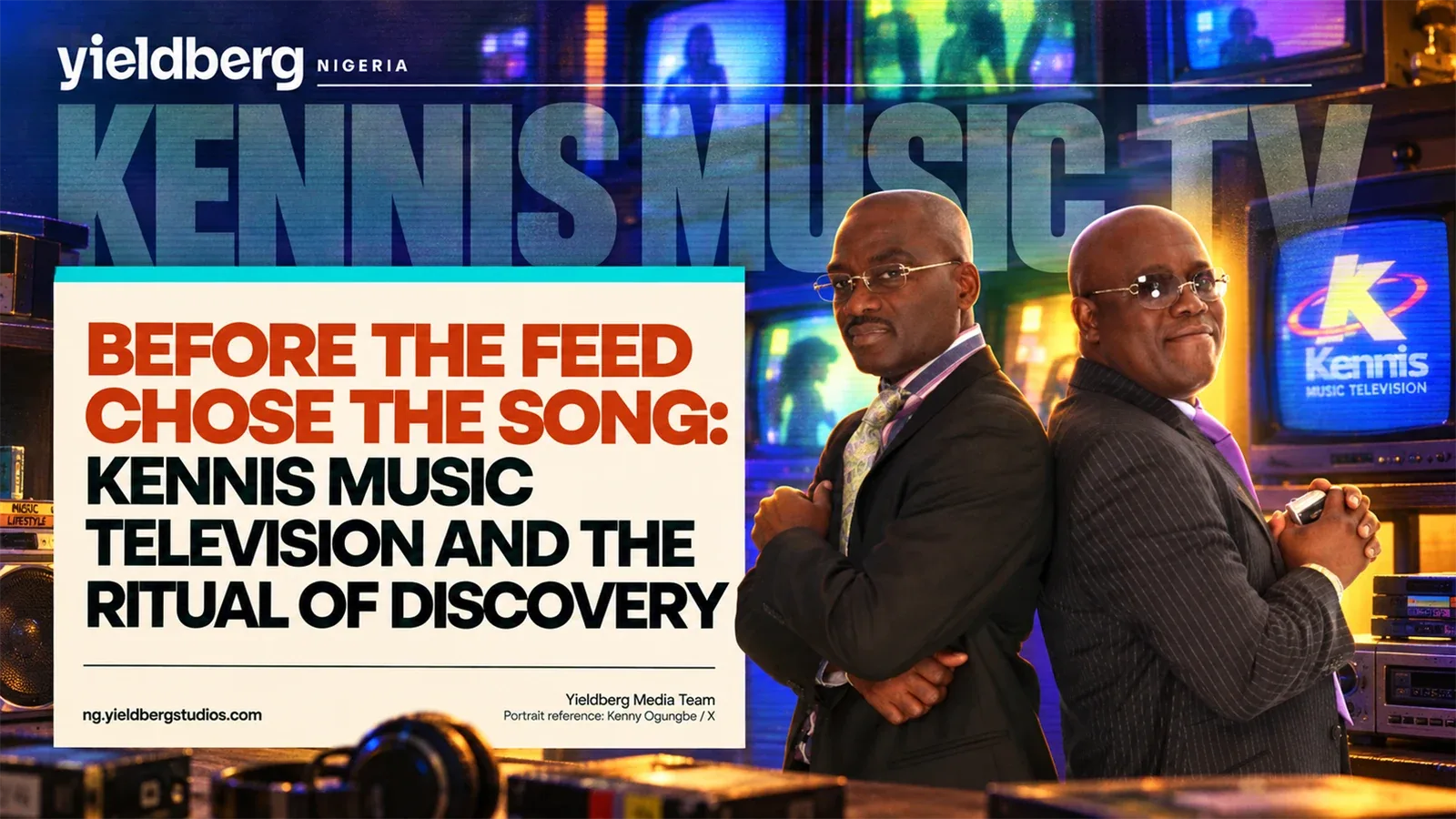
Before an application learnt what a listener liked, Nigerian music television asked viewers to trust a presenter, a schedule and the next video in the running order. The Kennis-linked broadcast world, remembered through names including AIT Jamz, PrimeTime Jamz and PrimeTime Africa, made that trust commercially powerful. It helped Nigerian pop look like an industry while the industry was still constructing itself.
People often use “Kennis Music television” as a broad memory rather than one perfectly stable programme title. That distinction matters. The best-documented path begins with Kenny Ogungbe and Dayo Adeneye on AIT Jamz, followed by versions of PrimeTime Jamz or PrimeTime Africa associated with NTA and the wider Kennis and Primetime operation. The names, stations and eras should not be collapsed into one uninterrupted show.
The emotional memory, however, is coherent: local music arrived on television with presenters who treated it as news, style, business and identity.
A new song had somewhere important to go
Today, a Nigerian artist can upload a song and video directly to a global platform. In the period that made Kennis influential, distribution involved a narrower set of gates. Radio play mattered. Television play mattered. A presenter who placed an unfamiliar artist beside established acts could lend the newcomer status.
Kenny “Keke” Ogungbe and Dayo “D1” Adeneye understood the relationship between those gates. According to D1's account reported by TheCable, the pair returned from the United States and were invited by DAAR Communications founder Raymond Dokpesi to develop programming. They hosted AIT Jamz in the late 1990s, with the programme later taking the PrimeTime Jamz name on NTA.
Their advantage was not simply enthusiasm for music. They could operate across radio, television, live events, artist development and promotion. A track did not exist as sound alone. It could become an interview, a video, a wardrobe choice, a concert appearance and a story about the person who made it.
This is what viewers were actually watching: Nigerian music learning how to present itself.
The pleasure of not knowing the next video
Scheduled music television produced a distinctive kind of suspense. The audience could not see the whole playlist in advance. You waited through one selection because the next might be the video everyone had been discussing.
Discovery therefore contained patience. A song could surprise you before you had read a caption, checked its numbers or seen an argument about the artist. The presenter supplied context, but the first encounter still had room to feel unprocessed.
That made repetition meaningful too. When a video returned in another episode, its status appeared to be growing. When an artist sat for an interview after weeks of airplay, the face completed a story the song had begun.
The modern feed offers greater range and faster access. It also reveals its judgement constantly through recommendations, view counts and trends. Old music television hid more of the machinery. Viewers experienced the sequence as a programme rather than as a personalised prediction.
Keke and D1 were part of the format
Music-video programmes can become little more than storage containers. A title card appears, a video plays and the channel moves on. Keke and D1 supplied a recognisable human relationship between the clips.
Their partnership gave the programme rhythm. One personality could push, the other could steady. The banter signalled familiarity with the culture while their broadcaster's discipline kept the show moving.
They were also demonstrating a new kind of Nigerian media figure: the entertainment executive who was visible to the audience. The presenter was not separate from the business of building stars. Kennis Music and the broadcast platforms were connected parts of the same ecosystem.
That integration created opportunity and power. The Kennis network helped develop or amplify performers including The Remedies, Tony Tetuila, Eedris Abdulkareem, Sound Sultan and 2Face Idibia. A ThisDay profile of Ogungbe traces his work across broadcasting, music production and later station ownership.
The same integration also raises an editorial question that remains current: when the people selecting music are commercially connected to some of the artists, how should the programme disclose and manage that relationship? Nostalgia should not prevent the question. It should help us see how early Nigerian entertainment businesses combined functions that mature markets often separate.
The clothes were also broadcasting
D1 has recalled that clothing brands supplied outfits for the presenters and that items worn on a Friday programme could attract customers soon afterwards. In TheCable's report of that recollection, he described the practice as a precursor to contemporary influencer marketing.
The story is useful because it shows that music television carried more than sound. Viewers studied hair, shirts, sunglasses, speech and posture. The programme taught a visual grammar of Nigerian pop celebrity.
This was before every performer maintained a daily stream of personal content. A television appearance had to do concentrated identity work. An artist's choices in one interview could supply weeks of conversation.
The limitation is obvious. Brand relationships that remain unstated can blur recommendation and advertising. Contemporary producers should preserve the cultural excitement while being clearer about sponsorship, label interests and paid placement.
Nigerian music stopped appearing like a guest
One of the deepest achievements of the era was psychological.
Foreign music videos had long supplied images of scale, fashion and confidence. A local artist shown briefly between them could appear to be visiting someone else's idea of popular culture. Repetition changed that. Nigerian acts returned week after week. Presenters pronounced their names with familiarity. Their videos were debated on their own terms.
The screen did not merely reflect an industry that was already secure. It helped audiences imagine that industry into permanence.
Academic work on Nigeria's popular-music economy has described the importance of Kennis and the emerging private-media system in the circulation of hip-hop and pop. One research compilation from France's National Music Centre identifies Kennis Music's position at the junction of private broadcasting and sponsorship as part of the infrastructure that preceded the contemporary Afrobeats economy.
That does not mean one label or television show “created Afrobeats”. Nigerian popular music has many lineages, regions, institutions and innovators. The more defensible claim is that Kennis helped build a repeatable route from recording to public visibility at a crucial moment.
What the era could not preserve
The archive of Nigerian music television remains fragmented. Programme titles are inconsistently recorded. Clips circulate without dates or full credits. Promotional accounts sometimes turn industry history into brand mythology.
That makes verification difficult and gives current writers a duty to distinguish memory from evidence. An old video upload may establish what appeared on screen, but not its original broadcast date or national reach. A founder's interview establishes the founder's account, not an independent measure of influence.
A serious archive would gather complete episodes, transmission logs, rights records, artist releases, advertising material and interviews with producers, camera crews, editors, label staff and viewers. It would also record disagreement about names, sequences and credit.
The story deserves that care because music television did not simply entertain young Nigerians. It documented a generation deciding that its music should occupy the centre of the picture.
What a new music programme should recover
The answer is not to recreate the old graphics or pretend streaming never happened.
A contemporary programme should recover curation with accountability. It should explain why an artist is being shown, identify commercial relationships and make room for scenes outside Lagos. It should place a new act beside an established one without using follower count as the only measure of readiness.
It should also restore conversation. A five-second clip cannot reveal how a performer thinks about craft, ownership, performance or audience. The older format gave artists time to become more than thumbnails.
Finally, it should create an archive that artists can access. Clear credits, captions, dates and rights information would turn entertainment into future evidence.
When Saturday had a soundtrack
What viewers miss is not the inconvenience of waiting for television. They miss the weight of the encounter.
A new video appeared and, for a few minutes, there was nowhere else to scroll. A presenter placed it inside a wider story. The artist looked out from the screen as if Nigerian pop had always expected to be there.
The feed now knows our taste with astonishing precision. Yet it rarely gives a song the communal arrival that scheduled music television once could. Kennis and the programmes around it made discovery feel like an appointment. When the hour came, Nigerian music did not ask to be found. It arrived.
Sources
- TheCable Lifestyle: D1 on AIT Jamz, PrimeTime Jamz and early brand influence
- ThisDay: “Kenny Ogungbe: King of Nigeria’s Air Wave”
- ThisDay: Kenny Ogungbe and talent development
- National Music Centre research compilation on African cultural industries
Next decision: Read Build the Show, Not Just the Spot.
Related reading

 By Isong Godswill
 By Omodot Jackson