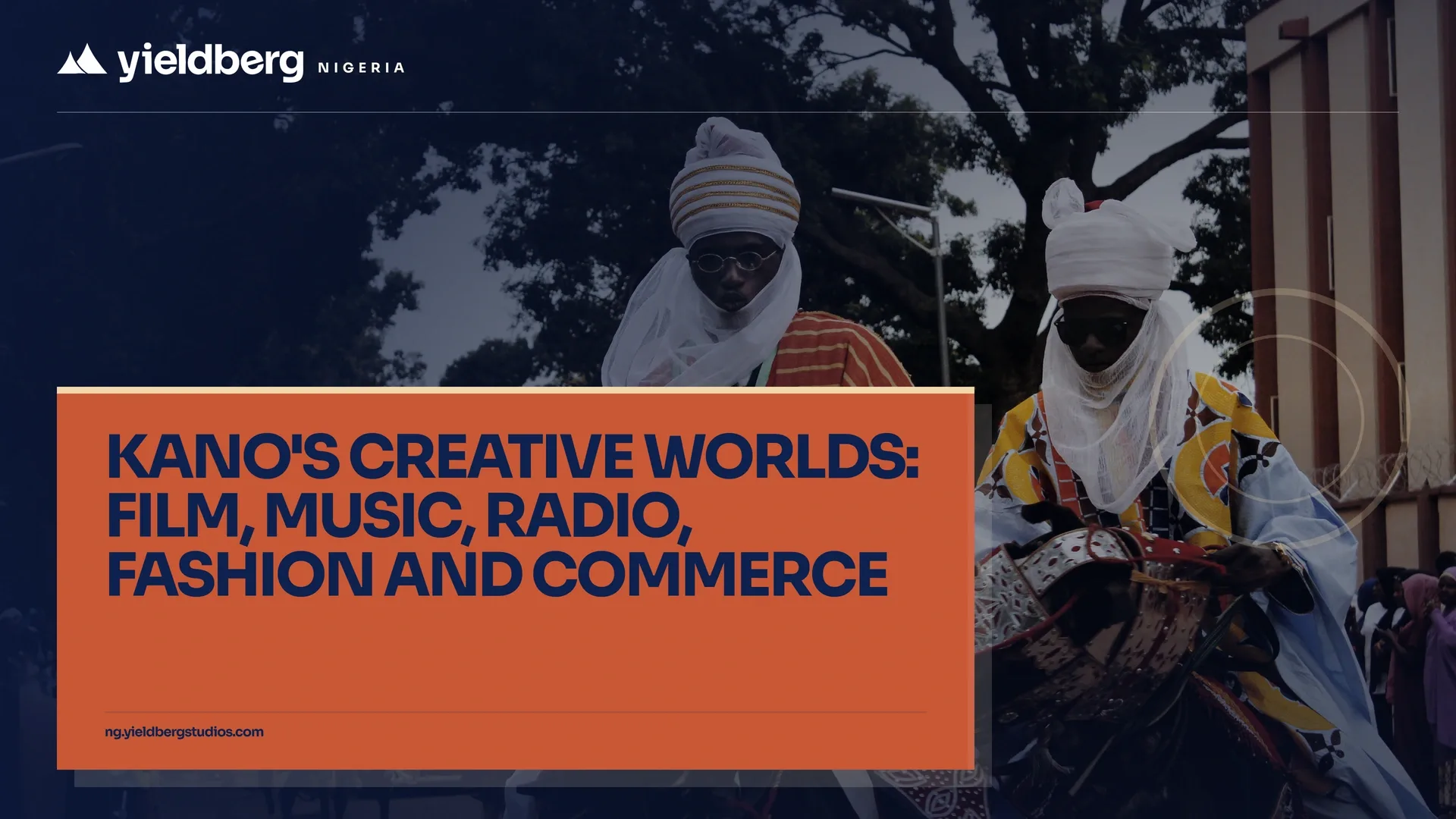
Kano works as a creative ecosystem because film, music, radio, clothing trades, markets and digital media exchange stories, labour, customers and routes to attention. Kannywood is a major node in that system, not shorthand for the whole of it. A serious Kano brief should map how a song reaches radio, how a tailor or textile trader supports a screen production, how a broadcaster commissions talent, and how a digital release changes the commercial route.
The boundaries matter. Kano city is a production and trading centre. Kano State is an administrative and regulatory territory. Northern Nigeria is a much wider region. Hausa-language publics extend beyond all three. A 2024 BBC Monitoring directory of Hausa media lists outlets in Nigeria and Niger and notes Hausa speakers elsewhere in West Africa. It is a dated outlet overview, not an audience count or proof of reception in Kano.
Start with language, place and public
Hausa is central to Kano's creative life, but “Hausa audience” is not a precise segment. Bayero University's Centre for Research in Nigerian Languages, Translation and Folklore says it continued the work of the former Hausa Language Board, while its stated original remit already covered Hausa, Fulfulde and Kanuri. Its later remit adds translation, folklore and archives. That history warns against presenting a multilingual city through one undifferentiated voice.
Variation exists inside Hausa too. Muhsin Ibrahim's 2021 doctoral research used primarily three films, related events and engagement with filmmakers, cultural and religious stakeholders, and audiences. It found a preference for the Kano variety while another subregional dialect could be pushed to the edge, and describes Hausa culture and Muslim audiences as plural rather than monolithic (University of Cologne repository). That bounded study does not represent every Kannywood production or prescribe today's language mix. It identifies a question to test.
Write four lines before commissioning anything: the physical location, the legal territory, the intended language public and the distribution territory. “Made in Kano for northern audiences” leaves all four unclear.
The Kano Creative Circulation Map
The Kano Creative Circulation Map is an original Yieldberg editorial method for planning work across the city's creative economy. It is not an established industry standard, an audience-measurement model or a substitute for local fieldwork and legal advice.
| Layer | Question | Evidence to collect | Common scope error |
|---|---|---|---|
| Place | Is the activity in Kano city, elsewhere in Kano State or another northern centre? | Address, route, local partner and jurisdiction | Calling every northern project “Kano” |
| Public | Which language variety, faith context, age group and viewing or listening situation matter? | Local interviews, language review and format test | Treating Hausa speakers as one audience |
| Making | Who writes, performs, records, sews, styles, shoots, edits and transports? | Named roles, rates, credit and delivery terms | Counting only visible talent |
| Gatekeeping | Who can approve, schedule, classify, stock or remove the work? | Named decision-maker, current rule and written approval | Confusing influence with legal authority |
| Exchange | Where do money, goods, commissions and rights change hands? | Quote, invoice, contract, licence and payment date | Calling activity a market without tracing a transaction |
| Circulation | How does the work move through radio, television, shops, events, messaging and platforms? | Format, territory, reporting method and handoff | Treating technical availability as attention |
The map has an institutional echo. A December 2023 Kano State Investment Promotion Agency guide to credit facilities reproduces a National Creative Art and Entertainment loan-scheme value chain that lists music production and distribution, film distribution, television, radio, fashion and production equipment. It shows what that guide counted as eligible at publication. It does not prove that the facility remains open, accessible or successful in 2026.
Film is an anchor, not the complete map
Kano's screen history was built through infrastructure and social use, not a label alone. Brian Larkin's 2008 study Signal and Noise connects radio networks, mobile cinema, theatres, Hindi-film circulation and Nigerian video to Kano's urban history. The lesson for current work is that a screen culture depends on spaces, technologies and distribution arrangements as much as directors and actors.
Abdalla Uba Adamu's 2017 political economy of Hausa popular cultural industries, based on embedded fieldwork in Kano and Niamey, traces links among drama groups, novels, video films, songs, radio and marketers. It dates the commercial release of Turmin Danya to March 1990 and documents 2017-era disruption of disc sales by satellite television, YouTube uploads and Kano download centres. Its studio counts and market observations are historical fieldwork snapshots, not present-day totals.
Contemporary practice is not uniform. In a 2025 interview, Kano-born filmmaker Ibrahim Kamilu, known as Dan Hausa, described weak distribution as his biggest constraint and argued for stronger role knowledge and collaboration (The Nollywood Reporter). That is one practitioner's account, useful for identifying questions rather than measuring the whole sector.
For public exhibition or distribution in Nigeria, the federal National Film and Video Censors Board says every film and video work must be classified and identifies separate distributor-licence categories. A Kano project may also face state, venue, platform and contractual requirements. Confirm the current route for the actual work and territory rather than copying an old checklist.
Music and radio form their own circuits
Music in Kano cannot be reduced to film songs. Adamu's 2017 account separates soundtrack-oriented nanaye, devotional forms, independent popular music and rap, while also showing crossings among them. It records Freedom Radio's 2011 Kano Music Express as an outlet for rap artists who were not simply extensions of the film industry. Keep that date attached to the claim.
Radio remains important because it combines language, repetition, public affairs, entertainment and local scheduling. BBC Monitoring's 2024 directory identifies Freedom Radio, Guarantee Radio and the state-operated Kano State Radio Corporation as distinct Kano routes. Freedom Radio's own institutional history dates its Kano operation to 1 December 2003. Its claims about prominence are self-description, not independent audience evidence.
A radio commission therefore needs a named station, programme, presenter, language, transmission area and proof-of-play process. A singer's appearance, a presenter read, a recorded spot and a station-produced drama have different labour, rights and editorial controls.
Fashion and commerce are creative infrastructure
Clothing appears on screen and stage, but Kano's fashion economy also operates through its own histories of making and trade. Nigeria's 2007 World Heritage tentative-list submission describes Kurmi Market as lanes organised around trades including leatherwork, textiles, iron and brass work (UNESCO World Heritage Centre). This is a State Party description reproduced by UNESCO, not a World Heritage inscription or a current shop inventory.
A University of Cambridge repository thesis on indigenous tailoring in Kano City documents small workshops, labour recruitment, training, raw materials and markets, with its contemporary fieldwork focused on three Kano City wards. Use this historical study to recognise a production structure, not to estimate today's citywide workforce. Current operating conditions require current reporting: a 2024 ICIR investigation at Kantin Kwari and other Kano markets records trader complaints about overlapping levies and uncertainty over collectors, alongside denials and explanations from market and revenue officials.
For a film, event or campaign, map the stylist, designer, tailor, embroiderer, dyer, fabric seller and costume owner separately. Record whether an item is bought, hired, commissioned or borrowed; who may alter it; who receives credit; and whether its design or story can be reused in advertising.
Digital distribution changes the route
Digital media links, rather than replaces, the older circuits. AREWA24 says it produces programmes and Hausa dubbing in Kano and distributes through satellite, pay television and its on-demand service (company overview). Those platform and facility descriptions are useful. Its reach figure is a company claim and should not be presented as independently measured audience size.
The same discipline applies to creators. A skit maker, reviewer, fashion seller or musician may combine production, publishing, sales and community response in one account. The platform still controls delivery, and follower totals do not identify unique Kano residents or Hausa speakers. Ask for location evidence, viewing context, past sponsored results, rights terms and a reporting export. Use There Is No Single Nigerian Audience to separate a language public from a city sample.
A ten-day commissioning route
- Days 1 and 2: set the boundary. Define city, state, wider region, language variety, intended public and desired action. Mark every claim that depends on 2017, 2024, 2025 or 2026 evidence.
- Days 3 and 4: build the circulation map. Interview at least one practitioner from film, music or radio, fashion or textiles, and digital distribution. Include less visible labour and do not ask one prominent person to represent an entire sector.
- Day 5: trace one real transaction. Follow a song, costume, short film or creator asset from commission to payment and distribution. Record who adds value and who carries risk.
- Days 6 and 7: test formats. Run a language and comprehension review, a radio or audio test, and a low-data mobile version. Keep feedback separated by participant, location and recruitment route.
- Day 8: close rights and approvals. Confirm scripts, compositions, recordings, performances, footage, locations, garments, archive material, likeness, edits, credits, media, territory and term.
- Day 9: price contribution. Put research, translation, community review, transport, cancellation, overtime and payment dates into the budget. Consultation without decision power or pay is not local authorship.
- Day 10: approve with an evidence note. State which claims are observed, which come from dated sources, which are partner assertions and what the project still does not know.
The contribution should remain after publication: pay local researchers and makers, preserve agreed credits, return approved copies or documentation, and share results that partners can safely use. Cultural Relevance Is a Creative Operating System, Not a Final Check explains why that authority belongs near the start of the work.
Rights and evidence limits
Nigeria's Copyright Act 2022 lists eligible literary, musical, artistic and audiovisual works, sound recordings and broadcasts. Sections 28 to 30 cover ownership, transfers and licences, while Part VIII covers performers' rights; the Act also contains exceptions. A single video can involve several layers. Payment alone does not establish the media, term, territory or scope of an assignment or licence. Record ownership, permissions and permitted uses in writing, and obtain qualified Nigerian advice for an actual reuse decision.
This article is a planning map, not legal advice, a directory of every Kano practitioner or proof of audience size. No interview, market visit, audience survey or rights clearance was conducted for this article. Historical scholarship explains how particular institutions and routes developed. Official pages state mandates; Freedom Radio and AREWA24 provide organisational self-descriptions. A published practitioner interview reveals one filmmaker's reported constraint. None alone establishes the current scale, diversity or performance of the ecosystem. Verify contacts, rules, availability, rates and community context immediately before commissioning.
Related reading
FAQs
Is Kannywood the same as Kano's creative economy?
No. Kannywood is an important Hausa-language screen industry with a major production base in Kano, but the city's creative economy also includes music, radio, literature, crafts, clothing, markets, broadcast production and digital publishing.
Does a Hausa-language campaign reach all of northern Nigeria?
No. Language availability does not establish attention, comprehension or relevance across places and publics. Specify dialect, location, medium and audience situation, then test them.
What should a commissioner verify first?
Verify scope and authority: where the work is made, where it will circulate, who can approve it, who owns each contribution and what evidence will show that the intended public actually encountered it.
Sources
- BBC Monitoring: Hausa media outlets in Niger and Nigeria, 15 March 2024.
- Centre for Research in Nigerian Languages, Translation and Folklore, Bayero University Kano.
- Kannywood and the Cultural and Linguistic Contestations on Hausa Films, Muhsin Ibrahim, PhD thesis, University of Cologne, 2021.
- Guide on Access to Credit Facility, Kano State Investment Promotion Agency.
- Signal and Noise: Media, Infrastructure, and Urban Culture in Nigeria, Brian Larkin, Duke University Press, 2008.
- Commodification of Culture: The Political Economy of the Hausa Popular Cultural Industries, Abdalla Uba Adamu, National Institute for Cultural Orientation, 2017.
- Dan Hausa Rewriting Kannywood Playbook on Own Terms, The Nollywood Reporter, 2025.
- National Film and Video Censors Board, federal mandate, classification and licensing guidance.
- Brief, Vision, Mission, Freedom Radio Nigeria.
- Ancient Kano City Walls and Associated Sites, Nigeria's World Heritage tentative-list submission, 2007.
- Survival of indigenous tailoring among the Hausa of Kano City, Nigeria, Robert Jerzy Pokrant, University of Cambridge repository.
- Despite consolidation law, traders groan under multiple taxes in Kano markets, International Centre for Investigative Reporting, 2024.
- AREWA24 company overview, company description of production and distribution.
- Copyright Act 2022, Official Gazette via the Nigerian Copyright Commission.
Next decision: Use There Is No Single Nigerian Audience to turn the Kano scope into a tested audience, language and distribution brief.
 By Isong Godswill
 By Omodot Jackson