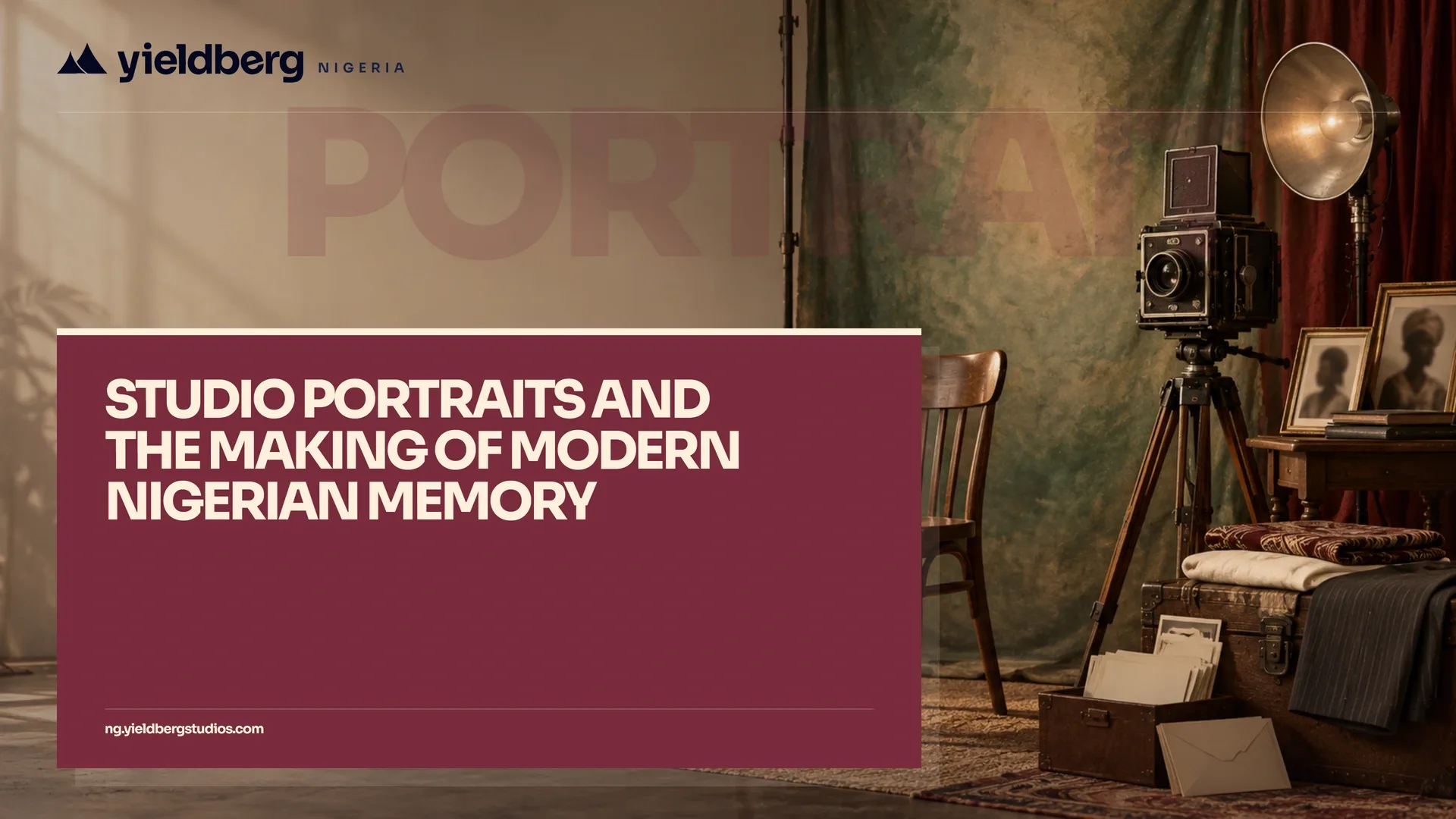
Nigerian studio portraits matter because they record how people presented themselves at particular moments: as relatives, graduates, workers, newlyweds, title-holders, performers, friends and urban residents. The room and camera were only part of the working arrangement. Sitter, photographer, clothes, props, backdrop, retouching and intended audience could all shape a public or family image, although the contribution of each must be established image by image.
That record is incomplete. Surviving collections favour work that families, estates, museums and researchers could locate and preserve. Captions can be missing or inherited from colonial-era album compilers. An elegant portrait may reveal presentation without telling us what the sitter thought. A responsible history therefore joins visual reading to names, dates, testimony, custody and rights, while marking gaps in each record.
Do not collapse every portrait into one tradition
Photography operated differently across time and place. Jonathan Adagogo Green worked in the Niger Delta in the late nineteenth century. Solomon Osagie Alonge built a twentieth-century commercial studio in Benin City. J. D. 'Okhai Ojeikere moved through public-service, campus, documentary and commercial photography. Abi Morocco Photos served Lagos clients from the 1970s to 2006. These practices overlap, but they are not a single national studio style.
The Metropolitan Museum of Art's West African portrait exhibition assembled photographs from the 1870s to the 1970s across several countries and formats. Its range is useful precisely because it resists one simple progression. A regional exhibition is not evidence that every Nigerian city followed the same dates, equipment or conventions.
Use “Nigerian studio portraiture” as a research field, not a claim that Nigeria had one studio system.
Use the Portrait Memory Record
The Portrait Memory Record is an original Yieldberg editorial method for researching and cataloguing photographs. It is not an established archival standard and should be adapted with a qualified conservator, rights specialist and the people represented.
Create one record per image:
| Field | What to record | Why it matters |
|---|---|---|
| Object | Print, negative, plate, slide, digital file and dimensions | Separates an image from a particular physical carrier |
| Maker | Photographer, studio, assistant, retoucher and printer | Restores labour that a studio stamp may conceal |
| Sitter | Preferred name, role, community and who supplied the identification | Prevents inherited labels from becoming unquestioned fact |
| Time and place | Date range, studio address and evidence for both | Places style and technology in a specific context |
| Occasion | Graduation, marriage, title, work, friendship or unknown | Connects the pose to social use |
| Visual choices | Clothing, hair, props, backdrop, pose, crop and retouching | Shows how presentation was constructed |
| Circulation | Family album, postcard, display, press, identity document or exhibition | Distinguishes private memory from public publication |
| Custody | Client, family, studio, estate, collector or institution | Makes the survival route visible |
| Rights and consent | Copyright status, reproduction permission and sitter or family consultation | Stops access from being mistaken for permission |
| Confidence | Confirmed, probable, contested or unknown | Keeps uncertainty inside the catalogue |
A beautiful scan without these fields preserves appearance while losing history.
The album catalogued under J. A. Green carries two records
The Smithsonian finding aid for a Nigeria photograph album catalogued with J. A. Green as creator dates it to about 1890 to 1900, identifies 174 prints and says it was probably compiled by a British official posted in the Niger Delta. It includes portraits, ceremonies, colonial officers, troops and views from the Niger Delta, Old Calabar and other locations. Item records distinguish titles supplied by archive staff from original album captions.
The collection-level creator field is not proof that Green made every print. Many item records name him as creator, while others do not. The unknown compiler's selection, ordering and captions are a separate record. The finding aid does not identify that compiler or supply a complete early custody chain; its provenance states only that the museum purchased the album in 2000.
The practical lesson is to transcribe an inherited caption exactly, mark offensive or uncertain historical language as such, and create a separate current description. Do not silently replace the original, because researchers need to see how classification changed. Do not repeat it as the sitter's chosen identity either.
The archive requires advance permission to reproduce its images and separately states that the collection is subject to copyright law. Those are conditions governing archival use, not proof that the archive owns copyright in every photograph. A searchable finding aid and physical custody do not by themselves clear a website cover or campaign.
Ideal Studio shows portraiture as urban social practice
The Smithsonian's history of Chief S. O. Alonge and Ideal Studio says Alonge, who lived from 1911 to 1994, opened the studio in Benin City in 1942. It describes a locally made backdrop, glass-plate negatives, night-time processing with kerosene lanterns, hand-colouring and the ability to take and process photographs indoors after electricity came to Benin City in 1945.
More important than the equipment is the relationship to clients. The account records portraits of residents, families, schoolchildren, church groups, clubs and civic organisations, as well as clients posing with trophies, bicycles, motorcycles, phonographs and cars. The museum calls such objects prized possessions. Their presence is observable, but their exact ownership and meaning should not be assigned without testimony or another record.
The Smithsonian collection record dates its holdings from the 1930s to the 1960s and lists 469 glass-plate negatives, 966 black-and-white and colour negatives, two albums containing 77 prints, and a small portable film developer. It says the museum purchased the collection from Alonge's son, Regie Alonge, in 2014. This is a custody and holdings record, not evidence that less fully preserved studios were less important.
The sitter was a participant, not raw material
Institutional accounts document patrons choosing dress and coiffures or posing with possessions. The image alone, however, rarely shows who selected the lighting, pose, props or frame. A finished portrait might be sent to a relative, kept in an album, displayed in a parlour or used to mark a life transition, but those routes also require object or testimony evidence.
The distinction between observation and interpretation is essential:
| What the image can show | What requires other evidence |
|---|---|
| A person wore a particular garment for the sitting | Whether it was everyday clothing, borrowed or selected for symbolism |
| A diploma, bicycle or radio appears | Who owned it and what it meant to the sitter |
| Two people touch or pose together | Their relationship and how they described it |
| A backdrop or chair recurs | Whether the studio, photographer or client chose it |
| Retouching or hand-colour is visible | Who requested it and how the client evaluated the result |
Interview prompts should begin with recognition rather than theory: Who is this? Where was the studio? What was being marked? Who paid? Who received copies? What name and description may be published now?
Ojeikere widens the account beyond a fixed studio
The Met's tribute to J. D. 'Okhai Ojeikere says he worked as a Ministry of Information photojournalist in the 1950s, became popular as a campus photographer in the 1960s and was hired by an advertising company in the 1970s, where he learned commercial-photography strategies. That sequence documents public-service, campus and advertising work; it does not establish one studio or contractual model across his career.
Ojeikere's celebrated hair photographs should not turn every sitter into an anonymous example of style. A formal series can document design and social change while still raising questions about names, collaboration, selection and later museum circulation. Catalogue what the institution knows and state what it does not.
His career also complicates the word “studio”. For cataloguing, record whether an image was made at a business address, on location or under another working arrangement. A backdrop alone cannot establish which.
Abi Morocco Photos connects family business to public history
Autograph's 2024 to 2025 exhibition page for Abi Morocco Photos identifies John Abe and Funmilayo Abe as the husband-and-wife team behind a Lagos studio that thrived from the 1970s to 2006. The page describes formal studio portraits, home commissions and celebrations, and says the exhibition concentrated on the studio's formative decade, the 1970s.
This record matters in two ways. First, it makes a family-run studio visible as a creative business rather than treating every photograph as the product of one famous individual. Second, it connects clients' style and aspirations to a changing Lagos without claiming the sitters represented all Lagosians.
Autograph says hundreds of Abi Morocco negatives faced degradation and that ten works from the exhibition entered its permanent collection. That acquisition does not amount to a stated transfer of the full negative archive or its copyright. The larger Lagos Studio Archives project describes thousands of film negatives documenting several photographers' studio and vernacular work in Lagos from the 1970s to the post-millennium period. Autograph dates the project's start to 2015; the PRAKSIS account says concern arose after a 2015 encounter with a destroyed archive and that a first batch from a small number of photographers arrived in 2016. These are the project's own accounts, not a complete survey or an item-level custody and rights history for every Lagos studio.
Build an archive without taking the story away
An archive project should not begin by exporting the best-looking pictures. Start with the people, records and responsibilities around them.
Use three file roles within a backed-up system:
- Working copy: a colour-managed scan or photograph used for cataloguing.
- Preservation master: the highest practical capture quality, retained without routine editing.
- Access derivative: a smaller file with the approved caption, credit and restrictions.
The 2023 FADGI still-image guidelines provide current technical benchmarks for photographic prints and negatives. The US National Archives advises keeping originals and using a 3-2-1 backup: three file copies, on two media, with one off-site. File roles and backup copies solve different problems.
Keep the original arrangement of envelopes, negative strips and albums before reorganising. Photograph studio stamps and handwritten notes. The Library of Congress guidance on care, handling and storage of photographs stresses suitable housings, environment and careful handling, with a photograph conservator for damaged material. Do not clean a negative with an improvised chemical.
The rights file should remain separate from the image file. It records the copyright assessment, owner or representative contacted, consent conversation, approved uses, credit line, expiry and takedown route. A family may approve historical research while declining social-media promotion. Honour that distinction.
A six-week portrait archive pilot
Week 1, define scope. Select one studio, family collection or bounded set of 50 to 100 objects. The archive lead records the present holder, purpose and no-go uses.
Week 2, stabilise and inventory. A conservator advises on handling. The cataloguer assigns identifiers without changing the original order and records condition.
Week 3, digitise. A photographer or technician creates preservation and access files, captures backs and envelopes, and logs equipment and settings.
Week 4, identify. The oral historian conducts consent-based sessions with photographers, assistants, sitters and relatives. Every identification names its source and confidence.
Week 5, rights and interpretation. A qualified reviewer assesses reproduction; the editor drafts captions that separate observation, testimony and inference. Participants review sensitive descriptions.
Week 6, decide. Publish only images with sufficient identity, context and permission. Restrict sensitive items, return copies and catalogue information to participants, and schedule a condition and rights review. If names or authority remain unresolved, publish the research method and gaps rather than the portrait.
Related reading
Frequently asked questions
Are old studio photographs in the public domain?
Section 19 of Nigeria's Copyright Act 2022 generally protects a photographic work until 50 years after the end of the year it was first made public with the author's consent, or 50 years after creation if it was not made public within that period. Historical holdings can still raise transitional, authorship, publication, contract and applicable-law questions. Age or possession alone is not clearance. Obtain qualified Nigerian advice when status is uncertain.
Can an archive publish a portrait when it owns the negative?
Sections 28, 30(7) to (9) and 108 of Nigeria's Copyright Act 2022 define the author of a photograph as the person who took it, generally place initial copyright in the author subject to agreement and statutory exceptions, and separate copyright from ownership of the material object. Section 28(3) also gives a person who commissioned a photograph for private and domestic purposes, subject to agreement, a non-exclusive licence for non-commercial use and power to restrain specified public uses. Owning the negative, commissioning the portrait, being pictured and holding archive access therefore raise different questions. Obtain Nigerian advice where the position is uncertain.
Should damaged or faded portraits be restored?
Preserve an unaltered master first. Record every restoration step and label the restored version. Do not invent facial detail, clothing or background that the source does not contain.
What if nobody knows the sitter's name?
Use “unidentified” and publish only when rights and sensitivity allow. Record place, studio, date range and objects without guessing ethnicity, occupation or relationship from appearance.
Sources
- The Metropolitan Museum of Art, In and Out of the Studio
- Smithsonian EEPA, Nigeria photograph album
- Smithsonian National Museum of African Art, Chief S. O. Alonge and Ideal Studio
- Smithsonian SOVA, Chief S. O. Alonge Ideal Studio Collection
- The Metropolitan Museum of Art, tribute to J. D. 'Okhai Ojeikere
- Autograph, Abi Morocco Photos: Spirit of Lagos
- PRAKSIS, Lagos Studio Archives
- Nigeria Copyright Commission, Copyright Act, 2022
- Federal Agencies Digital Guidelines Initiative, 2023 still-image guidelines
- US National Archives, digitising family papers and photographs
- Library of Congress, care, handling and storage of photographs
Next decision: Establish the audience, family and location boundaries for a portrait project with There Is No Single Nigerian Audience.

 By Omodot Jackson
 By Isong Godswill