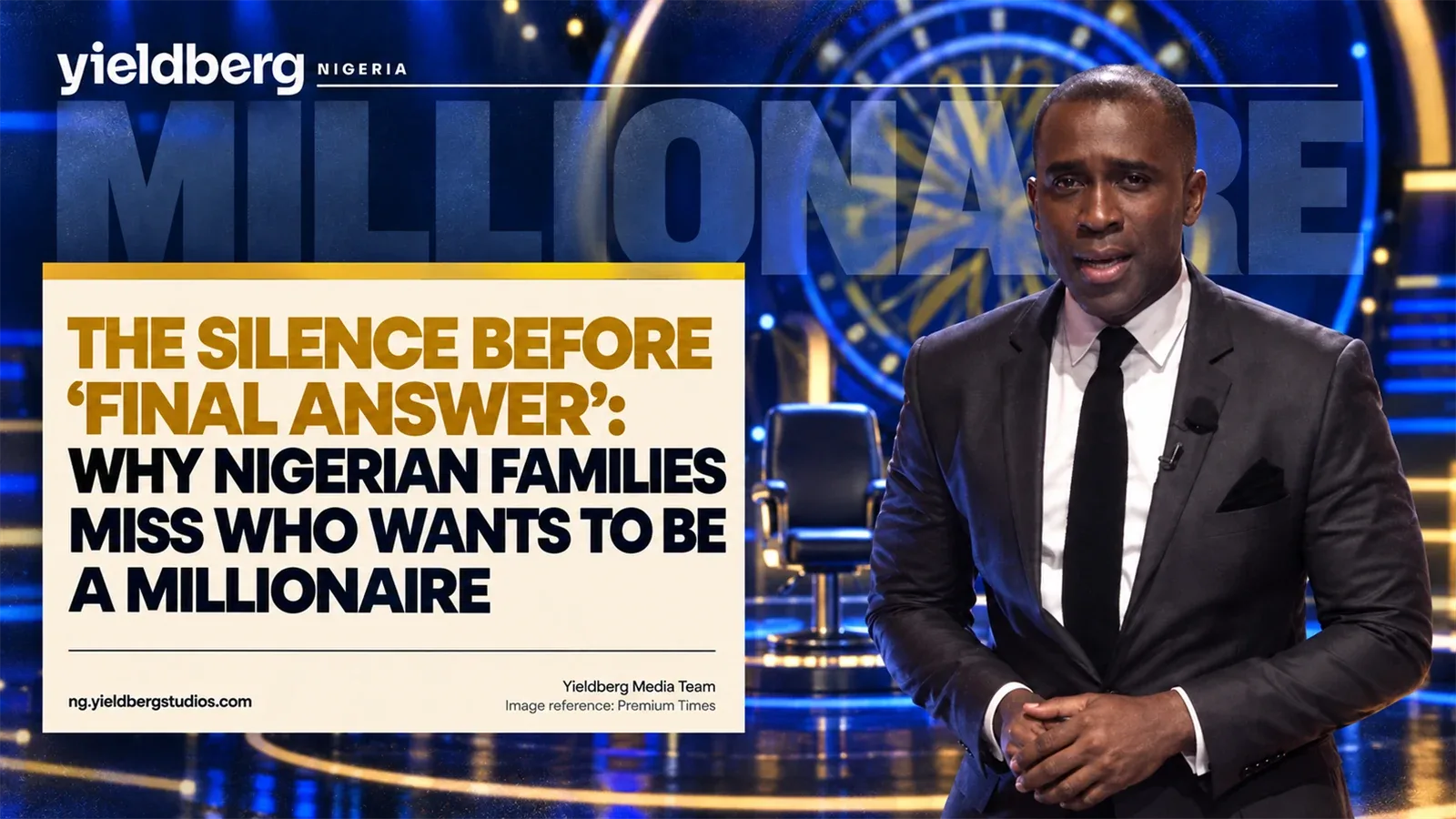
Who Wants to Be a Millionaire Nigeria turned knowledge into family theatre. Its achievement was not simply asking questions or awarding money. It made a pause feel enormous. While one contestant sat under the lights, viewers in thousands of homes argued, calculated, shouted at the screen and discovered how certainty changes when money is attached.
The show is remembered through Frank Edoho's voice, the darkened studio, the music tightening around a decision and one phrase: “Is that your final answer?” That sentence did not test only knowledge. It tested nerve.
A programme built from waiting
Most contemporary entertainment fears silence. Edits arrive quickly, music fills every gap and the next stimulus begins before the last one settles.
Who Wants to Be a Millionaire understood that waiting could be the spectacle.
A question appeared. The contestant considered four options. The camera moved between a face trying not to reveal panic and a host who seemed perfectly comfortable letting the discomfort grow. At home, everyone became an unofficial lifeline.
The format gave ordinary knowledge dramatic architecture. A fact about geography, literature, sport or Nigerian public life could suddenly carry the emotional weight of a penalty kick. The answer itself was small. The decision around it was television.
The Nigerian edition began in 2004 with Edoho as host. He has described reaching the role through an audition after years in broadcasting. In an interview with The Guardian, he recalled that the auditioners removed his script and asked him to improvise. That detail helps explain what viewers later recognised: the format needed control, but it also needed a person who could respond in the moment.
Frank Edoho made calm feel dangerous
The host's power came from restraint.
Edoho did not need to shout to increase pressure. A repeated answer, a raised eyebrow or a carefully placed question could make a contestant reconsider something that had sounded obvious seconds earlier. His humour released tension, then his stillness restored it.
That style turned him into more than a presenter. He became the guardian of the threshold between an answer and its consequence.
The performance worked because it never completely told viewers whose side he was on. He could encourage a contestant without rescuing one. He could tease without making the player insignificant. The money mattered, but dignity mattered too.
This balance is difficult in game-show production. If the host overwhelms the contestant, the audience watches a celebrity perform at a stranger's expense. If the host contributes too little, the format loses personality. Edoho occupied the narrow space between.
His association with the programme became so strong that later reporting continued to frame the show through his return. Premium Times notes that he hosted from 2004 to 2017 and returned when the programme was revived in 2022.
Every living room had four answers
The contestant appeared alone, but the experience was collective.
At home, the question divided the room. One person knew immediately. Another insisted the obvious option was a trap. Someone who had not looked interested suddenly supplied a date. A younger viewer learnt that an older relative carried an unexpected store of knowledge.
The programme rewarded different kinds of memory. School learning could help, but so could sport, proverbs, current affairs, music, religion or the details absorbed from ordinary life. This breadth allowed family members to take turns being the expert.
That is why the show produced more than winners. It produced household stories. The person who chose the correct answer from the sofa could retell that victory even though no money changed hands.
When the programme paused in 2017, the loss was therefore larger than an empty broadcast slot. A 2022 Guardian report on the return of television game shows described families gathering around the earlier run and identified the mix of general knowledge, contestants from different backgrounds and Edoho's presentation as part of its appeal.
The lifelines revealed how people trust
The lifelines were practical devices, but they were also small studies of judgement.
“Fifty-fifty” reduced the field without removing uncertainty. “Ask the audience” converted a room into percentages. “Phone a friend” forced the contestant to choose one person whose knowledge could survive a ringing telephone, a time limit and a badly heard question.
Each option asked a different question about trust.
Do you prefer reduced complexity, collective opinion or one known person? Do you believe the audience understands the subject? Can your friend think under pressure? Is the crowd's confidence evidence or merely a larger version of uncertainty?
The programme made these calculations visible without calling them media literacy. Viewers learnt that consensus could be wrong, expertise had limits and useful information must arrive in time.
The money was both dream and measurement
The title promised transformation, but most of the drama happened far below the top prize.
At each stage, the contestant had to decide whether additional possibility justified additional risk. The sums made abstract knowledge concrete. A correct answer could represent school fees, rent, a business plan or relief from an obligation, even when the programme did not know the contestant's full private circumstances.
That emotional charge made the format powerful in Nigeria, where a cash prize could be discussed in intensely practical terms. It also created an ethical responsibility. Producers needed to protect contestants from humiliation, explain rules clearly and avoid editing that turned ordinary uncertainty into ridicule.
The best episodes respected the courage required to sit in the chair. Viewers could disagree with an answer while understanding why the person hesitated.
A franchise became Nigerian through performance
The format originated outside Nigeria, but localisation is more than changing the questions and currency. A programme becomes locally meaningful through language, pacing, casting, humour and the social worlds its questions recognise.
Edoho's delivery gave the Nigerian edition a voice audiences could imitate. Local questions allowed national history and popular culture to stand beside global knowledge. Contestants arrived with accents, professions, ambitions and relationships that viewers recognised.
This offers a lesson for any imported format. The licence supplies a structure, not belonging. Belonging must be produced episode by episode.
The programme also showed that Nigerian audiences would accept quiet, intellectual suspense in prime entertainment. No one needed to sing, fight or survive in a forest. A person thinking carefully could hold the screen.
What its return could preserve
A revived game show competes with search engines, second screens and instant online discussion. It cannot recreate the information scarcity of 2004, and it should not try.
It can preserve fairness, human pacing and the dignity of knowledge. Questions should be rigorously checked, culturally broad and precise enough that the correct answer is defensible. Contestants should represent more than one professional, regional or educational type. Accessibility should include accurate captions and clear on-screen text.
The programme can also document itself better. Question databases, production credits, contestant consent, episode dates and full recordings are future cultural records, not administrative leftovers.
Most importantly, the show should resist speeding up simply because the internet is fast. Its signature experience depends on giving doubt enough time to become visible.
The answer we wanted to change
The most painful moments followed a familiar sequence. A contestant chose an option. Someone at home objected. Frank asked again. The contestant remained firm. For a few seconds, the entire household believed that volume might travel through the television and alter the decision.
Then came the answer.
That helpless participation is part of what people miss. The programme made viewers care about a stranger's reasoning and made family knowledge feel useful. It turned a question into a room full of voices, then quietened all of them with one final phrase.
The money created the stakes. The host created the tension. But the enduring memory belongs to the pause, when everybody watching still had a chance to be right.
Sources
- The Guardian interview with Frank Edoho
- The Guardian on the return of Nigerian television game shows
- Premium Times profile of Frank Edoho and his broadcasting career
Next decision: Read From Audience to Co-Author.
Related reading

 By Isong Godswill

 By Omodot Jackson