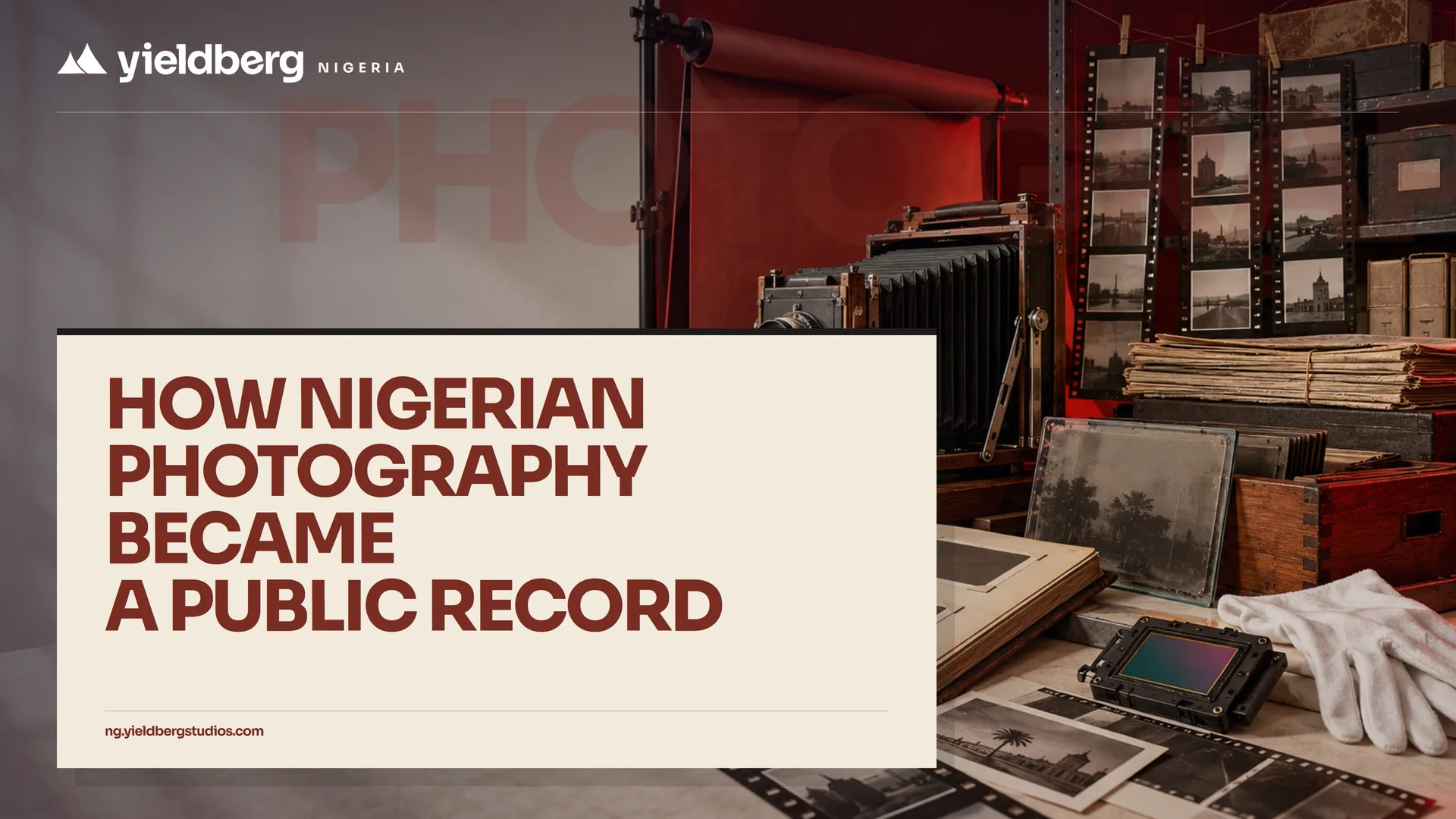
Nigerian photography became a public record through connected acts of making, captioning, circulating and preserving images in studios, royal courts, newspapers, family albums, documentary projects and art institutions. A photograph does not become dependable historical evidence simply because it is old or widely shared. Its value changes when the maker, subject, date, purpose, original caption, custody and reuse rights can be established.
This is why the history cannot be reduced to a list of famous photographers or a march from glass plates to smartphones. The image, its caption and the archive that holds it may each tell a different story. Public memory is built when those differences remain visible rather than being flattened into one confident description.
The Public Record Lens
This article uses the Public Record Lens, an original editorial method developed for this article. The lens, record card and 30-day sequence are not established industry standards, professional conservation protocols or legal advice. The method asks six questions:
- Maker: who made the image, and what can be verified about the commission or practice?
- Subject: who or what appears, and who supplied that identification?
- Purpose: was it made for a sitter, court, newspaper, business, state office, artwork or personal album?
- Caption: which words travelled with the original, and which were added later?
- Circulation: where did the image appear, and which audiences could interpret or contest it?
- Custody and rights: what physical or digital object survives, who holds it, and what permission governs access and reuse?
An image becomes a stronger public record when several of these fields can be supported. An unidentified print can still matter, but the uncertainty belongs in the record.
Local photographers recorded more than colonial encounters
Photography reached the West African coast in the nineteenth century, but Nigerian photographic history is not only a collection of pictures made by visiting Europeans. Jonathan Adagogo Green, who lived from 1873 to 1905, operated a business in Bonny. A major scholarly volume describes his portraits, scenes of daily and ritual life, commerce and buildings, and reports that researchers located 350 of his images across archives, publications and albums (Indiana University Press).
The dispersal matters as much as the number. An image made by a Niger Delta photographer could be separated from his name, placed in an album serving an imperial account, and interpreted through somebody else's caption. Recovering Green's authorship did not magically restore every missing note. It changed the questions that could be asked about who was looking, who commissioned the picture and how local subjects participated.
Solomon Osagie Alonge shows another route into public memory. After learning photography in Lagos, he established the Ideal Photo Studio in Benin City in 1942. A Smithsonian finding aid describes a six-decade collection of about 1,950 negatives, 100 prints and four albums. It records his individual and group portraits, civic and business subjects, and royal-court work, and notes how the portraits show Nigerians presenting themselves to the camera (Smithsonian Online Virtual Archives).
That distinction is important. A portrait is not valuable only because the sitter later became prominent. Clothing, posture, backdrop, hairstyle, objects and handwritten dedications can record aspiration, kinship, work and taste. The studio was a place where people made an image of themselves for family and community circulation.
Identification may remain unfinished. Community knowledge can improve a record when an archive documents who proposed a name, when, and what corroborated it; previous wording and contested alternatives should remain visible. Memory is evidence to evaluate, not an automatic correction.
Newspapers made photographs part of political argument
Studio portraits usually began with a sitter or group deciding to be photographed. Press images entered another contest: what the public should see, what editors considered evidence and what authorities permitted.
Olubukola A. Gbadegesin's study of the West African Pilot and other newspapers examines the emergence of press photography in Lagos from the 1930s to the 1950s. Its argument is carefully bounded: those newspaper images were both a record and a consequence of changing professional, legal and political freedoms in an increasingly anti-colonial city and nation-state (African Studies Review).
That means the photograph on a newspaper page should not be detached from its layout. The headline, crop, sequence, caption, date and neighbouring article help reveal how editors wanted the image to function. A surviving print without the page may preserve visual detail while losing the argument it once served. A scan of the full page may preserve that relationship even when its resolution is lower.
This is also why Lagos cannot stand in for the whole country. A Lagos newspaper archive can explain an important press centre, not every studio, newspaper or photographic practice in Nigeria. Regional collections, photographers' estates and household albums may reveal other histories, languages and circulation routes.
Long projects turned everyday change into visible series
J. D. 'Okhai Ojeikere's work demonstrates what systematic attention can do. The Museum of Modern Art says he began a project on women's hairstyles in 1968 and made more than 1,000 photographs over the following seven years (Museum of Modern Art). The Metropolitan Museum of Art instead dates the hairstyle work from the 1950s and gives a total of 2,000 negatives. It separately records his government photojournalism, campus and commercial photography, and seven years photographing Lagos architecture in the 1990s (Metropolitan Museum of Art).
The public pages do not explain how their dates and totals relate. Do not resolve the difference by assumption: attach each number to its institution and timeframe, and state the discrepancy.
Ojeikere's series made transient forms easier to compare across time. The same principle applies beyond hairstyles: a photographer who records one street, trade, performance, building type or community repeatedly can create evidence of change that a spectacular single image cannot. Consistency in dates, locations, names and working notes is part of the creative practice, not clerical work added afterwards.
Contemporary documentary photography also moves between news, testimony and art. George Osodi worked in Nigerian newspapers and for the Associated Press before developing bodies of work including the Niger Delta and Nigerian Monarchs. Liverpool Biennial describes his photography as moving between photojournalism and artistic documentary (Liverpool Biennial). The categories change how work is edited, exhibited, sold and remembered, but they do not erase the photographed communities or the conditions under which access was granted.
Festivals and museums can make a record public again
An archive may preserve an object without making it meaningfully accessible. Catalogues, exhibitions, festivals, books and searchable descriptions reconnect images with audiences, but every new presentation also introduces selection and interpretation.
LagosPhoto, launched in 2010, describes a programme of exhibitions, workshops, artist presentations, discussions and large outdoor prints intended to bring historical and contemporary photographic questions into public space (LagosPhoto Festival). This institutional role is different from making the original photograph. It creates encounters, commissions and interpretive frames through which images enter new conversations.
The best public presentation keeps provenance and uncertainty close to the image. It tells a viewer whether a title came from the photographer, an album, a newspaper editor, a cataloguer or a later researcher. It distinguishes a modern print from an original negative and identifies restoration, cropping or colour intervention. It provides a correction route when a family or community can supply better information.
A record card for every photograph
Use this card before publishing, digitising or accepting a historical image into a collection. The US National Archives separates descriptive, administrative, preservation, technical and use metadata, and warns that visually identical scans can represent different originals or copies (National Archives metadata guidance). It also distinguishes preservation masters from reproduction masters used to make access copies (National Archives reproduction-master definition). This card is a minimum planning aid; collection-specific standards may require more.
| Field | What to record | Responsible person | Evidence or confidence note |
|---|---|---|---|
| Record ID | A stable identifier connecting physical and digital objects | Archivist or collection manager | Never use a filename alone as the permanent ID |
| Maker | Photographer, studio and assistants where known | Researcher | Source, spelling variants and confidence level |
| Date and place | Exact date or defensible range; town, venue and state | Researcher | Explain how each was inferred |
| Subject | Names, roles and relationships | Community liaison and researcher | Record who identified each person and when |
| Original caption | Wording, punctuation and language as found | Cataloguer | Transcribe before correcting or translating |
| Later description | Clear present-day description | Editor or cataloguer | Keep it separate from the original caption |
| Purpose and commission | Family portrait, press assignment, court record, advert or project | Researcher | Note when purpose is unknown |
| Circulation | Album, newspaper issue, exhibition, website or social post | Rights and research lead | Preserve page, sequence and publication date |
| Custody | Current holder and known chain of transfer | Collection manager | Identify gaps rather than inventing continuity |
| Rights and access | Copyright, permission, privacy or cultural restrictions | Rights lead | Record licence, territory, term and credit line |
| Digital master | File format, resolution, checksum and storage copies | Digital archivist | Keep an unedited preservation master |
| Corrections | Disputes, alternative identifications and decisions | Editor | Date every change and retain prior wording |
Copyright and ownership of a print or negative are not the same. Sections 10 and 14 of Nigeria's Copyright Act 2022 cover reproduction, publication, communication, making available, adaptation, attribution and objections to prejudicial distortion; sections 30(7) to 30(9) expressly separate material ownership from copyright and licensing (Nigerian Copyright Commission). Section 28(3) also gives a private domestic commissioner defined rights, subject to agreement. Obtain qualified Nigerian advice when authorship, term, commission, succession or an exception affects use.
Copyright clearance is not this article's only publication check. As an editorial safeguard, review consent, privacy, dignity and cultural restrictions, especially for children, funerals, medical situations, violence or restricted ceremonies. Record why publication serves the public, what harm is foreseeable and who reviewed the decision.
Build a usable photo record in 30 days
Days 1 to 5: define the collection and freeze handling. Assign record IDs, separate originals from working copies and photograph existing envelopes, album pages and inscriptions before rearranging anything.
Days 6 to 12: digitise and describe. Create preservation masters and access copies. Transcribe original captions exactly, then add a separate present-day description. Do not sharpen, colourise or remove damage on the master.
Days 13 to 20: research people, places and circulation. Consult newspapers, directories, family records and knowledgeable communities. Record each source and confidence level. A disagreement becomes a note, not a reason to choose the most famous name.
Days 21 to 25: review rights, consent and sensitivity. Identify the likely rights holder, requested use, credit and restrictions. Remove an image from the publication set if permission or the public-interest case is insufficient.
Days 26 to 30: publish a small, testable catalogue. Release records with provenance, uncertainty and a correction form. Review whether users can find an image by maker, person, location, date range and subject without relying on one inconsistent caption.
At day 30, choose among three decisions: expand because the identification and rights workflow is working; pause to resolve major gaps; or preserve privately because public release would create unjustified harm. Treat cultural relevance as an operating system when deciding who should review descriptions and what context an audience needs.
Related reading
Frequently asked questions
Is every old photograph a public-domain image?
No. Section 19 of the Copyright Act 2022 measures the term for photographs from authorised public availability or, where that does not occur within the stated period, creation. Age alone and an online copy therefore do not establish permission. Identify the work, author, relevant dates, rights history and proposed use.
Can a family or community identification be added to a museum record?
Yes. Treat it as attributed evidence: identify the contributor and date, seek corroboration where possible, mark confidence or disagreement and preserve the previous description.
Should restoration remove scratches and stains?
Keep the untouched preservation master. Restoration may be appropriate on a labelled derivative when it improves access without inventing visual information. Document every intervention.
What is the most important first step for a photographer working today?
Create stable project and file identifiers, preserve original files, and attach names, dates, places, captions, consent and rights information while the people involved can still answer questions. Audience nuance changes what a photograph can responsibly claim, especially when one location or community is being used to represent a wider public.
Sources
- Indiana University Press: African Photographer J. A. Green
- Smithsonian Online Virtual Archives: Chief S. O. Alonge photographic collection
- African Studies Review: photojournalism and anti-colonial politics in Lagos
- Museum of Modern Art: J. D. 'Okhai Ojeikere's hairstyle project
- Metropolitan Museum of Art: tribute to J. D. 'Okhai Ojeikere
- Liverpool Biennial: George Osodi
- LagosPhoto Festival: festival overview
- US National Archives: metadata in electronic records management
- US National Archives: reproduction-master definition
- Nigerian Copyright Commission: Copyright Act 2022
Next decision: Apply Cultural Relevance Is a Creative Operating System, Not a Final Check before describing, exhibiting or republishing photographs from a community.

 By Isong Godswill
 By Omodot Jackson